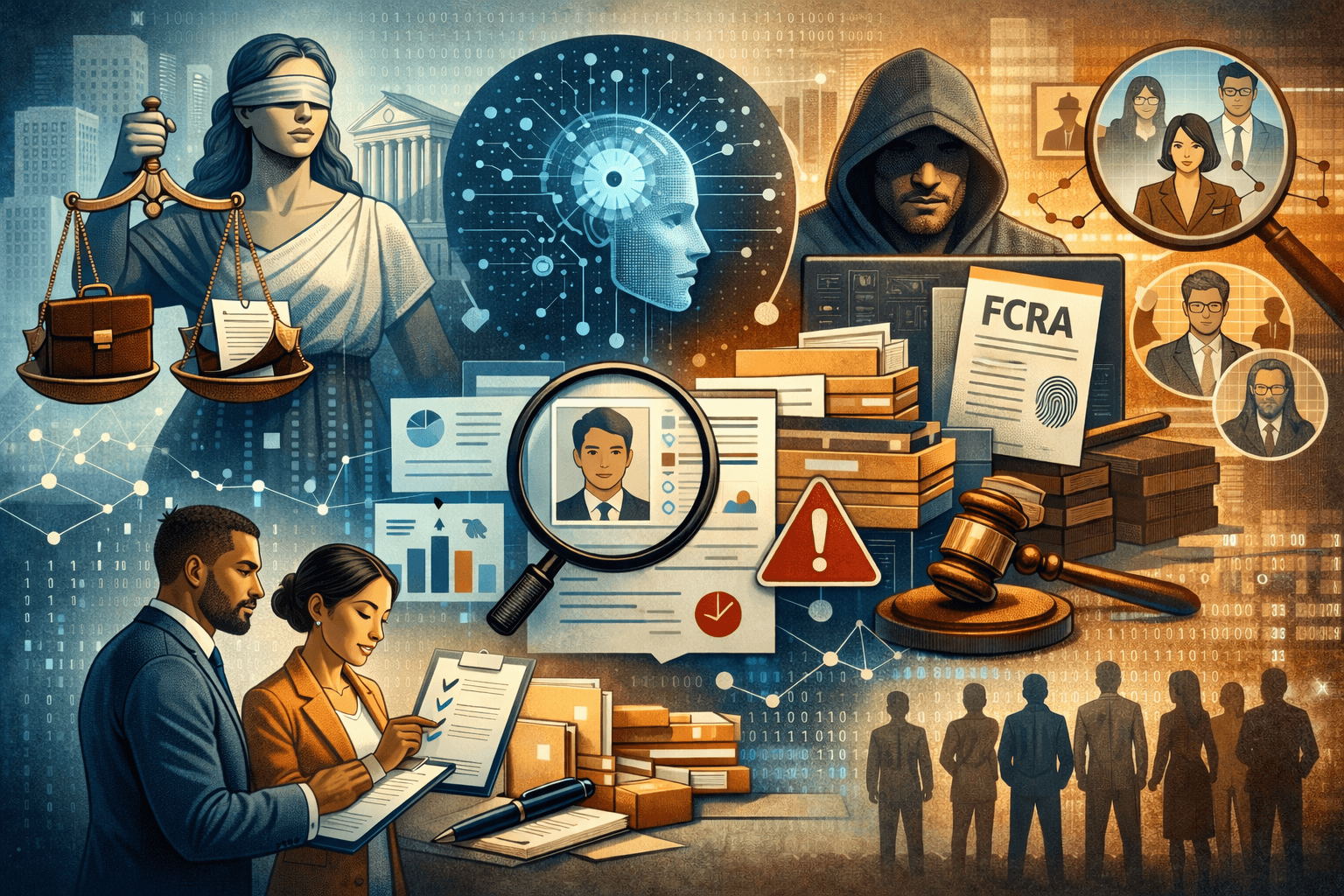
The Uniform Guidelines on Employee Selection Procedures have anchored talent acquisition for nearly 50 years, offering a shared empirical framework for validating hiring tools and evaluating adverse impact. As SIOP has warned, efforts to rescind the Guidelines risk weakening merit-based hiring and destabilizing the standards employers rely on to defend selection decisions. In an era where AI increasingly drives screening and ranking, that instability creates real exposure and legal risk.
The Eightfold Lawsuit: Why FCRA, Not Bias, May Be the Bigger Threat
While many observers have focused on discrimination lawsuits against AI hiring tools, a recent case highlights a different — and arguably more disruptive — legal vulnerability. In January 2026, job seekers filed a class action suit against Eightfold AI alleging violations of the Fair Credit Reporting Act (FCRA). The plaintiffs claim Eightfold secretly compiles “dossiers” on candidates, using personal data to predict success without notice, consent, or an opportunity to dispute the information.
As HR Dive noted, this caught many practitioners off guard: but the complaint asserts that “there is no AI-exemption to these laws, which have for decades been an essential tool in protecting job applicants from abuses by third parties — like background check companies — that profit by collecting information about and evaluating job applicants.” While HR and TA professionals may assume there are AI exemptions, the case law does not provide any legal leeway.
The complaint alleges that Eightfold’s AI aggregates data such as social media profiles and behavioral signals to generate predictive scores used by employers. These allegations have not yet been proven, and Eightfold has publicly denied scraping social media or similar sources. But the legal theory itself is significant: if AI-generated candidate profiles function like consumer reports, they may trigger FCRA obligations around disclosure, transparency, and dispute rights.
Cybervetting or the manual review of social media by recruiters or line managers is not new. What is new is the scale of this type of review. AI allows for greater automation, and potentially prediction of behaviors based on this type of webscraping. When AI systems synthesize data at scale to influence employment decisions, the legal expectations change. The Eightfold case forces a question recruiters can no longer ignore: If these tools look and act like credit reports, why wouldn’t courts treat them that way?
Validation Is the Missing Safeguard
Regardless of how the Eightfold case is resolved, it exposes a deeper problem: a glaring lack of rigorous validation across much of the AI hiring ecosystem. Vendors often market tools as “bias-reducing” or “predictive” without publishing role-specific validity evidence or longitudinal performance data. Validation refers to the process of analyzing hiring data to determine how well a tool (i.e. structured interview, AI hiring tool, situational judgement test) predicts job performance.
This is precisely where I-O psychologists and evidence-based TA leaders must step in. As the HR Dive analysis underscores, the goal is not to abandon AI, but to ensure that as predictive accuracy improves, litigation risk decreases. The vendors’ goal should be to protect their clients from legal liability as well as providing insights to job applicants’ potential performance.
What Recruiters Must Do Now (With or Without the Uniform Guidelines)
- Demand Vendor Validation — Then Verify It. Recruiters should require AI vendors to provide:
- Criterion-related validity evidence tied to actual job performance
- Adverse impact analyses using accepted statistical thresholds
- Clear explanations of model inputs, training data, and limitations
Vendors that cannot articulate how their tools were validated or vendors who dismiss legal scrutiny should be avoided. If you’re not sure how-to assess these reports or if you’re an AI assessment vendor that doesn’t have these reports, contact an Industrial-Organizational Psychologist with the necessary expertise to conduct the necessary studies.
- Conduct Your Own Validation Studies. Even strong vendor evidence is not enough. Employers must:
- Run concurrent or predictive validation studies using their own workforce data
- Test subgroup outcomes to detect differential validity or impact
- Document results in a way that can withstand legal review
This internal evidence becomes even more critical if the Uniform Guidelines are removed. You should understand how well each element of your selection battery (the tools you use to hire) predicts future job performance among job applicants.
- Measure Performance Longitudinally. The process of validation is not static. Performance changes over time and as you use any hiring tool it’s in your best interest to continue to evaluate how well that tool functions. Recruiters should track AI tool performance over years, not months:
- Do early predictions correlate with long-term success and retention?
- Does model accuracy drift as roles or labor markets change?
- Are adverse impact patterns emerging over time?
Longitudinal evidence is one of the strongest defenses an employer can have. Collecting data on your hiring processes and looking for trends over time will make your organization more ready for the future and be aware of how well its talent pipeline functions.
- Be Relentless About Legal Literacy. The Eightfold lawsuit makes one thing clear: ignorance is not a defense. Recruiters and TA departments must:
- Work only with vendors who understand FCRA, EEO law, and emerging AI regulations
- Build audit, disclosure, and data-access rights into contracts
- Escalate concerns early when tools generate opaque “scores” or profiles
Recruiters can take control of their legal situation by being more strategic about how they utilize AI. They should consider whether the AI tool allows them to make better hiring decisions and if they have the data to back up the use of the tool.
Why This Moment Matters
This is likely one of the first dominoes to fall. The Eightfold case, combined with potential removal of the Uniform Guidelines, signals a shift from informal trust in AI toward formal demands for evidence, transparency, and accountability.
AI still holds immense promise in hiring but trust will depend on whether employers can prove that these tools are valid, fair, and legally defensible. That proof does not come from marketing claims. It comes from rigorous validation, longitudinal data, and informed oversight.