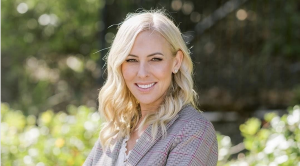
By her own admission, Marsha Stone (below) says she didn’t have a drink problem until her late 20s.
But eventually, looking after three children (by herself), started to take its toll.
“I’d gotten a scholarship into law school, but began to turn to alcohol,” she recalls.
“I’d crossed that invisible line, where drink began to take over me, but all the while I was telling myself ‘it’s just to cope with the stress, it’s fine.’
By then, I’d become an attorney, but it was only when my licence was revoked that the realization that I needed to sort myself out hit me. That’s when I focused on my recovering process.”
A familiar story
For millions of people, Marsha’s story will feel distinctly familiar. In the US it’s estimated that more than 6% of adults have an alcohol use disorder.
This equates to about 1 in 12 men and 1 in 25 women. In fact, some 88,000 people die of alcohol-related causes every year, making this the third-leading cause of preventable death in the country after tobacco and poor diet.
But according to Marsha, there’s something that doesn’t help matters – a culture in the workplace to have alcohol. “There’s nothing inherently wrong with drinking; it’s just the relationship people form with it, and the workplace is still somewhere where drink is promoted, she says. “Employers have, in part, created an alcohol-based culture.”
For Marsha, who has since completely dedicated her life to helping others like her – by becoming a licensed chemical dependency counselor, and founding Foundation Stone, a network for those struggling with substance use disorders – she sees how quickly people can become overwhelmed by alcohol, and says employers could be doing more to not pressurize staff into thinking after work drinks or corporate drinks are the norm.
“It’s important to have as many company events that are not based around drink as those that are,” she says of the tendency for managers to default to ‘work drinks’ and the subtle pressure this puts on staff to attend in case they are seen not be part of the team. “Don’t plan events that tend to veer towards drinking,” she says.
As part of this, she says companies should consider ‘sober work events’ – because actually, it won’t be the disappointment many managers may think they could be.
Tapping into the ‘sober curious’ trend
“A lot more people are what I call ‘sober-curious,’ she says. “There’s a growing movement around not being so drink-dependent. Not only is this being informed by big health agenda going on, but people are increasingly wanting ‘real’ connections with the colleagues, not alcohol-driven ones.”
She adds: “While it’s often said alcohol serves a purpose, by helping people relax, and actually assisting in loosening inhibitions, and making shy people confident to get involved, I also see that people want ‘real’ relationships with people more. A lot more people are craving a more honest and genuine sense of community.”
While no-one is blaming workplace pressures and workplace drinking cultures as overtly creating alcohol problems [Marsha says many turn to drink for complex reasons), she does say that alcohol is an anesthetic for people.
She adds that for some, having alcohol available through work can unwittingly makes existing problems worse.
“People drink for the effect it produces,” she says. “Burn-out, people being in an overwhelmed state, feeling under too much pressure at work – these are all things that contribute to people needing some sort of anesthetic.”
She continues: “What employers don’t realize till it’s too late, however, is that drinking never really cures depression or burnout; it just makes matters worse.”
The good news, she says, is that old-school management styles – of going to a bar after work, for ‘team building’ – is slowly working its way out of organizations. “I do think we’re at a turning point in our culture,” she says, “where people are more interested in how they can live their lives without certain substances.
Less good, she says, is that through remote working, more people could potentially be succumbing to at-home drinking, and might be even better at hiding it, because they don’t physically need to be in the office. Here, she says, leaders need to be more vigilant. ]
In the meantime though, she’s a firm advocate of more sober (not somber) workplaces.
She says maybe more CHROs should give it a try…
US and Drink – the facts:
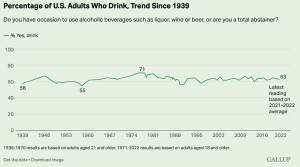
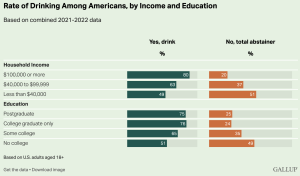
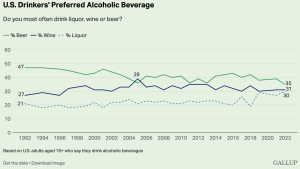
- According to the 2021-2022 data, 80% of adults aged 18 and older living in households earning $100,000 or more say they drink, far exceeding the 49% of those earning less than $40,000. The rate among middle-income earners falls about halfway between, at 63%.
- Whereas 60% of adults aged 18 to 29 say they drink, the rate is 71% among those aged 21 to 29. That matches the percentage of 30- to 49-year-olds who drink (70%), while it exceeds the rate among those 50 to 64 (64%) and 65 and older (54%).
- White adults aged 18 and older (68%) are more likely than Hispanic adults (59%) or Black adults (50%) to report they drink.
- When asked how many alcoholic drinks of any kind they had in the past seven days, a third of drinkers (34%) in 2022 said they had had none. About half (53%) said they had between one and seven drinks, while 12% reported consuming eight or more drinks, thus averaging more than one per day.