Advertisement
Weekly Wrap: How Work Rules Are Driving the Bay Area Transit Strike

Get articles like this
in your inbox
The longest running and most trusted source of information serving talent acquisition professionals.
Advertisement
Fridays are usually happy days in most organizations because the weekend is closing in.
That’s true most places today, unless you happen to work in Northern California. That because BART — Bay Area Rapid Transit, a public agency that runs trains up, down, around, and through the San Francisco Bay — has gone on strike.
This means that 400,000 commuters who count on BART to get to work are SOL today. As a former Bay Area resident who used to commute on BART to a job in San Francisco, I have a full appreciation for the havoc a system shutdown can have.
So, it’s Black Friday for workers in the Bay Area, but the interesting thing about this labor dispute is that it isn’t really about money. The big sticking point is about work rules, and BART management has drawn a line in the sand on this point, particularly getting control of an insidious labor issue known as “past practice.”
As the San Francisco Chronicle points out:
Both the unions and BART management agreed that the two sides were close to an agreement on economic issues Thursday, but the talks broke down over the transit agency’s call for work rule changes.
The unions’ position was that “we’ll take more money but won’t even talk to you about work rules,” Tom Radulovich, president of BART’s Board of Directors, said after the talks ended. “We need to be able to manage the district.”
And, just what are the “work rules” that are such a problem that they are basically shutting down the workforce in the San Francisco Bay Area today? Again, as described by The Chronicle:
When BART and union representatives talk about “work rules” leading to the breakdown in negotiations, they’re primarily referring to a clause in their contract that refers to past practices, or the way things have been done previously. To change a past practice, BART’s contracts require mutual agreement between management and the unions which can be hard to get.
According to BART officials, that makes it difficult to make technological changes like having station agents file reports by email instead of writing them out longhand, using email instead of fax machines to send documents and sending paycheck stubs to each work location electronically instead of hand-delivering them. …
It also prevents BART from making changes in the way it schedules workers or adds extra service on holidays … For instance, if BART adds service on a holiday because of a special event, the unions could force the agency to schedule similar service the next year on that holiday, even if the event is not being held.”
As someone who has experienced life in a unionized workplace, take it from me that work rules and past practices are always two giant problems for management.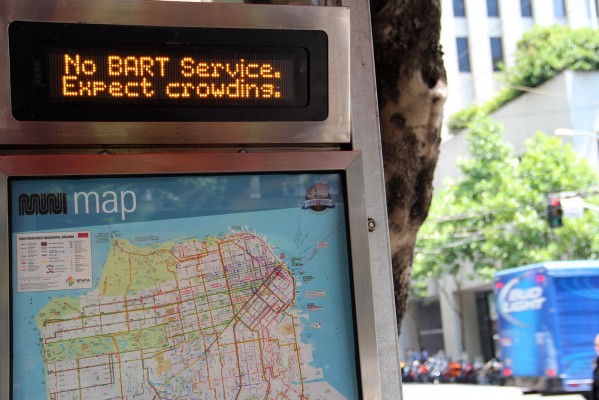
When I was Editor of a statewide newspaper in Montana, work rules made it impossible for me to allow reporters to take comp time in lieu of overtime, even though the reporters really preferred it and I would have rather let them take it. The problem was solved, eventually, when the news staff voted to decertify the union, but why did work rules prevent a reasonable on the job accommodation that both sides wanted in the first place?
Later, when I was Executive Editor of the morning newspaper in Honolulu, “past practice” tied my hands on a variety of management issues simply because some former manager had decided to deviate from the union contract at some point and gave somebody something that wasn’t specified in the union contract.
Once that happened — say, a manager allowed somebody to take a day off without having them put it in writing seven-days in advance, as the contract stipulated — it became “past practice” and an ironclad “rule” that couldn’t be changed except by negotiations with the union (and good luck on that).
In other words, a supervisor just trying to be nice, or, who makes a bad call in the heat of the moment, causes that decision to become carved in stone for all time as part of the union work rules without any negotiations or anybody else agreeing to it.
I don’t pretend to know all the ins and outs of the situation with the BART union and management in San Francisco, but I can tell you this: unbending work rules and a fixation on past practices make it impossible for managers to effectively cope with the rapidly changing workplace we all struggle with here in 2013.
The people who are paying the price for this are the 400,000 common commuters who depend on BART service every day to get to and from their jobs. And the economic impact is huge: $73 million a day, just in lost worker productivity, according to the Bay Area Council Economic Institute.
I’m all for treating workers well, because I think it makes for a much more productive workforce, but management needs the ability to adjust work rules and make changes to deal with the ever-changing demands of our tumultuous economic times.
Everybody in the San Francisco Bay area knows that — everybody except, it seems, the leadership of the BART union.
Of course, there’s more in the news this week than transit squabbles over work rules. Here are some HR and workplace-related items you may have missed. This is TLNT’s weekly round-up of news, trends, and insights from the world of talent management. I do it so you don’t have to.