Advertisement
Giving Workers Time Off to Vote Is Good Business

Get articles like this
in your inbox
The longest running and most trusted source of information serving talent acquisition professionals.
Advertisement
Related Articles
If civic responsibility isn’t reason enough for you to give employees time off to vote Tuesday, try these two:
Since compliance is easier for HR to sell, let’s start there.
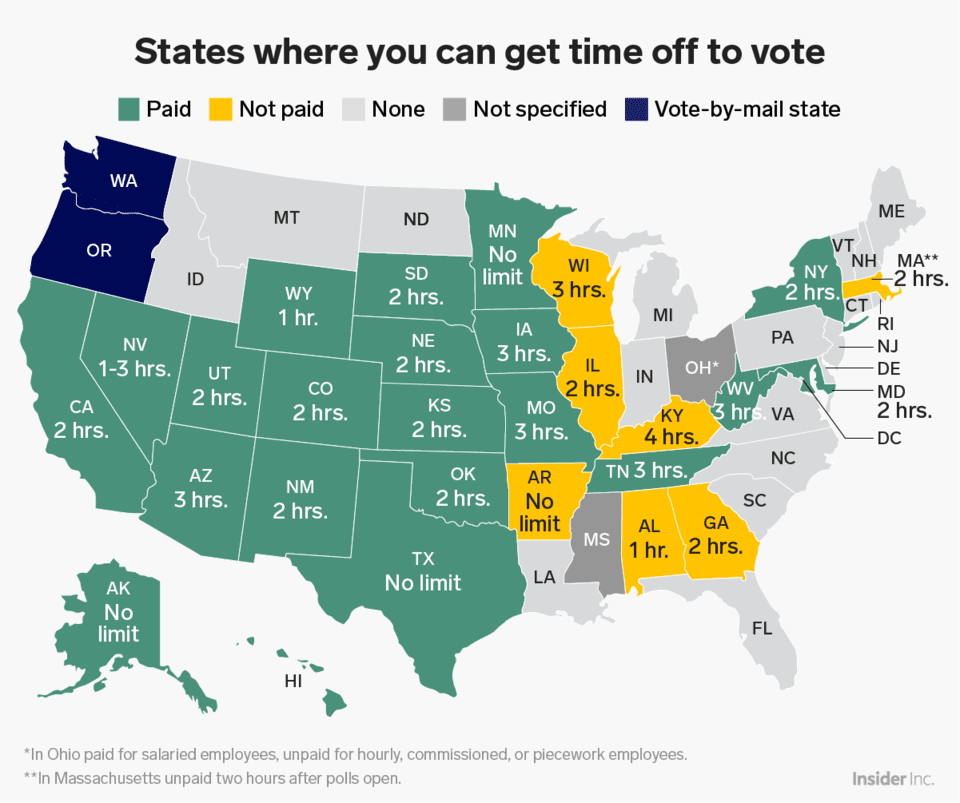
30 states have laws requiring employers to give their workers time off to vote. The largest share of these — 20, 21 if you count Ohio’s split pay requirement — allow workers to vote while on the clock. And that can be as much as 3 hours time. The balance of the voting time off states don’t require employers to pay workers, but they must still allow them to leave work for an hour, or 2 or 3 or, in Kentucky, 4 hours to vote.
There are limits: While they vary from state to state, the rules are generally:
Business Insider has a state-by-state list of time off rules and a handy map highlighting were each state stands on voting time off rules.
Even if you’re in one of the 20 states that have no time off requirements, allowing workers to come in later, leave earlier or take an extended lunch hour to vote is to your benefit. It sends the message that voting is important and that your company has a sense of civic responsibility. But it also is evidence of the kind of supportive workplace you have. A survey of 1,000 workers by the HR recognitions and rewards firm O.C. Tanner found that employees of companies with a time off for voting policy had higher engagement and worker approval than those at companies who don’t give them the time off.
The survey found that of those who get time off to vote:
I probably don’t have to explain that the companies with a time off policy have a culture that is supportive of their workers. The time off is a part of that culture, and not the cause of the higher engagement. But if you want your workers to have the same, positive opinion that the workers in the Tanner survey do, starting with a voting time off allowance can be your first step.