The workplace conversation about AI is often framed around two extremes. One is consumed by fear – mass job losses and algorithms erasing human relevance. The other dismisses AI as overhyped technology that will fade once the excitement passes.
Both reactions miss the more confronting shift now unfolding in professional life.
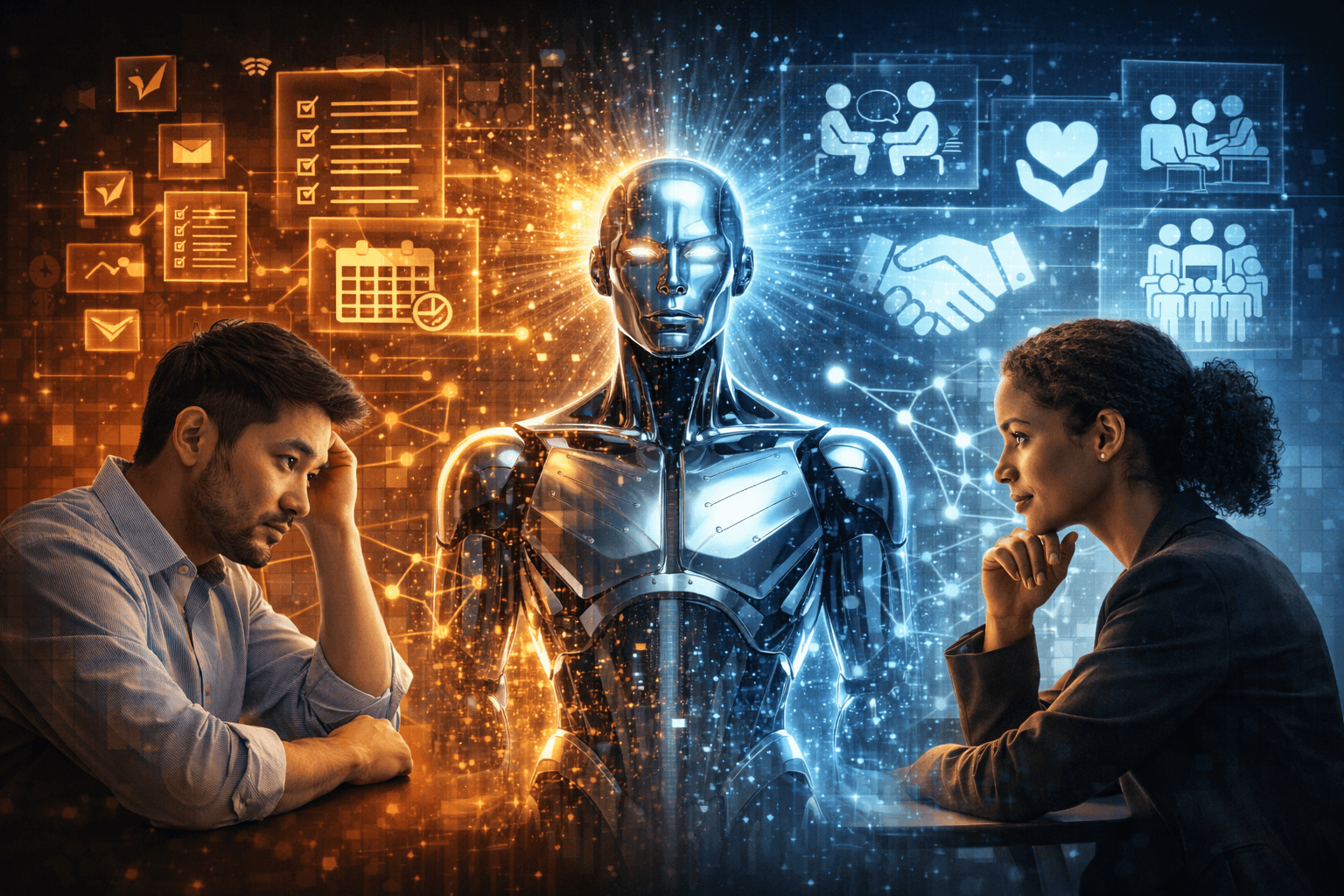
AI is not primarily a job killer, nor is it a harmless fad. It is a mirror for our thinking – one that reflects our standards, our intellectual discipline, and our depth. And as any experienced leader knows, mirrors often reveal things we would prefer not to see.
AI Doesn’t Create Capability. It Reveals It.
A persistent misconception is that AI generates intelligence independently. It doesn’t. Its usefulness is entirely tied to the quality of thinking that feeds it.
Vague input produces decorative corporate-speak. Weak problem-framing produces scaled weakness. But structured, disciplined thinking? That produces something powerful.
This is the great decoupling:
- Low performers use AI to avoid thinking. They ask it to “write a report” or “give me some ideas”, then cut and paste it.
- High performers use AI to interrogate thinking. They test assumptions, challenge their own reasoning, and simulate opposing perspectives, then iterate from it.
AI isn’t manufacturing capability. It is revealing the difference between those who think deeply and those who outsource their thinking.
Your Standards are the New Source Code
Every prompt you write today shapes the AI systems of tomorrow.
Your questions, assumptions, and context become data that compounds over time. AI systems are not just learning from our input, they are learning from our standards.
This is as much a cultural shift as a technological one. The quality of human thinking we contribute will determine the quality of artificial intelligence we receive in return.
AI is a cognitive amplifier. It allows thoughtful professionals to refine ideas, pressure-test assumptions, and deploy insight at remarkable scale.
But the amplification works both ways. Professionals who lack care, sound judgement, or ethical grounding will see those weaknesses travel further and faster than ever before.
AI does not just scale your work. It scales your standards.
Professional Exposure Therapy
For those concerned about AI eliminating their job, confronting the automation threat directly can reveal the roadmap for your own evolution.
Most professionals worried about AI are asking the wrong question: “How do I protect my job from automation?”
The right question is: “If AI were to eliminate my role tomorrow, exactly how would it do it?”
In psychology, exposure therapy works by confronting fear directly rather than avoiding it. Apply that logic to your career.
Take your role description and audit it honestly against these three questions:
- Is the work repeatable and rules-based? If your value is tied to templates and checklists, that contribution is a placeholder for a workflow.
- Do you create outcomes, or coordinate activity? If you primarily “follow up” on others or move information from Point A to Point B, your work is a friction point that software will eventually smooth over.
- Would the work still exist if stakeholders took direct ownership? If you are a middleman for decisions you don’t actually make, your exposure is significant.
To go deeper, paste your position description directly into an AI tool and ask it: “Which parts of this role are most vulnerable to automation in the next three years, and what would need to be true for this role to remain irreplaceable?”
The goal of this audit isn’t to make yourself redundant. It’s to redesign your role before the market does it for you.
What remains after you strip away the mechanical tasks are the things that genuinely matter and add value: judgment, accountability, and ethical decision making.
Your task then becomes simple: automate the mechanical and deliberately expand the work that requires human judgment and discernment.
Alert, Not Alarmed
One truth survives the intensity of the AI debate: human beings still need other human beings.
Businesses exist to solve human problems, serve human needs, and navigate human complexity. Machines can process information at extraordinary speed, but they cannot manufacture empathy, earn trust, or exercise moral courage.
The shift we are seeing should not cause panic, but it must kill complacency.
The professionals who thrive this decade will use AI to sharpen their thinking and redesign their work around judgment and responsibility. Those who ignore it may discover something uncomfortable: AI will expose exactly where real contribution exists, and where it doesn’t.
The real question is not whether AI will change your job. It is whether you will change your thinking before it does.