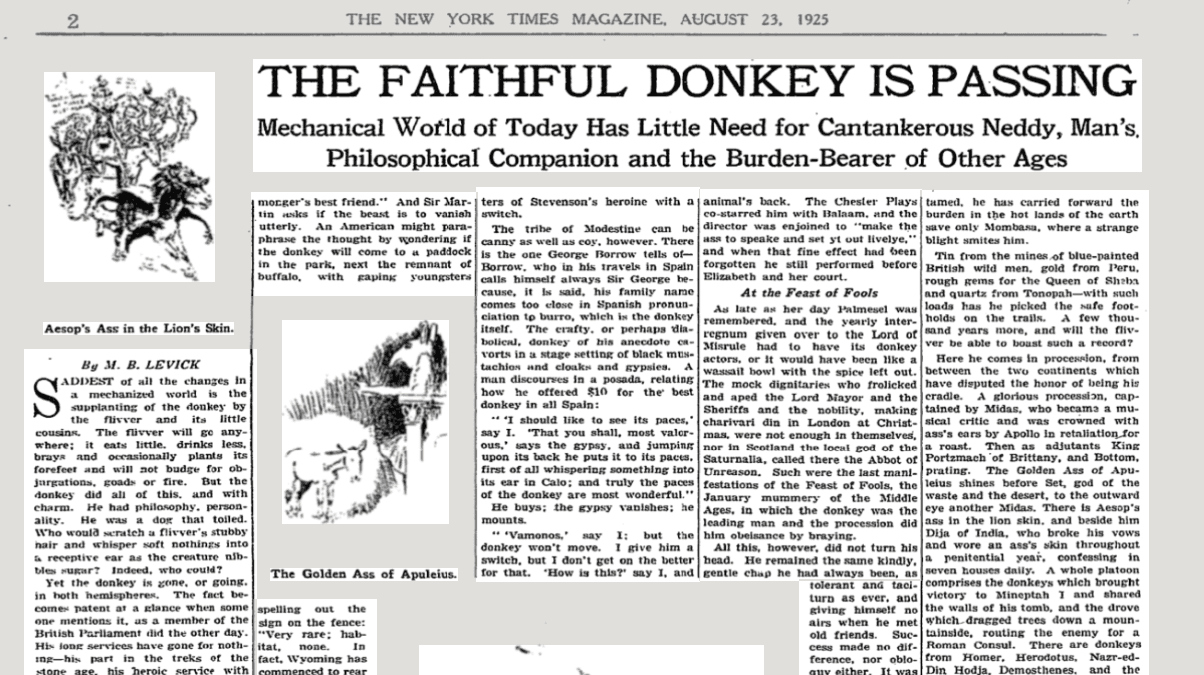
In 1925, The New York Times ran a piece titled “The Faithful Donkey Is Passing,” lamenting that machines were replacing the animal that had carried civilization for centuries. The article bemoaned that the donkey had been replaced by cheap vehicles which did all a donkey did, but without any of the charm. The donkey was indispensable—until it wasn’t.
A century later, we are writing the same obituary about human workers. The author of the New York Times piece wrote about donkeys, “He had philosophy, personality. He was the dog that toiled. Who would scratch a vehicle’s stubby hair and whisper soft nothings into a receptive ear as the creature nibbles sugar? Indeed, who could.” Sounds like some of the stories being written about ChatGPT replacing programmers.
AI is framed as a general substitute for cognitive labor, poised to wipe out white-collar jobs and hollow out the consumer economy. The case being made today is simple: this time is different. AI isn’t a tractor replacing muscle. It isn’t a spreadsheet replacing arithmetic. It is a general substitute for cognitive work. It writes, codes, designs, analyzes. Unlike past technologies that automated specific tasks, AI appears to automate thinking itself. If that’s true, what’s left? It’s a powerful argument. It’s also one we’ve heard before—just with different machinery.
The “Ghost GDP” Myth
A recent viral research note imagined a future of “Ghost GDP”—output generated by AI agents while human incomes collapse. The problem is that this vision ignores how economies actually work. Technology has always displaced specific tasks. It has not eliminated work in aggregate.
Throughout history, technological advance hasn’t, by itself, raised overall unemployment. Farming mechanized. Manufacturing automated. Spreadsheets replaced bookkeepers. Yet total employment continued to rise. When one sector shrinks, others expand. When productivity rises, prices fall, real incomes grow, and demand shifts.
The “Ghost GDP” scenario also runs into a basic economic wall. Production is income. If firms generate output and profits, that money is invested, distributed, or spent. If it were hoarded entirely, the result would be falling GDP—not a booming economy without workers.
Even in sectors thought to be highly exposed, the data are underwhelming. Software developers—supposedly prime AI targets—are up 5% year over year . Since Google Translate launched in 2006, employment of translators and interpreters has risen 73% . The apocalypse has a habit of not showing up in the labor statistics.
We’ve also seen the “free code” panic before. In the 1990s, open-source software was supposed to destroy the industry. Instead, the sector grew fivefold. Buyers don’t just purchase code; they buy reliability, support, upgrades, and accountability . AI may make code cheaper, but it doesn’t eliminate the need for governance, integration, or trust.
None of this means disruption won’t occur. Certain roles—especially entry-level cognitive tasks—will change. Some firms may use AI to accelerate restructuring they were contemplating anyway. And there is a real risk of overinvestment in AI infrastructure leading to a cyclical bust, much like the early 2000s tech crash. Some of those giant data centers will become empty shells – like malls.
But that is a capital cycle story—not a permanent labor extinction event.
The Real Conversation
If AI is not likely to eliminate jobs in aggregate, what should we actually be debating?
First, how do we manage transition? Labor markets reallocate, but reallocation is painful. Retraining, mobility, and wage insurance matter more than apocalyptic headlines.
Second, how do we ensure productivity gains translate into broad-based wage growth rather than narrow capital concentration?
Third, how do we build governance around AI deployment—especially in regulated fields like hiring, finance, and healthcare—so that augmentation improves outcomes rather than undermines trust?
And finally, how do we avoid mistaking task automation for job elimination? Jobs are bundles of tasks embedded in institutions, compliance regimes, customer relationships, and accountability structures. AI can compress or reshape those bundles. It rarely erases them entirely.
The donkey passed. The typist passed. The bookkeeper passed.
Work did not.
AI will change what we do. It will not eliminate the need to do something.