Advertisement
With Women’s Employment Slowing, Employers Need to Do More

Get articles like this
in your inbox
The longest running and most trusted source of information serving talent acquisition professionals.
Advertisement
An opinion piece in The New York Times a few weeks ago really jolted me.
I had my head buried in “best company” applications all summer— helping clients put together strong submissions for the Fortune 100 Best Companies list. It’s time-consuming work, which is why I hadn’t managed to post a blog in months. Heck, I barely had time to read a newspaper. When I finally had a chance to sit down to the Times’ Sunday Review, it was unnerving to come across a picture of Candace Bergen as Murphy Brown, the smart single lawyer from the 90s TV show of the same name, under this headline: “The Best Era For Working Women Was 20 Years Ago.”
In fact, it is now down to a disturbingly low 75% for women during the prime working ages of 25-54. It’s true that in the wake of two recessions men’s participation has also fallen, but it remains a great deal higher; it’s at 89% now. Both have shown a slight uptick in the last year.
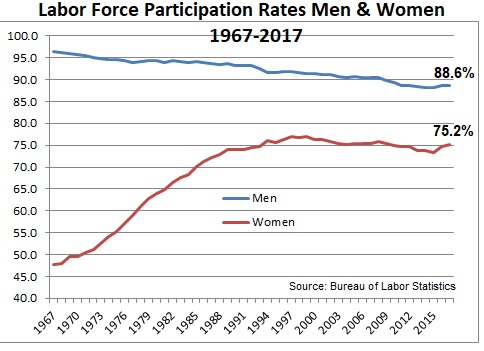 Women also are more consistently underemployed than men: 67% of all part-time workers last year were women, and in 2014, 19% of women aged 25-54 were working part-time, as opposed to just about 7% of their male counterparts.
As the Times article’s author, Bryce Covert, points out, the U.S. is moving in the opposite direction from numerous industrialized countries when it comes to women in the workforce. Undoubtedly this has much to do with our complete lack of government policies that tend to be especially helpful to women, notably, paid parental leave and universal child care. Just-in-time scheduling, the gig economy, and other “innovations” in today’s world of work also have a role to play.
(While unpredictable hours, uncertain pay and a lack of benefits are hard on both men and women, women are statistically much more likely to be in these sorts of jobs, and may also suffer from this disproportionately since they still carry the brunt of dependent care and other home responsibilities.)
Neglecting to create policy that helps raise women and children out of poverty is short-sighted, period. In fact, many civil society organizations doing work in impoverished nations focus specifically on supporting women’s health and rights, reasoning that the status and condition of women have a direct impact on the health and education of the next generation, both male and female. Surely this applies in this country, as well!
Personally, I believe the U.S. government needs to catch up with other countries and start providing paid parental leave, public child care, and ideally, free or at least highly-subsidized higher education. But none of that is likely to happen any time soon, and in the meantime, employers can play an important role in lifting the status of women. They can do this by:
By taking these steps, employers can greatly improve working conditions for women, making full-time work a viable option for many. But though this is good for women, good for the economy and good for the country, that’s not the only reason employers should do it. Study after study shows that a diverse and inclusive work environment is good for business. So, don’t do it for me — do it for you!
This originally appeared on the Robin Hardman Communications blog.