Organizations spend millions replacing technology systems. ERP platforms change. HR systems change. Applicant tracking systems change. A few years pass and another migration begins.
Yet something strange keeps happening. Technology changes, but the results often do not.
If new systems truly solved operational problems, companies would not keep replacing them every few years. But they do. Over and over again.
Watch the enterprise software market long enough and a pattern appears. Some companies move from Workday to Oracle. Others move from Oracle to Workday.
In recruiting technology, the same pattern shows up. Companies replace Taleo with iCIMS. Others move from iCIMS to Workday Recruiting. Some organizations move from SmartRecruiters to Greenhouse.
And some move from Greenhouse to Lever.
Just kidding. Let’s be real.
No one switches from Greenhouse to Lever.
But the point still stands. Companies change technology platforms constantly, yet the results rarely improve as much as leaders expect.
If the technology keeps changing, why do the results stay the same? The answer is simple. The problem was never technology. The problem was the design.
Same Tool. Different Outcome
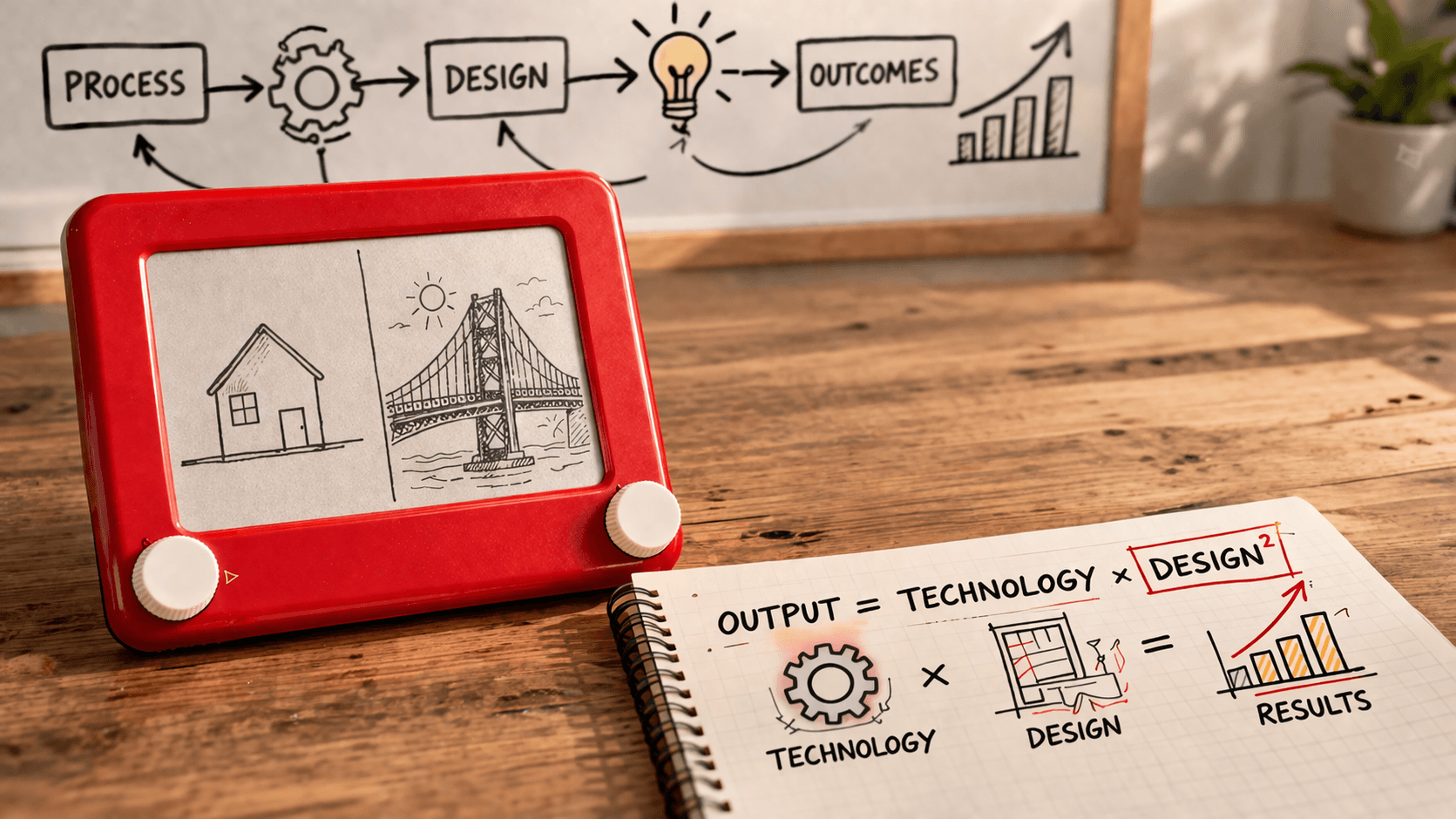
Look at the drawings below. Both were created on the same Etch-A-Sketch. The same knobs. The same limitations. Yet the results are completely different.

Nothing about the tool changed. The difference is the design.
A skilled designer can produce impressive work even with a simple instrument. A weak design stays weak no matter what tool produced it.
Technology systems work the same way. A strong process running on average software will often outperform a poorly designed system running on world-class technology.
Changing the Medium Does Not Fix the Design
Now imagine recreating a poorly designed drawing using different tools: crayons, acrylic paint, oil paint, digital illustration software, vector graphics, even AI image generators.

The tools become more advanced. The medium changes. But the design itself does not improve.
Organizations often do the same thing with enterprise technology. They redraw the same flawed process inside a new system. They upgrade the interface. They modernize the platform.
Yet the underlying design stays the same. When that happens, the results stay the same as well.
A $30 Million Lesson
About twenty-five years ago I worked at a paper company that implemented JD Edwards.
The project was supposed to cost ten million dollars. Leaders expected the new system to modernize operations and improve efficiency.
Instead, the company spent roughly $30 million customizing JD Edwards so it would behave exactly like the system it replaced.
Processes that had been redesigned by the software were rebuilt to mirror the legacy workflows people were already comfortable with.
The result was predictable. The company installed a modern platform and recreated the same operating model it had before.
The technology changed, but the design did not.
The Physics of Technology Systems
Einstein described energy with one of the most famous equations in science.
E = MC²
The squared term matters because it amplifies the effect dramatically. Small changes in velocity produce enormous changes in energy.
Technology systems behave in a surprisingly similar way.
Organizational output can be thought of like this.
O = TD²
Organizational Output = Technology × Design²
Improving Design Without Replacing the Entire Stack
There is a growing category of platforms designed to improve workflows without forcing organizations to replace the core systems underneath.
Instead of ripping out an ATS or CRM, these tools sit across the existing stack and extend what those systems can do.
Public Storage redesigned its recruiting funnel with an automation vendor, replacing fragmented manual workflows with automated screening, scheduling, and structured candidate routing.
The changes reduced time to schedule from 14 days to under three, improved the application-to-hire ratio from 100:1 to 30:1, and lowered post-offer drop-off from 30 percent to 10 percent.
The technology stack underneath remained largely the same. The design of the system changed, and the outcomes changed with it.
When Technology Enables Real Innovation
Great technology can support bold new designs when organizations are willing to rethink their processes.
A good example is the ATS system that was implemented at UPS for high-volume hiring.
Instead of forcing the technology to mimic the old process (which was already impressive), UPS worked with a new ATS vendor to redesign the hiring workflow from the ground up.
By reducing the hiring process from 50 steps to 20, UPS removed significant friction from the workflow, cutting the median time from application to conditional offer by roughly 64 percent on average. And they do this with amazing volume. During their last peak season, UPS hired 250,000 people in just 2.5 months.
Applicants could move from application to offer in less than twenty minutes. That improvement did not happen because the software was magical, it happened because the design changed.
The Etch-A-Sketch Lesson
Most organizations do not have technology problems. They have design problems.
Until those design issues are addressed, switching systems rarely changes much. Companies migrate platforms, install better software, and expect different outcomes. Yet they keep reproducing the same system again and again.
Changing tools does not fix bad design, it only redraws the same picture with better art supplies.