Advertisement
Right-to-Work or Wrong-to-Work? Why the Michigan Vote Makes Sense
Get articles like this
in your inbox
The longest running and most trusted source of information serving talent acquisition professionals.
Advertisement
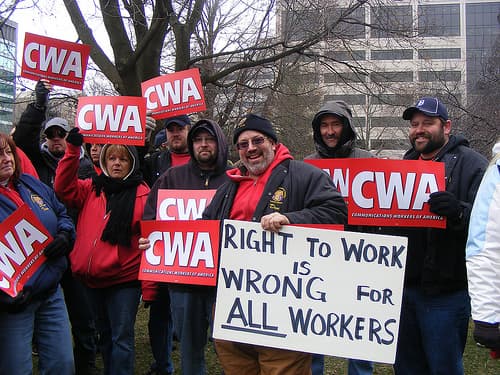
I have to say it’s been fun to have a front row seat in the Right-To-Work debate that raged on in Michigan this past week!
Even President Obama made an appearance in Michigan and was probably the only one to put this debate into it’s proper context. He said Right-To-Work legislation is not about economics, it’s about politics – and for once in his life he was right. Unfortunately, he then spewed a bunch of union propaganda numbers and made it even more political, but hey, he’s a politician.
I have a bunch of thoughts on this that don’t really make one coherent post, so I’m just going to share those thoughts and we can take it from there:
I’m an HR Pro, so in my career I’ve been on the opposite side of the table from unions. I’m management; I don’t have a positive view of unions because I believe they don’t make my workforce better, they make it weaker.
Everyone in a union is treated the same, which just pushes everyone to the middle. High performers have no reason to be high performers when they are treated the same as the weakest performer. I’ve seen this and have dealt with it professionally — unions telling me I have to treat these two groups the same.
This does not create high performance, it creates worse performance. This is what I know.
Everyone needs a wake-up call. I think Michigan enacting Right-To-Work legislation is a wake up call to unions to reinvent themselves, and to start to really think, “how do we show our membership we are adding value to their lives.”
It can’t just be about “protecting” jobs. They’ve protected jobs right out of this state. It has to be about creating opportunities for their membership – that is, a 180 degree difference in philosophy from where they are at.
They need to find a way that employers are begging for their membership to come and work in their companies, because their membership is so highly performing and skilled. Right now, employers are running away from unions because the value equation of skills and dollars don’t match up.
This was originally published on Tim Sackett’s blog, The Tim Sackett Project.