As managers, at some point we all encounter an employee who frustrates us and drains the life and energy out of the team.
When you are in this situation with someone, you know it in your heart that you should act, particularly when they really annoy you. But, you don’t act right away because you second guess yourself, and you keep thinking, “they really do some things very well — sometimes…”
Can’t or won’t?
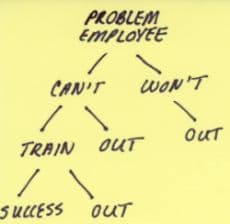
A colleague of mine shared this decision tree (right) with me, and since then life has been easier. When you are questioning yourself, whether or not to act, look at this chart. It makes it pretty clear.
Since a picture is worth a thousand words, I could probably stop here, but I’ll make a few additional points.
Reasons managers don’t act
- The person has flashes of true brilliance, interspersed with being a drain, so you keep changing your mind about their value to the team.
- You are afraid to lose a person doing some work even if they’re not the best.
- They are doing work that you don’t know how to cover without them.
- They have political support from elsewhere in the organization that may be hard to manage.
- There is a “no replacement” rule and you don’t want to lose headcount.
- It’s hard. On any given day, it’s easier to ignore the problem.
- It’s not fun.
- It takes time away from “real business.”
- It’s legally complicated.
Poor performance is contagious
I am seeing more and more research that says that the overall team performance is defined by the lowest performer, not the highest performer.
One of my favorites was the NPR This American Life prologue, where a researcher got an actor to join a work team and act like a jerk, a slacker, or a depressive … and the rest of the team followed suit! Fascinating. (By the way if you go to this link, don’t miss the second act, the Mike Birbiglia segment, on a comedy routine gone horribly wrong. It’s wonderful.)
Even though it’s tough to act, it is worth it.
If you have a “Won’t” on your team — someone who may be capable but is fighting you at every turn, annoying others, being negative, checking in and out, working against what you are trying to do, or, damning it with superficial support — the payoff for dealing with them is big.
Rewards for taking action
My experience has been, 100 percent of the time, that getting a “Won’t” out has a remarkably positive impact:
- You will be more productive, as you will no longer waste time dealing with the variety of annoying, draining, damaging, needing to be corrected or re-worked, “not good enough,” or otherwise apologized-for issues that this person causes.
- The motivation and productivity of whole team goes up, even if they have to cover the work.
- Everyone feels the positive impact that results from the negative energy being removed.
- Your top performers stay motivated to keep performing.
- You build trust with your team, by showing that good performance counts for something.
- If you position this as a critical skill replacement, you will often get your replacement headcount, even if the rules say no.
Taking action
Here are a few thoughts for taking action on poor performers:
- Be honest with yourself. Don’t shy away from the situation or just hope it will improve. Face it head on.
- Get your data together. Start making notes as soon as someone’s performance starts bugging you. After a couple of weeks you will have suffering + data vs. just suffering.
- Get support from HR. Let your manager know and HR know what you are considering, early in the process. HR can help you with the process.
- Reinforce your performance standards. Reinforce your standards and the level of performance you expect with the rest of your team, before, during and after dealing with a problem employee.
Everyone is watching
It’s also important to note that the problem between you and a poor performer is not just between the two of you.
Your whole team sees it and they are watching and waiting to see what you will do about it. The longer you don’t act, the more you degrade your credibility and trust with the rest of your team, and maybe, even with your peers and boss.
This is the least fun part of management, but I bring it up from time to time because upgrading low performers has such a big impact on the success of your business — not to mention your sanity.
This was originally published on Patty Azzarello’s Business Leadership Blog. Her latest book is Rise: How to be Really Successful at Work and LIKE Your Life.