Advertisement
One Important and Overlooked Key to Truly Great Leadership

Get articles like this
in your inbox
The longest running and most trusted source of information serving talent acquisition professionals.
Advertisement
Related Articles
In our world of “selfies” and social media apps to facilitate telling the world about our every thought and how we spend our time, it’s not shocking that humility is a characteristic often in short supply.
I recently read that the College Board, the organization that administers the Scholastic Aptitude Test (SAT) taken by millions of high school students each year, shows evidence of an over inflated opinion of ourselves.
On the SAT test there are a number of questions other than Math and English which the students are asked to answer.
For example, they are asked to evaluate their leadership ability, where 70 percent of students rated themselves as above average in leadership, and only 2 percent as below average. When it comes to athletics 60 percent rated themselves as above average while only 6 percent rated below average.
In rating how easy they are to get along with, 25 percent said they were in the Top 1 percent, 60 percent said they were in the Top 10 percent, and absolutely no one said they were below average in being easy to get along with.
Huh.
Let’s be clear — This is not necessarily a generational issue. I’ve worked with a number of executives (in my age range and older) who think they are all that and a bag of chips … if you know what I mean.
Most say, “you have to see yourself as successful and believe in yourself.” I understand that good self-esteem and confidence in our abilities are important for success, but that doesn’t equate to arrogance and self-importance.
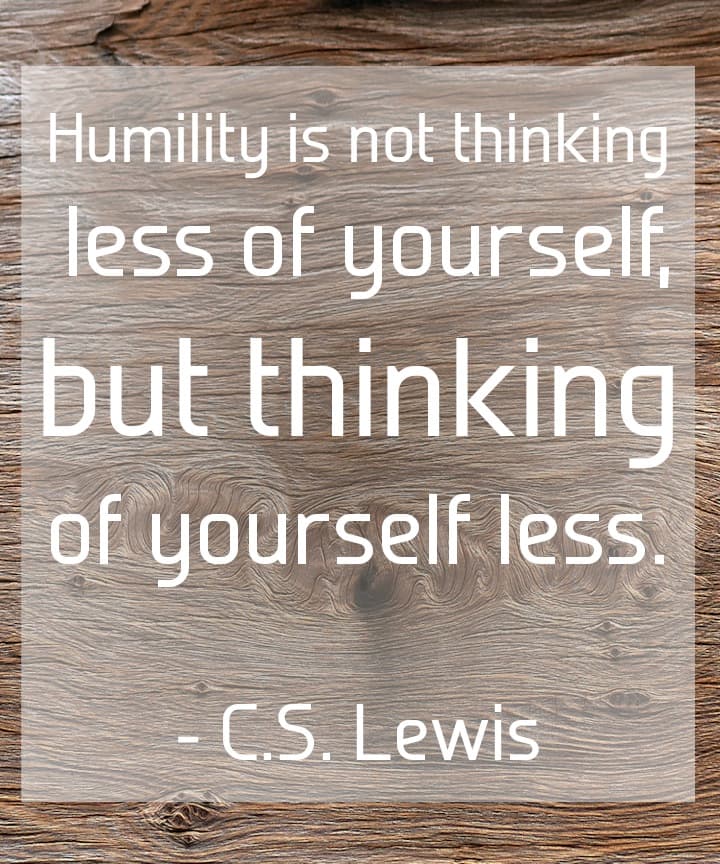
A quote from one of my favorite authors, C.S. Lewis, sums it up nicely: “True humility is not thinking less of yourself; it is thinking of yourself less.”
Here are my thoughts about what components must be present for humility to exist:
These are not characteristics you can fake. What the world sees in our observable behaviors is a reflection of what’s inside – our core values.
So what are two behaviors that leaders with humility demonstrate consistently?
Asking questions, genuinely seeking to understand and learn, suggests that “I don’t know everything.” Additionally, it shows an interest in the thoughts and contributions of the team, implying to the team members they are worthy and the leader can learn FROM them.
Intently listening creates energy and encourages others to share knowledge and imagination answering those “what if” and ”what would you do” questions.
We’ve all had the experience of “feeling heard” vs. having a conversation with someone who is interrupting to share their perspective or clearly focused on something else other than our conversation.
Remember what that feels like? Offer the gift of your full attention to someone else.
OK – time for a bit of honest self-reflection.
If your mouth is getting more exercise than your ears … shut your pie hole!
The humble leader is:
Interesting — when someone is truly humble, not seeking the spotlight is what makes them truly stand out!
This was originally published on PeopleResult’s Current blog.