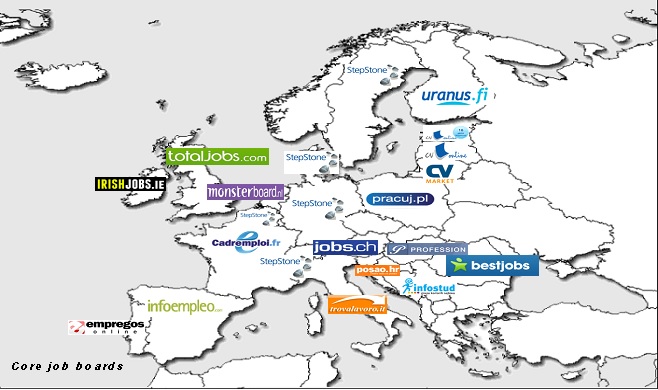
Local champions of Engineer job boards in Europe. Source: Intelligence Group
While Europe still has the rather arrogant attitude thinking the “global workforce” prefers working in Europe, the rest of the world has taken a more realistic point of view. Has Europe become the new hunting ground for talent?
China, Singapore, and Australia already discovered their way to European talent. Recently countries like Brazil, Vietnam, the United Arab Emirates, and Malaysia also source the most talented Europeans. Due to the euro crisis and high unemployment rates, many — often young and highly educated talent, and among them scientists — leave Europe in search for better career perspectives.
Europe is Losing Talent to the Rest of the World
According to Spanish statistics, over 700,000 people — mainly high educated and very talented workforce — left the country to continue their career abroad. They leave Spain with a shortage of scientists. And this phenomenon will not stop while Europe struggles to recover from the current recession. According to Rainer Munz — chief economist of Erste Groupe (an Austrian savings bank) who is also linked to the (Brussels think tank) Bruegel — a “war for talent” will arise in Europe.
In 2050 there will be a shortage of 60 million people within the European workforce. Meanwhile, European institutions and companies still act on the basic assumption that every Asian wants to come to Europe, while the statistical facts show the opposite: Europe looses more talent (in quality) to Asia and the rest of the world than vice versa. China’s own need for an international workforce will explode in seven years. Combine mentioned misconceptions on the European labor market with talent deficits in other parts of the world, and employers eventually will have to develop initiatives to source, attain, and retain talent internationally.
There Is No Such Thing as a “European Labor Market”
Europe will increasingly become hunting ground for talent. The enormous complexity of the composition of its labor market is Europe’s occasional luck in the international war for talent. Local talent acquisition without having feet on European ground is not as easy as it might sound. The reason is simple: there is no such thing as a “European labor market.” And therefore a standard recruitment strategy for the entire European labor market is an illusion.
Let’s take a look at Europe’s labor market and how to recruit there.
The (Im)possibilities of the “European Labor Market”
Europe consists of 51 labor markets with strong local differences
Europe consists of 51 countries. In total 28 countries are member of the European Union. Membership of the EU allows citizens to travel and work without limitations. This open-market space indicates an open labor market where employers and employees can unite and manage the supply and demand dynamics of talent within the EU. Note the word indicates in the former sentence: historic backgrounds and cultural roots limit companies and citizens to create a European labor and job market. Belgians and Dutch people are from small countries and friendly good neighbors. They even speak the same language, but the cultural differences make it almost impossible to work together.
Differences also concern:
HR legal procedures and rules: the status and rights of every kind of labor contract differ per country. For example: a valid reason to fire an employee in one country possibly will not hold in a neighboring country. Firing someone due to economic reasons is scarcely possible in France, due to the complex labor legislation that protects to employees to an extreme extent. This protection can also be translated in a very inflexible, stringent labor market, which is unique in Europe.
Recruitment: how employers and employees find each other and unite varies a great deal. While in the Netherlands it is common to look for a job on a job board, in Spain and Italy you need your personal network to find you a job.
Expectations from both parties, based on “unwritten rules,” lead to misconceptions even within the EU. In France handwritten application letters are not unusual; in Italy the application letters are extremely polite and formal, whereas in Slovenia they are straightforward, as written in Eurograduate.com. In some areas you are obliged to mention in a job interview that you have a second employer or your own small company where you work during the evenings.
No European Recruitment Standard
Data on the most effective recruitment approach on the local labor markets in Europe is non-existent. There is not a European recruitment standard. The majority of the local markets do not even have a local standard. What we need to create this universal European standard is:
Understanding of each other’s “recruitment language”: in one country the word “candidate” might have a different meaning in another country. “Time to fill” is also a term with different meanings.
Comparable recruitment procedures, mainly by using the same definitions across countries, but also by adjusting elements of the procedure. In Italy psychometric assessments are common in addition to three to four interviews with the aim to get a good feeling about the candidate’s personality. In Germany the candidate’s expertise is tested during two interviews.
Integrated data and information in one source including the dynamics of the local labor markets. This is only possible with a universal “recruitment language” and procedures. Global ATS and e-recruitment systems are gaining market share in Europe, which supports the development of international recruitment standards. However, it is not realistic to expect a European recruitment standard before 2020.
Limited Collaboration Between European Countries
The lack of a universal recruitment standard is one of the causes of the limited collaboration between European countries in creating a unified European labor and job market. Let’s take a look at the first indications of European labor market knowledge exchange:
Neighboring countries with languages and legislations that are more or less alike put effort in opening borders for cross-border recruitment. The number of Dutch talent who work just across the border is increasing (especially in Germany) and the unemployment rate in this area is decreasing.
Conferences with a European character.
Collection of international data on recruitment.
LinkedIn links talent across borders.
Non-Europeans recruiting in Europe
Besides these first signals, international recruitment to optimize the match between demand and supply on the European market is scarce: country borders still work like Chinese walls. The main reasons are the cultural, language, and juridical differences. What should you think about effective recruitment of non-Europeans in Europe when the Europeans themselves are limited in their own international recruitment success? For a successful international recruitment approach, you need to answer the following questions:
Where can talent be found locally, and how do you get in touch with them?
How do you appeal to talent, and connect with them in a way that meets their ambitions and needs?
How to Recruit Successfully in the European Labor Market
This is how you do not want to recruit in Europe: asking your non-European advertising or recruitment agency to come up with a strategy or plan. Despite all their hard work and best interests, these agencies will rely on traditional, familiar media parties and “global players” like newspapers, LinkedIn, Monster, Adecco, or Michael Page. These companies are global players but no local champions. This is important to bear in mind, because Europe exists of mainly local champions (see graphic at the top).
LinkedIn seems an excellent choice for European recruitment. Nevertheless, its strength ends when entering the German-speaking borders. In the German speaking part of Europe, Xing is the dominant player, while in France LinkedIn has a competitor called Viadeo and in the eastern part of Europe other social media companies hold an important position (such as Goldenline in Poland.
How to Recruit Effectively in Europe? Local focus
Develop a local recruitment approach for each individual country that fits the local recruitment habits and customs. Consider using the below key ingredients for this local flavor:
Local recruitment champions: these are often used for job searches by the talent group
Messages that are appealing to the local talent group and that compete with local job offers
Recruitment marketing in the local language, preferably translated by a (near) native speaker.
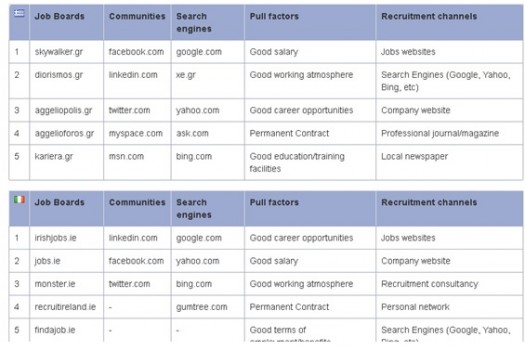
A tool that offers information on labor market behavior of international-driven talent in 66 (European) countries is globalrecruitmentchannels.com. This tool focuses on online recruitment channels and titles: job boards, blogs, social media, and other communities. It also offers insights in offline channels like newspapers and magazines, and it shows the most important drivers (pull factors) of every talent group on the European labor market.
This information supports you to build your own sourcing grid.
Financial/banking specialists in Greece and Ireland. Source: www.globalrecruitmentchannels.com
Sourcing grid
With open data (big data) and data mining, you can develop your own sourcing grid for recruitment success abroad. A sourcing grid is a “road map” for every talent group. This road map describes which part of the talent group (active and passive candidates) can be approached by which kind of means. Every single part of the talent group is identified and receives a specific “treatment” based on a specific communication strategy. A part of the group needs to be hunted; another part is approachable by job postings or advertisements at a local recruitment agency. The combination of these means, applied to certain parts of the talent group, gives employers the best opportunities to reach a large part of local talent.
For instance, when you search IT graduates in Portugal, it could be that you will find them on emprego.sapo.pt while the more experienced part of the group could be found via careerjet.pt or sitting behind their desk enjoying their current job. The ambitions and drivers of the talent groups are also part of the grid. IT talent in Portugal early in their careers arevery keen on good salaries and the possibility to get training and education on the job, whereas the more experienced part of the IT group in Portugal prefers a good career over good salary.
Summary: How to Recruit Talent in Europe
For successful talent acquisition in Europe by European and non-European companies there is no single solution nor single approach. Every talent group and every country or even area demands a specific approach. Trying to reach out to European citizens as part of one entire labor market is ineffective.
There is no “European Labor Market.” Even members of the EU do not take advantage of the available talent within the EU borders. This is mainly due to the local differences in cultures, languages, legislation, and expectations. This also results in the absence of a universal recruitment norm.
Besides the differences, local talent groups have different drivers, motivations when looking for a job, and use other media channels or networks.
Local data and information are essential to create a successful sourcing grid. In this grid, every part of a local talent group is identified and will receive an adapted communication strategy to make the connection between employer and the diffuse European labor market possible.