Advertisement
How Rewards Programs Can Make Your Strategy Perform Better

Get articles like this
in your inbox
The longest running and most trusted source of information serving talent acquisition professionals.
Advertisement
Related Articles
I like to argue that we should be holding our compensation programs – and the money they represent – to a higher standard.
Research examining how well company strategy delivers on its potential – and where and why it fails – sheds some light on the important contributions that rewards can make.
Your reward programs, in reality, do a lot of things beyond delivering economic and psychic value to employees. Any of you who’ve bumped into the unintended repercussions of a misguided incentive plan know this to be true.
Reward programs also:
Can these things measurably improve how our organizations execute strategy?
Research (covering nearly 200 companies worldwide) conducted by Marakon Associates and reported by Michael Mankins and Richard Steele in their Harvard Business Review article Turning Great Strategy into Great Performance, found that the average company’s strategy delivers only 63 percent of its potential financial performance, the financial projections set forth in the company’s strategic plan.
Clearly, a significant strategy-to-performance gap exists. What causes it?
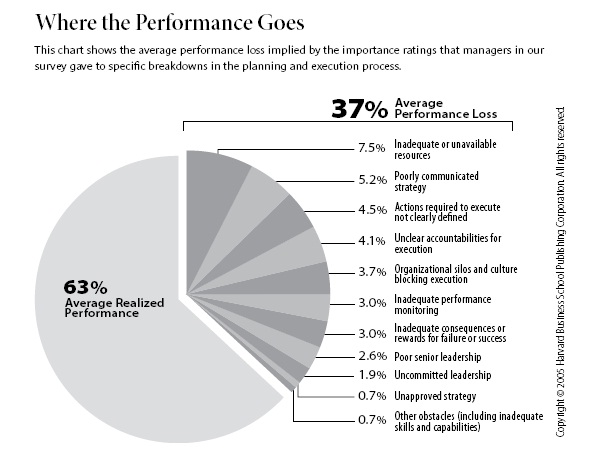 Mankins and Steele take a look at the flip side of that 63 percent average realized performance to see where the other 37 percent of performance gets lost. In their study, managers at the participating companies reported the specific places where strategic planning and execution breaks down. Take a look at the chart to see what they discovered.
So, here’s my point. Well over half the factors that cause strategy execution to fail are things that rewards can impact. Specifically:
My math and Mankins’ and Steele’s findings suggested that our concerted efforts to align reward plans and practices with business strategy have the potential to reduce the strategy-to-performance gap from 37 percent to as low as 13 percent.
TOTAL — 24.2%
Of course. It is unlikely that rewards alone can completely eliminate each of these roadblocks. But there is a strong case to be made that rewards – done well – can influence each and every one of them; in some cases to a strong degree.
So let’s get to work making it happen!
This was originally published on Ann Bares’ Compensation Force blog.