For an employer, this prospect can be disconcerting, to say the least — especially if party activities were fueled by free-flowing, unmonitored alcohol consumption.
Employer-sponsored holiday parties can, of course, present a number of risks when alcoholic beverages are served. Aside from the embarrassment an employer may face if party exploits are broadcast via Facebook, YouTube or other social media channels, issues of harassment and liability may also arise as a result of these events.
Two major concerns for employers
With inhibitions relaxed, some employees may engage in conduct which they might not otherwise pursue, leading to overly friendly or aggressive behavior.
This type of activity — especially if sexual in nature — could expose an employer to complaints of discrimination under Title VII of the Civil Rights Act of 1964. This would be more likely to take place if the actions of an individual were a continuation of previous indiscretions, which might open the door to potential “hostile work environment” allegations.
In short, employers should be cognizant that holiday office parties can be opportune occasions for sexual harassment incidents to occur.
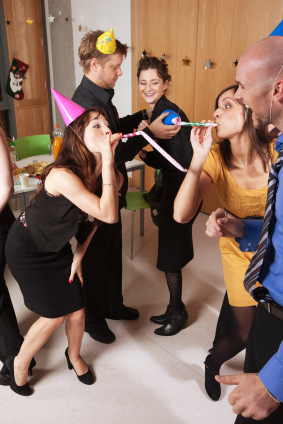
Holiday parties can be a challenge for management and HR. From the HR blog at TLNT. (Photo by istockphoto.com)
Civil liability for injuries or damage caused by an intoxicated partygoer – whether to himself or to a third party – should be another concern for company officials. If an employee injures himself at or after the party, the sponsoring employer could find itself subject to a workers’ compensation claim. Similarly, if an employee is involved in an accident with a third party on his way home from the event, the employer could – depending on state law – be the target of a “host liability” charge.
While Ohio law, for the most part, excuses an employer from such liability, other states may not. Consequently, it is imperative that party planners familiarize themselves with the appropriate state statutes before the planning process begins.
Having said this, companies need not abandon their holiday celebrations. These are occasions when an employer can truly express appreciation for its employees’ contributions to the organization throughout the past year.
How to help avoid a holiday party problem
By following a few suggestions, companies can still provide a safe, enjoyable and, to the extent possible, liability-free environment for all who wish to join in the festivities:
Have a written policy prohibiting inappropriate behavior, including excessive alcohol use, and distribute the policy again before the event.
Hold the party at a restaurant or bar during non-working hours and have employees pay for alcohol; alternatively, provide one or two drink tickets per person.
Manage the party and the alcohol consumption – designate responsible individuals to monitor the attendees’ behavior; remember, this is still a “work” event.
Don’t encourage excessive consumption, such as “beer-drinking” contests, and avoid serving “spiked” punch or other drinks that mask alcoholic content.
Limit the alcohol served to one or two drinks per guest, and be sure to make a wide selection of non-alcoholic beverages readily available.
Avoid serving salty or greasy foods, which tend to encourage drinking; instead, offer food high in starch or protein, which can slow the rate of alcohol absorption into the bloodstream.
Advise the bartender not to serve anyone who appears inebriated, and stop serving alcoholic beverages at least two hours prior to the end of the party.
Be sure that the caterer is licensed – according to the National Association of Catering Executives, a party sponsor could be deemed liable if a guest becomes ill after consuming food prepared by an unlicensed caterer.
Make attendance voluntary instead of mandatory, as some people are uncomfortable in these types of situations.
Keep the party a fun, social event — encourage attendees to avoid conducting business during the festivities.
Skip the mistletoe — it can lead to unwanted kissing or touching.
If you wish to record the party for posterity, designate one responsible person to serve as the company’s photographer throughout the event; at the same time, ask that employees refrain from taking their own photos or, at a minimum, from posting them on Facebook, YouTube or Twitter.
Don’t allow employees to return to work afterward or to operate employer-owned vehicles.
Offer free cab rides, or other transportation options, home — in some cities, there are services available that employ cyclists to drive a partygoer’s vehicle home (the cyclist merely inserts his folded bike into the customer’s trunk and retrieves it when he reaches their destination); this allows the employee to avoid the annoyance of having to retrieve his vehicle the next day.
Discourage “after parties.”
Numerous harassment, workers’ compensation or personal injury allegations have stemmed from incidents that occurred at holiday office parties or at unsanctioned “after party” events. In order to avoid such claims, and to ensure that holiday parties engender only pleasant memories, it’s important for employers to take steps beforehand to minimize the potential for problems.
In doing so, they will also be enhancing their ability to continue their holiday party tradition for many years to come.