The Equal Employment Opportunity Commission (EEOC) resolved 99,109 employment discrimination claims in fiscal year 2017, resulting in $398 million in compensation paid to claimants. Of the claims resolved, 47% were for retaliation by an employer against a complaining employee. These statistics suggest we are witnessing two phenomena related to the EEOC claims:
- Employers are not being well educated on how to avoid retaliation cases, and
- More disgruntled employees might be tempted to take advantage of the increasing willingness of the EEOC authorities to systematically trust the plaintiffs.
How to protect your business
First, business owners and their executives must be more involved in the hiring process with HR managers. People work for people, not for companies. Creating a connection in the first steps of the recruitment process may make a dramatic difference. Many business owners tend to offload the responsibility of talent acquisition – either to their HR manager if the company is big enough, or to any willing administrative, trusted person.
Second, to prevent such situations, employers should implement clear procedures or policies for addressing workplace complaints, ensure these are known and followed, and take affirmative steps to avoid the possibility of adverse actions against individuals who complain about EEOC (or other) issues or otherwise participate in investigations into such issues.
Third, every business should put more attention on creating a work environment that is more conducive to job satisfaction and more generally, happiness at work. They should also take measures against bullying at work or rough management principles. When employees feel that they are important and that management genuinely cares, they are less tempted to abuse the advantageous legislative position. Cases in point:
Fourth, there are unfortunately a minority of applicants and employees who will always take advantage of any opportunity to make money out of some defective procedure or lack of respect of applicable laws. Often pushed by shark-type lawyers to maximize the accusations, they will not hesitate to exaggerate the facts about seemingly faltering or illegal hiring and/or management procedures committed by their employers. So, employers must be able to detect such personalities and act accordingly.
HR managers can play a vital role in minimizing legal trouble throughout the hiring process. Here are a few tips which can be easily implemented in any type of organization:
- Education — Most business owners and their executives have not been educated to recruit – it is NOT in any high school or college curriculum. There is a science to successful or no-fail hiring. There are many training programs available both in-person and online.
- Enforce standardization —When it comes to talent acquisition, subjectivity is the big killer. From an EEOC viewpoint, lack of objectivity and formalization in the hiring procedure can lead to legal trouble. HR managers very often have difficulties making management aware of the importance of formalization.
- Stop focusing on hard skills — As stated above, almost 50% of discrimination claims are retaliation cases. What it means is that in many cases, retaliation from the employer occurs after personality clashes and/or emotional reactions in the relationship between a senior and his/her junior.
- There’s much evidence to show hard skills do not guarantee success on the job. In fact, per Leadership IQ, almost 50% of newly-hired employees fail within 18 months. Of those, only 11% of failures are due to lack of hard skills, whereas lack of soft skills account for 89%.
- Technically qualified applicants know their value and, in the current applicant-driven market, often inflate their salary expectations. Small business owners may tend to blindly compromise with their original plans and succumb to their hard-skilled candidates’ negotiation tactics. The problem is, higher salary does not always lead to better performance.
- Another interesting report suggests that if you neglect the soft side of candidates and rely primarily on their hard skills, you double or triple the odds of experiencing a hire failure.
Look for these skills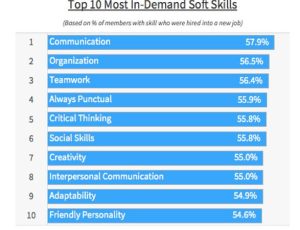
In a Job Outlook survey conducted by the National Association of Colleges & Employers (NACE), the top characteristics looked for in new hires by 276 employer respondents (mostly from the service sector) were all soft skills: communication ability, a strong work ethic, initiative, interpersonal skills, and teamwork.
Per research undertaken by LinkedIn in 2016, the chart shows the most searched-for soft skills.
By focusing more on hiring great soft-skilled employees, employers reduce the risk of legal trouble, hiring the right people leads to higher profitability and viability for organizations.