At first mention, the concept of feeling fulfilled, or having a sense of purpose at work, may seem like a luxury for a select few, like new grads, entrepreneurs, nonprofits, or healthcare professionals. After all, purpose-driven employees are those who seek a deeper meaning from their employment, beyond pay or status.
So, what role does purpose play, really, in roles like finance, retail, or … recruiting? A big one, it turns out.
LinkedIn, with the help of Imperative, recently undertook a global study on the role of purpose in the workplace, encompassing 40 countries and 26,151 respondents.
Purpose-oriented professionals prioritize work that matters to them, their company, and the world — more than money or advancement. But we found that purpose isn’t limited to idealistic or service-oriented groups, but rather spans industries, job functions, geographies and demographics.
Recruiting Is at the Forefront of the Purpose Movement
For recruiters, purpose translates into placing people into jobs — or companies — where they can drive meaningful impact. (Aaron is doing a talk on this at ERE Spring in San Diego, by the way, as well as a small-group workshop.)
 One of the biggest business cases for seeking out purpose orientation in a candidate is the potential impact he or she may have on the company’s bottom line. Research from the EY Beacon Institute and Harvard Business School shows a connection between purpose and profit. In their study, 85 percent of companies that prioritize purpose showed positive growth, while 42 percent of non-purpose-led companies showed a drop in revenue during the past three years.
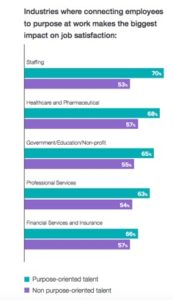
Another key draw is the impact of purpose on job satisfaction, and the implications that brings for business success. Overall, purpose-oriented professionals report greater job satisfaction than their peers (73 percent vs. 64 percent). This correlation remained consistent in virtually every country and industry, demonstrating that purpose is a motivator regardless of region, culture, language, or occupation. The research found that because purpose-oriented workers are more fulfilled and satisfied at work, not only are they more productive and engaged, they also remain with their company longer than their peers.
What’s more, they’re more likely to hold leadership positions, and to promote their company to others.
That said, some industries and functions attract and empower purpose-oriented professionals more effectively than others.
The good news for your organization is, of all the professions studied, working with purpose had the highest impact on recruiters’ job satisfaction. Recruiters who are purpose-oriented experience a 70 percent rate of job satisfaction vs. 53 percent for those who aren’t driven by a deeper meaning. That’s higher than both healthcare professionals and the nonprofit/education sector.
This could be the case because, as Dr. John Sullivan points out, “other than getting married or buying a house, few things in life have a bigger impact on an individual and their family than landing or missing out on a great job. Because of that tremendous impact, most recruiters find it easy to maintain a high level of excitement and commitment to excellence.”
As one New Zealand staffing director in our study put it, “I enjoy helping people fulfill their dreams, personally and professionally. My work as a recruiter gives me purpose.”
How to Recruit Other Purpose-driven Professionals
It’s not just recruiters, though. Increasingly, workers are seeking out jobs that allow them to connect with more than a paycheck. In fact, 37 percent of LinkedIn members characterize themselves as purpose-driven, i.e.: they prioritize work that matters to them, their company, and the world — over money or advancement. So, how can companies go about finding and attracting these valuable folks?
- Know that they’re out there … but they’re not necessarily looking for you. Purpose-oriented employees are more likely to be passive candidates (69 percent vs. 61 percent who are not purpose-oriented). To get their attention, incorporate purpose into your employment brand. The top three factors that entice these folks to accept a new job are culture, mission, and product offering. Put your mission front and center on your career site and social channels. Post content that shows people what it’s like to be an employee at your company, what you do together, and what impact you have on the world.
- Infuse your organization’s purpose throughout the recruitment process. When you’re reaching out to candidates, focus your messaging the same way — more on culture and vision and less on perks and benefits. Executive engagement and purpose-driven content can go a long way here. Consider the impact a post from the CEO or your company’s head engineer can have in the recruiting process, if used effectively. During interviews, start conversations by highlighting your organization’s mission and values. Ask questions like “what motivates you?,” “what do you value most about your work?,” and “how important is purpose to you in your job?”
- Look beyond the requisites. Don’t limit yourself to making the perfect skill match. Instead, recruit candidates into roles that connect with their sense of purpose. At LinkedIn, purpose-oriented employees outperform their peers in all areas.
- Always be recruiting. Even if you’re not hiring, you can nurture candidates with a sense of purpose. Then, when the need arises, you’re prepared with a pipeline of professionals who can help drive results.
For recruiters, the purpose movement isn’t to be ignored. More and more people are looking for jobs that provide personal fulfillment. At the same time, companies are seeing that purpose-oriented employees become more productive and successful. As economic conditions fluctuate, recruiting purpose-oriented talent to allow the company to adjust as needed will be a powerful competitive differentiator.


