In a recent report by Universum, a tactical view of how organizations are attracting talent and combating problems is given with some fresh insight.
The report, titled State of Employer Branding, is part one a four-part 2020 Outlook series and based on responses from 2338 interviews conducted in the winter of 2014 in 18 different countries. Respondents represented a variety of industries and job functions, with more than 50 percent working within HR, 16 percent being the CEO of their respective organization, and 23 percent working for organizations with more than 1000 employees in the country.
Universum’s report starts by posing a necessarily blunt question to its readers, “How long have executives argued over the need to make talent attraction a corporate strategy rather than an HR strategy?”
Where does branding responsibility lie?
Point taken — talent acquisition remains an ongoing point of struggle for organizations, but is a critical strategy for organizations to remain competitive.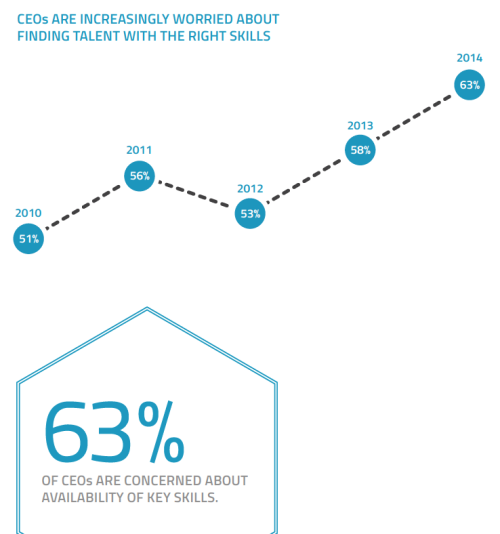
As Universum makes clear — and we’ve known this for a while — what are organizations doing to step up to issues relating to talent? Let’s take a look at the meaty details of Universum’s report.
Talent acquisition and retention is a complex equation involving (among other things) talent management and development, employer branding, and analytics to measure effectiveness. Part of the problem with employer branding is where responsibility lies:
- 60 percent of CEO’s feel they own employer branding;
- 58 percent of HR executives, 63 percent of talent acquisition executives, and 57 percent of recruiting executives say HR owns employer branding;
- 39 percent of marketing executives point to HR owning the role, and 40 percent to the CEO owning the role.
Is HR up to the task?
Why all this variability? Universum underlines repeated studies that have shown CEOs don’t believe HR is up to the task, as well as studies that say HR itself is not confident in their current approach, or do not feel their approach is innovative. Greater stakeholder cooperation is another broadly identified need when it comes to employer branding efforts:
- 70 percent of senior executives see a closer need for stakeholder cooperation in the next five (5) years.
- 77 percent of HR executives see a closer need for stakeholder cooperation;
- 53 percent of CEO’s see stakeholder cooperation as a growing need.
Though this is an identified need, without changing the CEOs’ confidence in HR to solve strategic talent challenges, HR will be hard pressed to effect change in this area.
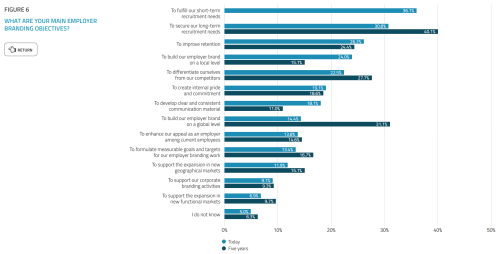
Universum asked respondents about their employer branding objectives, and how these objectives will change in the next five years.
No clear priority from executives
Interestingly, of all the objectives listed, none earns much more than one third of respondents’ votes. The most critical need is “to fulfill our short-term recruitment needs,” but that is mentioned by just 36 percent. This should lead us to ask why so few executives (and CEOs in even lower numbers) are prioritizing such objectives?
Universum offers the following explanations:
- Organizations face a lack of clarity about which objectives matter most.
- There is a perceived lack of ownership for the discipline of employer branding.
- Employer branding is not viewed as a critical priority when organizations face many other pressing challenges.
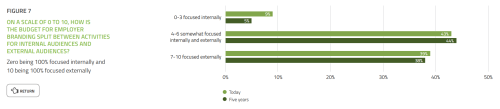
To better understand their commitment, Universum studied how organizations are currently investing in employer branding:
Overall, we see that organizations are overwhelmingly focused on external employer branding efforts. KPIs, however, often measure almost inclusively internal factors (presenting another potential issue).
Organizations also face a perceived gap when it comes to the association between consumer and employer brands. Recently there has been a concerted effort to more closely align employer and consumer brands, yet when executives were asked how closely they feel these are aligned, the responses indicated there’s still much work to be done:
- 19 percent say their employer and consumer brands are the same.
- 36 percent say “there is a connection today;”
- 17 percent say there is no connection at all.
When marketers were asked this question though, the answers were remarkably different, with marketers much more likely to report a connection between the employer and consumer brand.
93% of CEOs know they need to change strategy
How do organizations more forward with an employer branding and talent strategy when there appears to be little consensus about how to do so? Universum’s report cites from PwC’s global CEO survey, which reports that while 93 percent of CEOs say they know they need to change their strategy to attract and retain talent, 61 percent say they have not taken steps to do so yet.
The first step towards addressing “the talent gap” may just be to get organizations to accurately recognize areas of misalignment and differing perceptions. Employer branding, as we see from this data, is certainly one of these areas.
Organizations must also commit to an investment strategy. As Universum states:
If talent is as important to competitive might as capital, it must be managed and measured with the same disciple applied to financial planning and management.”
A showdown coming for HR?
This report makes me think we have a massive showdown coming between HR and CEOs. I don’t know about you, but I think I know who’s going to win unless something big happens. And the only thing big I see happening is Marketing swooping in to save the day.
HR, if you think you’re hearing footsteps, you probably are!
This originally appeared on China Gorman’s blog at ChinaGorman.com.
