Advertisement
When ‘Please’ and ‘Thank You’ Aren’t Enough

Get articles like this
in your inbox
The longest running and most trusted source of information serving talent acquisition professionals.
Advertisement
Related Articles
Saying “please” and “thank you” is one of the most fundamental communication strategies we use to project our own intentions and gauge the intentions of others. That is why it is crucial to use them in the workplace — arguably, with no exceptions.
This is not a tall order however. Most people, when placed in a roomful of strangers, will default to “please” and “thank you.” The words are great equalizers, and graciousness makes an excellent foundation for any relationship. We know this intuitively, since human beings are hardwired to cooperate, not compete. The words are valuable engagement currencies in the workplace, no doubt about it.
Yet there is a very important principle to keep in mind when engaging employees through feedback recognition: the law of diminishing returns. It refers to the point at which the level of benefits gained by a certain tactic is less than the amount of energy invested. After that point, the benefits of said tactic diminish rapidly until it wears out its welcome.
“Please” and “thank you” are powerful, but they have their limits. Tangible rewards and recognition like gift cards, displayable awards and in-house fame add an unmistakable layer of excitement to the workplace that “please” and “thank you” have trouble replicating. But where gift cards and merchandise can excite the senses more, those simple gracious words can satisfy us much deeper in our hearts.
Psychologists call this extrinsic (external) versus intrinsic (internal) motivation, the shorthand of which is, there are things in this world that motivate our extrinsic outer desires (such as material gains and social status), and there are other things that motivate our intrinsic inner desires (such as validation, respect, and inclusion). The human psyche needs a balance of both to reach peak motivation, not just at work, but at any task in life. If we get too much of one over the other, the law of diminishing returns kicks in.
Think about it: How great would you really feel over time about being showered with gifts if nobody at work ever gave you the basic respect of “please” and “thank you?” And by the same turn, how fulfilling can “please” and “thank you” really become if they are never backed up with tangible rewards?
We constantly emphasize balance when engaging employees with recognition. Suffice to say, it’s not enough to just be nice. You may have a rewards system with amazing gifts, but as the saying goes, “If you don’t use it; you lose it.” Here are some tips:
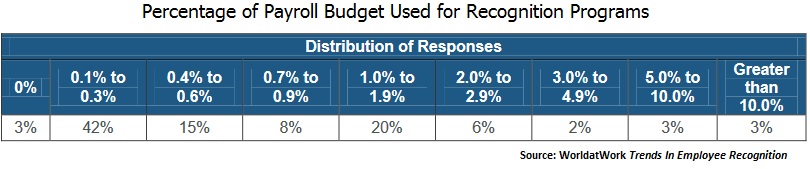
According to WorldatWork, 80% of organizations have a budget for their recognition program with 42% allocating 0.1% to 0.3% of their payroll cost to it. They are not usually overly expensive or burdensome programs. Still, I would bet real money that several of those programs aren’t getting the added value or efficiency from proper balancing.
We must always keep in mind that employees are a group of random strangers who must make a choice every day to set aside differences and get the work done. Therefore, they must be approached with the same objective balance, no matter how casual or informal workplace relationships become.
This was originally published on the Michael C. Fina blog.