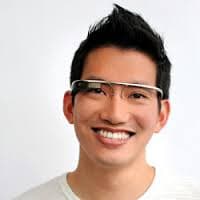
I haven’t tried Google Glass but I’m intrigued.
As James Rivington writes in Techradar’s Google Glass: What You Need to Know, Google Glass is defined as:
An attempt to free data from desktop computers and portable devices like phones and tablets, and place it right in front of your eyes.
Essentially, Google Glass is a camera, display, touchpad, battery and microphone built into spectacle frames so that you can perch a display in your field of vision, film, take pictures, search and translate on the go.”
Are you ready for Google Glass?
How ridiculous?
In a recent Saturday Night Live skit, tech correspondent Randall Meeks, (played by Fred Armisen) hilariously demonstrates the upsides and downsides of Google Glass.
It’s hard to envision people blinking, gesturing or using voice commands as they interact with their eyewear.
For most of us, our knee-jerk reaction to Google Glass is “not for me” or “how ridiculous.” It’s an understandable response. We’re asking our brains to imagine the unimaginable.
Habitual resistance
But as quickly as we roll our eyes to the absurdity of Google Glass, we might also be creating a state of unconscious and habitual resistance.
Habitual resistance sneaks into our thoughts, our language and our mindset.
- “We can’t afford to invest there.”
- “That doesn’t fit within our mission.”
- “Our Board of Directors will never go for that.”
- “This technology is fine, it just needs a few bandaids.”
- “Let’s wait and see what happens.”
Habitual resistance is insidious and dangerous. Especially for leaders, because when leaders get too comfortable with the status quo, they become stale.
The danger of playing it too safe
Bad things happen to stale leaders (and their stale organizations).
- Stale leaders miss opportunities.
- Stale leaders are too scared to fail.
- Stale leaders don’t listen.
- Stale leaders squash innovation.
- Stale leaders get blindsided.
- Stale leaders don’t attract or retain talent.
- Stale leaders don’t stretch.
- Stale leaders leave behind stale organizations.
Great leaders constructively challenge but allow themselves to stay open and imagine the unimaginable. They are receptive to the possibilities, the what-ifs and could-be’s.
Who knows; in a few years, sporting wearable technology like Google Glass might be as common as earbuds are today. Or, Google Glass could turn out to be the next Segway and a total bust.
But no one will say that Google played it safe.