Advertisement
What HR Is Measuring: Employee Satisfaction and … Retention?


Get articles like this
in your inbox
The longest running and most trusted source of information serving talent acquisition professionals.
Advertisement
I always find studies and surveys that talk exclusively to HR people to be especially fascinating. I start scanning through the pretty graphs and data and if anything is outside of my understanding of HR, I like to call it out.
I was able to get an early peak at an HR benchmarking survey done by the folks at Focus and I’ll be honest with you, one thing did stand out right away: HR people consider measuring employee satisfaction and retention as the way to assess the success of HR in their organizations.
Does that align with your thinking on what HR should be measuring? That and some other interesting results are after the jump.
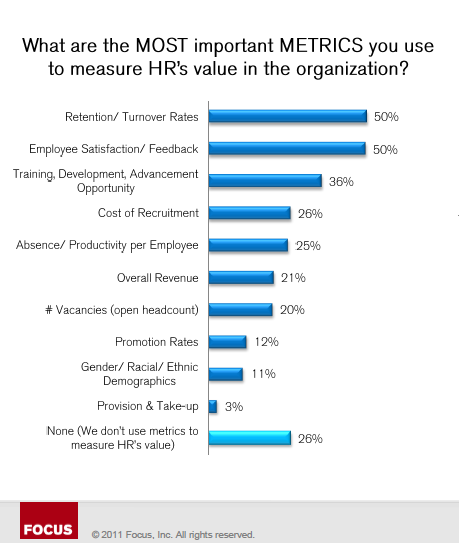
When asked what the most important measurements were for gauging HR’s value in the organization, retention and employee satisfaction tied for first place. Other top factors included training and development, recruiting costs, productivity per employee and overall revenue.
Now I’m not saying that employee satisfaction and retention aren’t important to measure (in fact, there is no doubt they should be taken into consideration) but they certainly aren’t the most important metrics for assessing HR’s value. They would be valuable in determining if you have the right managers in place though.
I think as you get further down the list, you start to see more things that the CEO and CFO care about: costs, open reqs, revenue, and productivity. And at the very least, you have to connect those retention and employee satisfaction numbers with the higher concerns for your colleagues in the C-suite.
Maybe the more alarming for some of you will be the 26 percent of organizations that don’t use metrics at all to evaluate HR’s value to the company. One in four (1 in 4) not using metrics is a tough number to swallow for a function that strives to be more relevant and visible among the organization’s top leaders.
Make no mistake about it though: measuring (and focusing on) the wrong things can be as costly as doing nothing at all.
Some of the other interesting information shared in the survey also piqued my interest:
Does any of this seem odd or out of place? Is anything drastically different than the companies that you are aware of?
From where I sit, everything looks pretty much where I thought it would be. Now if we could only fix some of the metric questions, we might be able to do a bit better on figuring out how to explain HR’s true value to the organization.