Advertisement
Weekly Wrap: Women Get More Raises, Still Get Less $$$ Than Men


Get articles like this
in your inbox
The longest running and most trusted source of information serving talent acquisition professionals.
Advertisement
Related Articles
There’s good news and bad news on the workplace gender gap front.
Here’s the good news, according to a new Pay Raise Index from “social HR pioneer” TribeHR, 7.4 percent of women received raises during the first nine months of 2012, compared with only 6.2 percent of men who got a pay hike.
Sounds like progress, no? Good to hear that women, who have traditionally been underpaid compared to men for similar work and job titles, are finally catching up a bit.
Well yes, that’s true, but here’s the bad news: when analyzing the size of pay raises, the same TribeHR Pay Raise Index found that men were three times more likely to earn a salary increase in excess of 25 percent. And if you look at pay raises of 5 percent or more, the data shows that 60 percent went to men and just 38 percent to women.
It’s like the old song says, “one step forward and two steps back. Nobody gets too far like that.”
“The new TribeHR Pay Raise Index reveals a mixed picture when it comes to fair pay,” said TribeHR CEO, Joseph Fung, in a press release about the latest data.
He added: “It’s interesting to see that women seem to be overtaking men in terms of the number of pay raises given but there’s still a stark imbalance in the size of salary increases awarded. Employee satisfaction and workplace culture play an increasingly large role in a business’ brand reputation — and those who pay fairly and amply recognize employee contributions will reap the benefits when it comes to hiring and talent retention.”
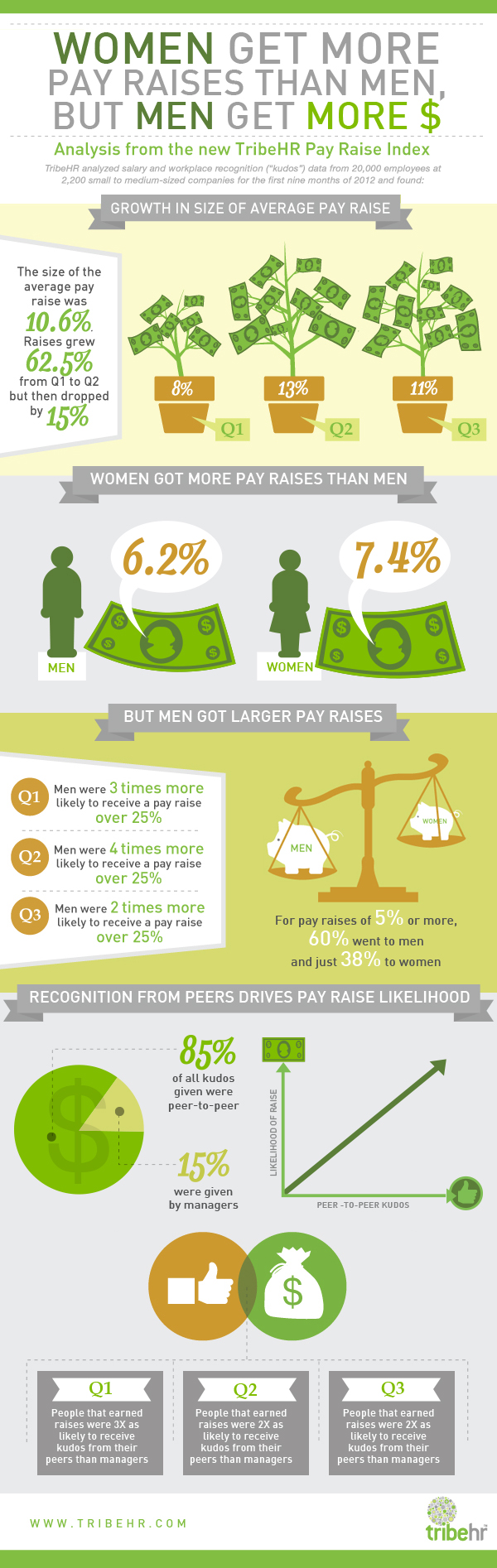 TribeHR analyzed salary and workplace recognition (“kudos”) data from 20,000 employees at 2,200 small to medium-sized companies between Q1-Q3 2012, and although they don’t get into what larger companies did during this time frame, the data is pretty telling that it is still a tough path to some measure of pay equality in the workplace. .
Overall, the TribeHR Index reported that the average salary increase for employees at small and medium-sized businesses grew by almost 11 percent between Q1 and Q3 2012, and that the size of the average salary raise grew from 8 percent in Q1, to 13 percent in Q2, but then dropped to 11 percent in Q3.
The they also examined the correlation between salary increases and employees who had received documented recognition for a job well done, finding that 85 percent of documented recognition was given by peers, and, that employees who received recognition from peers were two to three times more likely to earn a pay raise.
This just goes to show you why the crowdsourcing of performance reviews to include what peers think is an important trend that needs to become a more regular and accepted part of the evaluation process. As the TribeHR Index data shows, recognition of good work from your peers makes it a lot more likely that a person will get a raise, and that’s because peers generally have the greatest insight into who is performing well and who is not. Managers everywhere would do well to take heed of that simple fact.
But, I’m also with TribeHR CEO Joe Fung in his assessment that the “stark imbalance” in the size of raises for women versus men is a problem that needs to be addressed. Yes, it always seems to be “one step froward and two steps back” when it comes to righting the wrongs of the past, and this is just another bit of data that shows yet again that no matter how far we think we have come on these issues, there is still a long way to go to finally make things right.
Of course, there’s a lot more than the gender gap in pay in the news this week. Here are some HR and workplace-related items you may have missed. This is TLNT’s weekly round-up of news, trends, and insights from the world of talent management. I do it so you don’t have to.