I look for management and hiring wisdom wherever I can find it, and sometimes, I find it in the The New York Times’ Corner Office column.
Although the advice can, on occasion, be silly or a bit out of whack, it’s often insightful stuff worth some thought and consideration.
That’s why I found the comments from Katia Beauchamp, co-founder and co-chief executive of Birchbox, a beauty products website, pretty interesting. She tackled a topic that is near and dear to my heart — optimism as a workplace best practice.
Looking for “hopelessly optimistic” people
Here’s what she said to The New York Times:
Question — Let’s talk about hiring. What do you look for?
Answer — I really look for people who are hopelessly optimistic. I try to understand them by the way they describe their career thus far. And people who are really ambitious are always looking for a challenge, and love the idea of a challenge. I try to scare them a bit about how hard things are here, and that we don’t really have a playbook to say: “Here is how you do this. Here is how you run this.” I also like people who describe themselves as lucky, because I believe that you make your own luck through really hard work.
If you’re going to report to me, you’re going to be a manager. So I’m looking for your management style and what you really believe in. Are you somebody who is comfortable not being the smartest person in the room for everything, letting ideas come from everywhere, giving people credit for those ideas and really thinking about the careers of the people on your team?
Q — What would cut an interview short for you?
A — If somebody is negative at all about anything, it’s done for me. If they describe a past job as not fun, I am literally done because it’s your job to make your life fun, and it’s in your hands. If you didn’t figure out how to make something of it, you’re not going to figure out how to make something of it here.
Go for Tigger rather than Eeyore
Now, I don’t buy into everything that Katia Beauchamp had to say — like the notion about “it’s your job to make your life fun” — but I do think she’s on to something when she says how she wants “hopelessly optimistic” people because it is that kind of mindset that will help get the organization through the tough times that every organization faces.
I’ve worked in far too many environments where the prophets of doom seemed to dominate and pull down the ability of everyone around them to work through the things that happen when times get tough. And although an optimistic approach might not solve all of your problems, it WILL make everyone more willing and able to see that there is usually a way out of whatever problem you may be facing.
On top of that, optimistic people just make for a more appealing workplace environment, and that helps to improve everyone’s on the job experience.
Lets face it: I’d rather deal with the sometimes annoying enthusiasm of Tigger instead of the perpetual pessimism of Eeyore.
Of course, there’s more than hiring optimistic people in the news this week. Here are some HR and workplace-related items you may have missed. This is TLNT’s weekly round-up of news, trends, and insights from the world of talent management. I do it so you don’t have to.
- Struggling to manage a multigenerational staff. The New York Times’ Who’s the Boss? column is another one that frequently digs into interesting subjects, and so it is with the challenges of managing so many different generations in the workforce. “Jessica Johnson, who owns Johnson Security Bureau, said she … had staffing challenges. These include, she said, determining how to “get the best out of different generations.” The workers she needs to motivate include security guards and office staff. Ms. Johnson said her company gets lots of young applicants. “They don’t know what else to apply for,” she said. But with many older people also out of work, she said the company is also getting more “mature” applicants. She’d like to give them a chance but hasn’t found an effective way to acclimate them to the company culture.”
- Is just being average at work OK? A recent HBR blog dug into the notion that the drive to be perfect — particularly in the workplace — may actually not be such a good thing. “David Burns, author of Feeling Good … (says that) in his more than 35,000 therapy sessions he has learned that the pursuit of perfection is arguably the surest way to undermine happiness and productivity. There is a difference between the healthy pursuit of excellence and neurotic perfectionism, but in the name of the first have you ever fallen into elements of the second?”
- California’s unemployment payment meltdown. A Los Angeles Times report says that, “Officials in charge of California’s troubled unemployment insurance program said they underestimated the gravity of a computer meltdown that has left thousands of jobless workers scrambling to pay bills and feed their families .. (and) payments to about one-fifth of California’s roughly 450,000 unemployment insurance recipients are still delayed because of ongoing problems.”
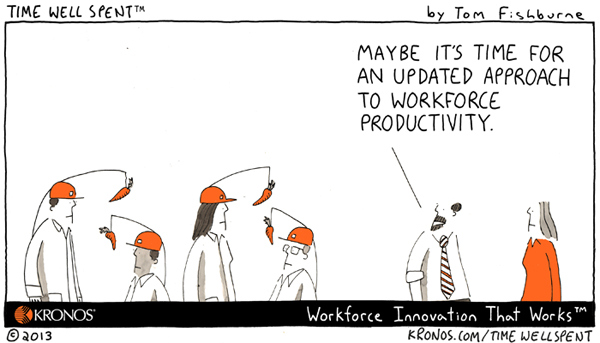
- Kronos Time Well Spent cartoon. Kronos, the company that probably makes your organization’s time-and-attendance systems, publishes a regular Time Well Spent workplace cartoon by Tom Fishburne. I post them here from time to time in the Weekly Wrap.