Advertisement
Watching the NBA Playoffs? I Hope You Didn’t Call in Sick to Do It

Get articles like this
in your inbox
The longest running and most trusted source of information serving talent acquisition professionals.
Advertisement
Related Articles
Over the years, I’ve had employees call in sick for all sorts of reasons and I’m sure that at least some of the time, they weren’t completely truthful about a) the reason they were ill; or b) that they were really sick at all.
Yes, even in our modern world with flexible work schedules and PTO banks, employees sometimes call in sick when they really aren’t sick and have something else going on instead.
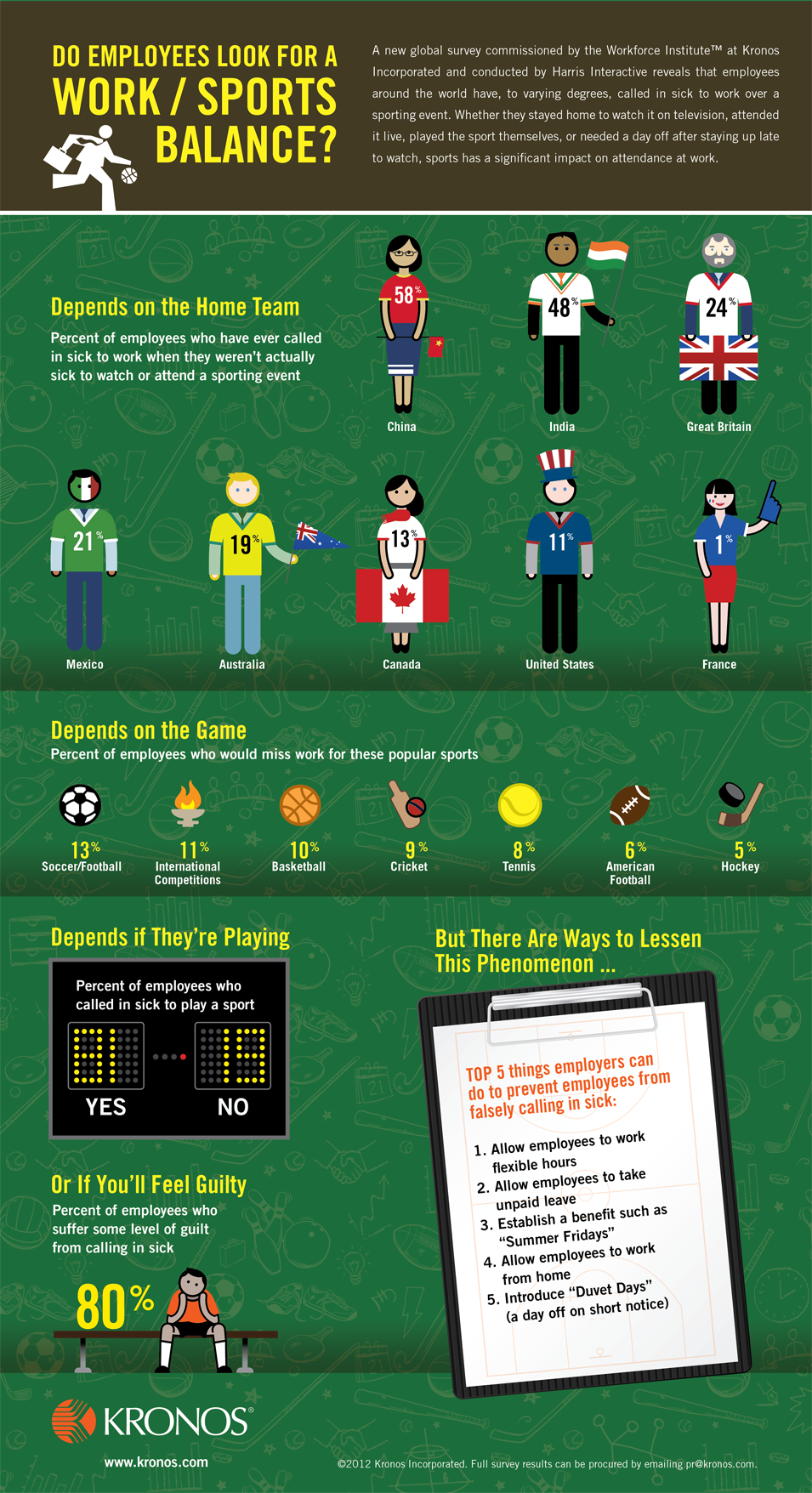
That’s why this new global study conducted by Harris Associates for The Workforce Institute at Kronos Incorporated doesn’t come as a huge surprise: it found that “employees around the world have, to varying degrees, called in sick to work over a sporting event.”
The Kronos “Sidelined by Sports” survey talked to workers in Australia, Canada, China, France, India, Mexico, the United Kingdom, and the U.S.A. Here’s the highlights of what they found:
Kronos also noted that unscheduled absences – such as when an employee calls in sick at the last minute – cost organizations 8.7 percent of payroll each year, as they found in a recent Kronos survey conducted by Mercer. That alone should give organizations that don’t offer flexible schedules a good reason to re-evaluate their thinking.
“Unscheduled absences cost organizations 8.7 percent of payroll each year – that’s a significant dollar figure,” said Joyce Maroney, director of The Workforce Institute at Kronos in a press release. “This survey indicates that sporting events of all kinds can be a trigger for unscheduled absences. Managers would do well to speak with employees when they know there is a big sporting event coming up to try to determine who is likely to be out. Planned absences cost organizations less because alternatives can be put in place at a less-than-premium price.”
The “Sidelined by Sports” survey was conducted online within the U.S. by Harris Interactive on behalf of Kronos from April 10-12, 2012 among 2,145 adults ages 18 and older, of whom 1,189 are employed full/part time. This online survey is not based on a probability sample and therefore no estimate of theoretical sampling error can be calculated.
Globally, the study was conducted online by Harris Interactive on behalf of Kronos among a total of 7,302 adults aged 16-64 (5,793 of whom are employed full/part time) within Australia, Canada, China, France, Great Britain, India, and Mexico from April 11-17, 2012 via its Global Omnibus product. Figures for age, sex, education, region, income, and Internet usage were weighted where necessary to bring them into line with their actual proportions in the population.
Employees shouldn’t be forced to fib or lie to get time off, for whatever reason. If your workforce policies are driving workers to have to call in “sick” to watch a game or do something else, well, you need to take a good, long look at those policies and do something to fix them before your people decide to simply go find another place to work that is a little more forward thinking.