Are there women in tech?
Yes, but the truth is, not many. Certainly nowhere near their proportion to women in the workforce.
Women are barely a quarter of the IT professionals, yet they account for half the civilian workforce. Women earn 60 percent of the bachelor’s degrees, but fewer than 20 percent earn a degree in computer science. Back 25 years ago, 37 percent of the computer science degrees went to women.
In some specialties — cyber security, for one — men outnumber women 9 to 1.
Women are filling more new tech job
There’s no shortage of studies and theories to explain the imbalance. Everything from cultural influences to lack of role models, peer pressure, and even parental disapproval have been cited as contributing causes.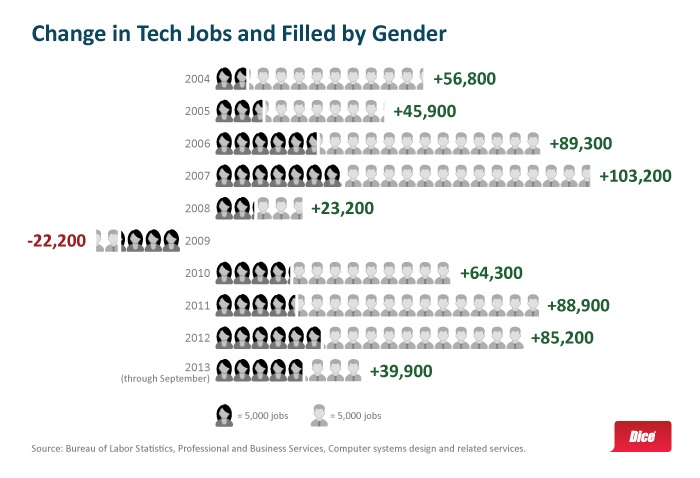
Lyla Perrodin, CIO of MRIGlobal,who was lucky enough to be encouraged by a high school teacher to enter the field, says:
Young females can encounter social pressure not to excel in math and science. They lack female role models to show them that you can be a “techie” and still be “cool.”
Recruiting technology professionals of any sex is hard enough; recruiting women engineers, as the numbers demonstrate, is so much harder still.
Still, there is some light, though no one says it’s anywhere near the end of the tunnel. Dice, the tech career site, analyzed tech hiring data and found that through September 2013, women filled 24,100 of the 39,900 new tech jobs.
“Companies have been focusing on getting more women into technology for a long time,” said Shravan Goli, Dice president of Dice. “Those efforts appear to be paying off.”
Recruiters need to be more aggressive
True enough. In the decade covered by the Dice study the number of women techies finding jobs each year has more than doubled. However, the number hasn’t changed appreciably since 2010. In 2012, about 30,000 women were hired into tech jobs. Men, though, got the other 55,000 positions.
To create a more diverse tech workforce, recruiters have to be more aggressive in both sourcing and selling, says Sarah Allen, CEO of Blazing Cloud, a software development firm.
“If you’re interviewing people for your job, and you haven’t interviewed a woman, don’t hire until you’ve at least interviewed one woman. And if your recruiter can’t get you resumes that are diverse, find another recruiter,” she told an NPR interviewer.
Her advice is not as harsh as it might seem. Wanted Technologies took a look at the computer science gender gap finding that the percentage of women possessing the most in-demand tech skills is on a par — or nearly so — with the percentage of men. Numerically, there are far more men than women; 80 men and 3 women for every tech job opening, says Wanted.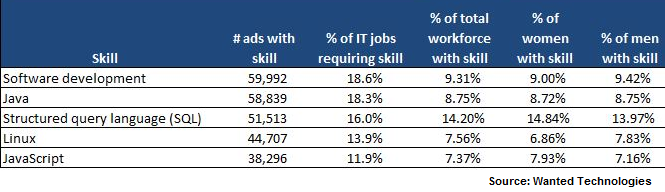
Against those numbers, arts and crafts marketplace Etsy decided that training junior women made more sense, especially if it wanted to attract senior women coders. So the company partnered with Yammer and 37Signals to offer scholarships to a three-month long Hacker School summer session in 2012.
Etsy hired six women from the class, which, in turn, cause other women to take notice of the Etsy culture shift. Now, Etsy has 20 women, a 500 percent increase from before the school. Better, but with 130 engineers, the imbalance is still there.
Where to look for female tech talent
It should be obvious by now that creating a more balanced engineering and tech workforce is not only difficult, but requires a commitment to the long-term. Training, mentoring, and relationship building are critical to supplement recruiting efforts.
Here are some places to look and organizations that can help:
- The Society of Women Engineers: The organization has sections and local groups in most parts of the country, with many of them based on college campuses with engineering programs. The society also has an active job board.
- Black Girls Code: As the name makes obvious, this is a site for black, female future coders. It’s intended to nurture young girls interested in a career in computer science. It is not a place where you will fill your job req, today.
- Rails Girls: This international organization focuses on organizing teaching workshops for women coders with a special, but not totally exclusive, focus on Ruby on Rails. The next U.S. workshop is in February in Houston.
- Grace Hopper Celebration of Women in Computing: Organized by the Anita Borg Institute, this annual conference is reputedly the largest gathering of women engineers in the world. The Institute is a digital community for women in computing with multiple networks and its own career site.
- GirlGeeks: Primarily a job board, but some additional features.
- Webgrrls International: An online and offline networking organization that’s not exclusive to tech women, but counts a number of technologists among its membership. It has local chapters, some more active than others.
America’s tech schools are also looking to increase their enrollment of women in computer science courses. Some 20 universities are participating in the National Center for Women and Information Technology’s Pacesetters program, which gives special help to women tech students.
Though little more than two years old, the program has already added 1,600 female recruits to tech programs.