Advertisement
Unemployment Is a Problem, But Youth Unemployment Is a Crisis

Get articles like this
in your inbox
The longest running and most trusted source of information serving talent acquisition professionals.
Advertisement
You probably know a good kid like this.
Graduating from high school in June. From an OK high school. Not the best student. Probably not able to get in to college – even if they could afford it and were motivated to try.
They had a part-time job a couple of years ago, but got laid off. Haven’t really looked for a job since then. No real skills that employers can use. No idea how to look for a job. Starting to think about the future. No idea where to start.
Guess what? Their prospects are not good. And they need help.
You know we have an unemployment problem. Did you know we have a youth unemployment problem?
Employers of every size in every sector lament the lack of skills available to them in the talent pool. Whether you’re reading reports from McKinsey, the Georgetown University Center on Education and the Workforce, or countless other research organizations, the message is all too similar: our post-secondary education system isn’t delivering enough degreed individuals to meet the demands of employers world-wide.
And it’s only going to get worse, something I’ve written about here, here and here.
But it isn’t just the post-secondary education system. The secondary system is doing even worse.
The youth labor market has collapsed since 2000. The rate of overall youth employment in the teen population has fallen from 45 percent in 2000 to 26 percent in 2012 – a 42 percent drop, to the lowest point in post-World War II history. In 1989 the youth employment rate was 48.5 percent.
Here are some sobering statistics from research completed in 20120 by The Center for Labor Market Studies at Northeastern University for Jobs for America’s Graduates:
And these are high school graduates. In the U.S., the percentage of high school graduates by state ranges from 62 percent (Nevada) to 88 percent (Iowa), with an overall average of 78 percent. What about the 22 percent of young people who drop out of high school? What are their prospects?
From a historical perspective, this chart shows the economic impact of dropping out of high school. But that lifetime earning amount of $1,198,447 will surely decline as fewer young people with – or without – high school degrees gain full-time employment.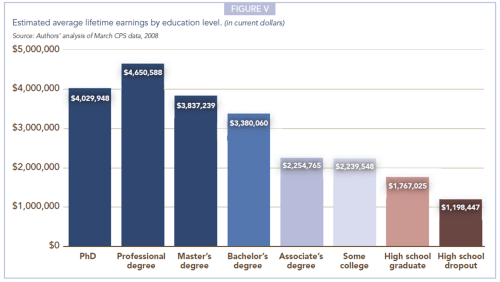
And this is a problem. If unemployment in the teen population continues to rise, then a key argument to stay in high school to graduation begins to fade, further impacting college graduation rates.
If unemployment in the teen population continues to rise, then key employment skills building experience will decline making employment less likely as they age in to their 20’s. If unemployment in the teen population continues to rise, then a whole host of societal challenges will grow – and none of them positive for people or the economy.
Involvement in organizations like JAG* (Jobs for America’s Graduates) can help. I’ve written about JAG here and here (and full disclosure — I serve on JAG’s national board of directors). It’s the longest-lived, most successful program in the U.S. that keeps the most at-risk kids in school through graduation and then stays with them through their first year of employment, college or military service.
And it is making a difference in the graduation and employment rates of kids in 33 states. Here are some current outcomes:
It’s hard to argue with success. It’s even harder to argue with 32 years of consistent success. This video really captures the effectiveness of this approach:
Employers that hire skills that require high school graduation need to be concerned about the entire talent pipeline, not just the college-degreed pipeline.
And by concerned, I mean involved in keeping young people in school until they graduate so that they are employable.
And by involved, I mean supporting programs like JAG that are focused on providing real, sustainable results.
And by support I mean financial support, political influence support and the promise to provide job interviews to every JAG student where they have a presence. (Archer Daniels Midland has done just that!)
You know we have an unemployment problem. Did you know we have a youth unemployment problem?
This originally appeared on China Gorman’s blog at ChinaGorman.com.