Advertisement
Top Organizations Do Pay Differently From Everyone Else


Get articles like this
in your inbox
The longest running and most trusted source of information serving talent acquisition professionals.
Advertisement
In the latest “Compensation Best Practices Report,” which gathered responses from 7,100 respondents on their pay practices, PayScale – the company where I work – took a look at what really sets top performers apart.
In this report, top-performing organizations were defined as those who are number one in their industry and which also met or exceeded their revenue goals in 2017.
What PayScale found is that compared to typical organizations, top-performing organizations often make different decisions about compensation, culture and pay brand. We identified four sets of behaviors that set top performers apart:
Top-performing organizations tend to consider pay to be an ongoing dialogue with employees, not an annual event that comes and goes. In the survey, top-performing organizations reported doing these things more frequently:
Top-performing organizations are also more likely to connect the dots between compensation and culture. They recognize that the way they pay, including how much and why, matters to their potential employees and current employees.
They start by being intentional about how they spend their compensation budgets: top-performing companies are more likely to have a formal compensation strategy (46% vs. 35% of typical). In practice, this means they:
Top-performing organizations are more likely to trust their managers to have difficult pay conversations with employees.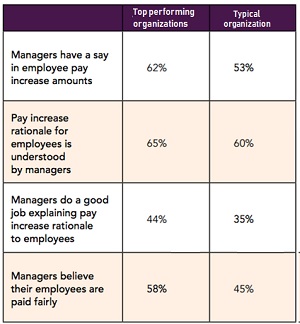
In fact, 67% of top-performing organizations are either confident or very confident in their managers’ abilities to have tough conversations about pay (vs. 57% of typical). They are also more likely to train managers to talk about pay (36% vs. 27% of typical).
Finally, top-performers are more likely to report that their managers have a say on pay for their direct reports, understand the pay increases approved for their direct reports, can explain the rationale behind increases and believe their direct reports are paid fairly. In short, they give their managers credit for knowing both how comp decisions are made and how to communicate comp across their organization.
For more on manager involvement in pay decisions, see “What If Managers Didn’t Make Comp Decisions?”
Top-performing organizations get a pulse on employee engagement much more frequently. 24% use ongoing or real-time surveys to measure employee engagement, vs. 16% of typical organizations. What’s more, they actually pay attention to results: 32% of top-performing companies have changed their pay strategy as a result of employee feedback (vs. 26% of typical).
Find out why your compensation strategy has the power to make or break your business this year. Download the full Compensation Best Practices Report here.