Advertisement
The Win-Win When Companies Start Leveraging Baby Boomers
Get articles like this
in your inbox
The longest running and most trusted source of information serving talent acquisition professionals.
Advertisement
Related Articles
I’m a Baby Boomer, born smack-dab in the middle of my generation. And I’m beginning to concretely think about the answers to questions like:
Just as I wrestle with these questions, organizations are facing stiff headwinds on the talent pipeline front making workers like me critical components in workforce planning activities. We all know that workforce demographics are changing rapidly and many organizations are flummoxed when they try to get a picture of how to respond to this critical talent dynamic.
Say what we will about the criticality of Millennial employees, many organizations are starting to pay equal attention to retaining the backbones of their organizations: Baby Boomers.
A terrific source of practical and actionable research based information is the SHRM Foundation’s recently published Effective Practice Guideline: The Aging Workforce: Leveraging the Talents of Mature Employees. As with all the reports in this series, it takes a rigorous approach to discovering what the research says and what organizations are actually doing in the topic area.
If you haven’t discovered the SHRM Foundation’s EPGs, you’ll thank me after you download and read this free report. Not just because the data is useful and the examples practical, but because it is written for practitioners, not academics, and is super easy to consume.
Here’s a quote from The Aging Workforce:
Mature workers will be a firm’s largest source of talent in the next two decades. There will not be enough younger workers for all the positions an organization needs to fill, particularly those requiring advanced manufacturing skills or advanced education in science, technology engineering and math.”
We all know this — the real question is what do we do about it?
This report lays out a roadmap for data gathering within your organization, a planning outline, successful examples from other organizations, and strategies for moving your plan forward.
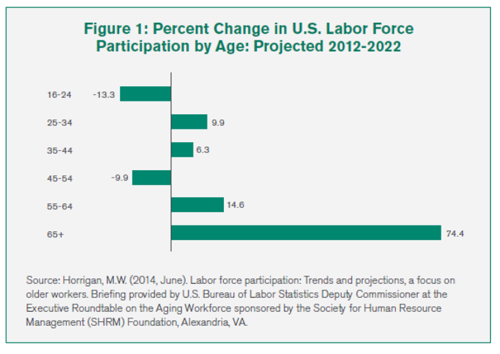
This chart lays out the challenge well. What follows is a trove of information about mature workers — what they want, what they can do, and the inordinate benefits of keeping them engaged in the workforce.
Here are several benefits outlined in the report: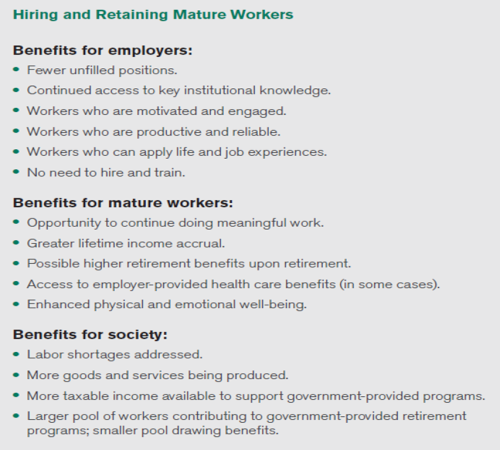
The real meat of the report are the 15 strategies for engaging and retaining mature workers that are based on both research and real organization practice. There are mini-case studies from 30 employers sprinkled throughout the strategies that share effective practices.
Perhaps the most impactful sentence in the entire report is in the introduction to the 15 strategies:
The best way to engage and retain workers of any age is to provide a strong vision at the executive level, fair compensation and competent, respectful supervisors.”
While the focus is clearly on the acquisition and retention of mature workers, every age demographic benefits from these strategies.
These strategies for engaging and retaining mature workers include:
It’s obvious that none of these strategies are rocket science. In fact, as you look at the list you might think, “well, these are just common sense practices that will support the engagement and retention of ALL of our workers.”
And that’s the point. We can’t focus our workforce planning activities on one generation alone. And ensuring that we Baby Boomers remain engaged and valued will make the demographic transition that is looming just over the horizon more effectively managed for organizations, for workers and their families, and for society.
I call that a win-win!
This originally appeared on China Gorman’s blog at ChinaGorman.com.