The conversations that I usually have with people in talent acquisition about careers and the future of work have centered on the impact of AI and robotics. They go something like this: “If AI capabilities continue to grow at the current pace, they will inevitably be able to do the work currently done by employees. What kind of work will humans do in the future?”
But what if the next big change that will impact the workforce is less about AI and more about demographics?
Yesterday, John Sumser published an excellent primer on the demographic and economic forces pushing the U.S. toward a smaller labor pool.
The current challenges in the employment marketplace can make labor shortages seem like a ridiculous notion. Employers today are cutting recruiting teams, delaying requisitions, and receiving hundreds of applications for individual jobs. But many of those conditions are cyclical. The demographic forces reshaping the U.S. workforce are structural, and they are moving in the opposite direction.
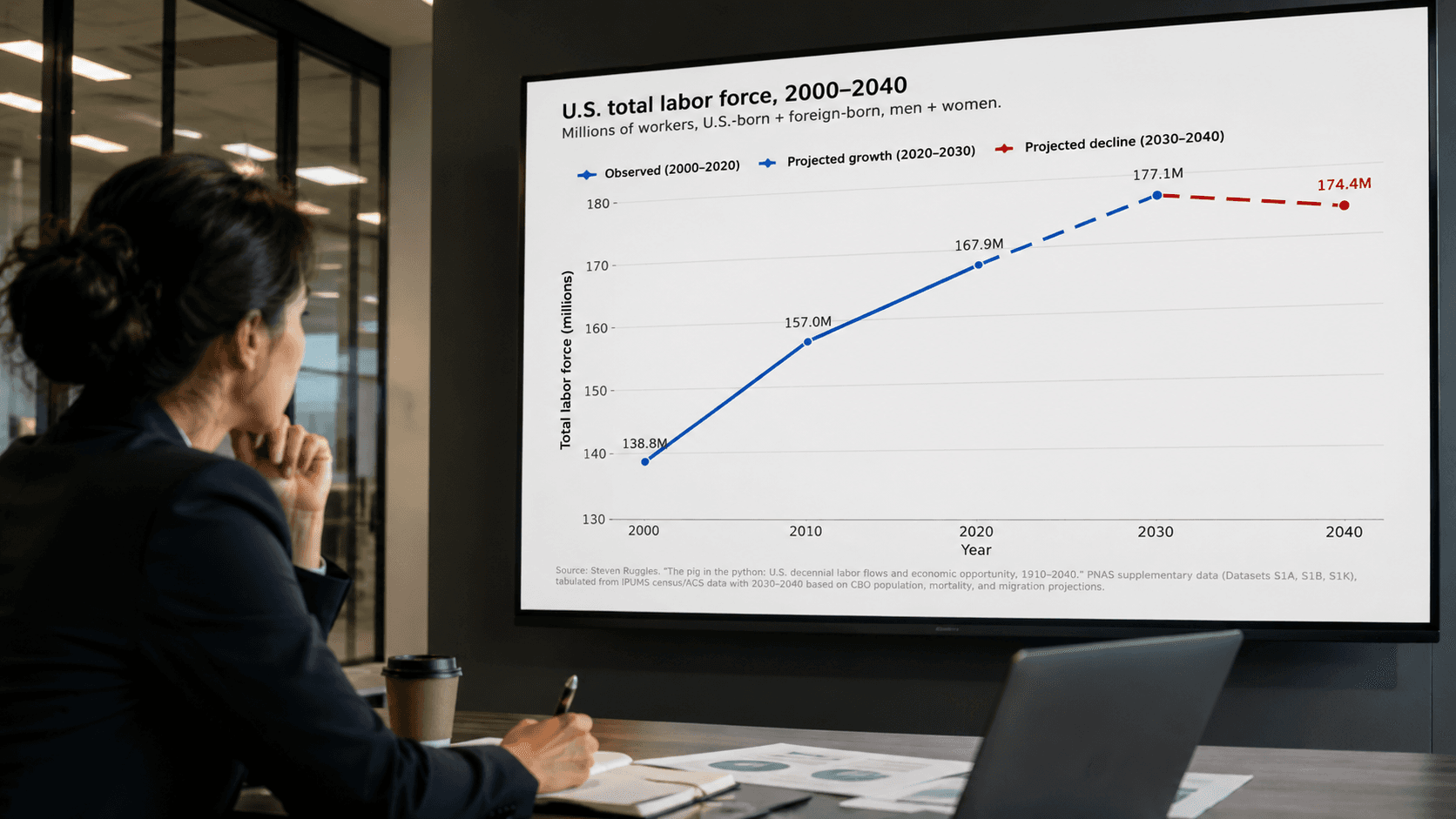
Simply put, the United States is producing fewer future workers. The U.S. fertility rate fell to approximately 1.6 children per woman in 2024, a record low. At the same time, millions of baby boomers are reaching retirement age, leaving fewer workers behind to replace them.
Demographer Steven Ruggles projects that the U.S.-born labor force will shrink by 2.7 million people in the decade following 2030. From that point forward, labor force growth will depend on immigration, and a recent analysis found that net immigration in 2025 was actually negative for the first time in a half century.

One of the basic assumptions underlying the entire hiring ecosystem in the U.S. is an ever-growing workforce. In the last half century, we’ve seen baby boomers enter the workforce in enormous numbers, women’s participation increase dramatically, and immigration add millions of workers.
If the forecasts are correct, that’s all about to change.
Japan offers a possible window into what a transition to a shrinking population and workforce could look like.
Between 1995 and 2024, Japan’s population aged 15 to 64 shrank by approximately 15%, from 86.9 million to 73.7 million. Over the same period, total employment increased by 5%, as higher participation among women and older people more than offset the demographic decline.

The Japanese experience suggests that the early phase of demographic decline is not necessarily characterized by mass unemployment. It is more likely to be characterized by an intense effort to employ a greater percentage of the available population, followed by increasingly persistent labor shortages as that reserve is exhausted.
Talent acquisition cannot manufacture additional people. It can, however, help employers stop unnecessarily excluding the people who are already available. That means reevaluating degree requirements, experience thresholds, location restrictions, scheduling practices, and lengthy hiring processes.
Employers will also have to become more serious about talent pools they have traditionally described as “alternative,” such as older workers, people with disabilities, caregivers returning to employment, veterans, people with criminal records, immigrants, workers without college degrees, and candidates seeking reduced or flexible schedules.
That brings us back to AI. In a few years, we may not view AI as a simple substitute for labor, but as an essential tool for adapting to a world where our population is no longer growing.