Advertisement
The Titleless Leader: They Understand That We’re Better Together
Get articles like this
in your inbox
The longest running and most trusted source of information serving talent acquisition professionals.
Advertisement
Related Articles
By Nan S. Russell
“If you want to go quickly, go alone. If you want to go far, go together.”? ~ African proverb
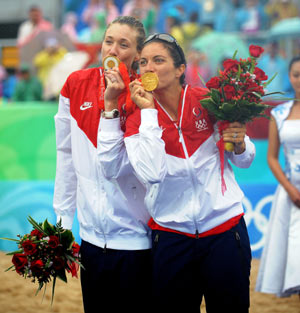
During the Beijing Olympics, beach volleyball players Misty May-Treanor and Kerri Walsh were undefeated in their second gold medal Olympics, with an amazing record of 108 consecutive wins.
Watching the advancing duo during the Olympic coverage, I heard commentators mention that when either woman was asked during individual interviews which one was better, they responded, “We’re better together.”
That contrasts sharply with end-zone-prancing receivers, ego-encrusted celebrities, and I-did-it-myself executives, whose look-at-me antics communicate the belief that their success has nothing to do with their teammates’ skill, coaches’ mentoring, or staffs’ support. That behavior alerts coworkers, teammates, or followers their talents, ideas, and collaborative spirit are not wanted here.
I’m sure you know people like this. They take credit for a group’s success, brag about a promotion as if they worked in isolation, or claim the idea or results as if a sole-proprietor. These people hoard information, steal the spotlight, and play a one-winner game.
While they view success as purely their doing, any failures belong to bad trainers, poor bosses, incompetent coworkers, or terrible workplaces. They blame others, shirk accountability, and offer excuses for missed results.
But, titleless leaders see it differently. They see the collective talent, the team effort, the individual contributions in each success. They understand without the person who can sell the idea, or those who can execute it on the team, the idea flops like a burned pancake.
They know without the relationship-wizard who can maneuver silos and bureaucracy to get the purchase order signed or the work order elevated, wishing and hoping persists until the clock runs out. And they’re well aware without someone to plan, strategize, and analyze issues, the focus dissipates like a shaken soda.
Yet, being better together requires more than knowing you need different people to bring and apply their magic to the team, project, or task. No matter their role, titleless leaders operate with basics that enable others to do what they do best. That’s what you’ll find in this chapter.
Uncommon leaders getting results without title are like my toddler granddaughter playing with her shape-sorter. She understands there’s a unique shape for each opening, and they do, too.
Some of us are the trainers, not the players, the techies not the promoters, the teachers not the students, the visionaries not the tactical implementers. Some of us are the cheerleaders, supporters, and encouragers that foster others’ success. Some of us are the stars and some of us are the supporting casts that enable stars to shine.
As motherhood and apple pie as that sounds, not everyone agrees in theory or in practice. Creative people often value the idea more than the execution.
Those who are technical might view analytical thinking higher or harder than relationship building. But, doesn’t it depend on what you’re trying to do and why? People who work in disciplines often referred to as the “hard-side” — finance, IT, product development, research, engineering, operations — tend to think that those on the “soft-side” — human resources, customer support, communication, sales, administration — have easier jobs, and vice versa.
But the reality is, we typically value higher what we know or do, and undervalue what we don’t.
Whatever is easy for us is easy for us. As bestselling author and columnist Harvey MacKay tweeted, “The only things that are truly work are the things we don’t do well.” That thinking is the foundation for a better together approach — help people excel at what they naturally do well, and work with people who do well what you don’t.
Who wants to work with, around, or for someone who uses their talents, brings out the best in them, helps others shine, inspires interesting challenges, and an engaged synergy? I’ll go out on a limb and say most of us.
Titleless leaders recognize, build upon, and engage self-strengths and the strengths of others, to achieve exceptional results. They get together people who complement each other’s skills, build teams that embrace differences, and ignite thinking that celebrates new perspectives.
This isn’t done because there’s an organizational directive or program, but because they have an inherent belief in the power of individuality adding value to the whole. Gallup’s work with over 1 million teams found the best performing ones had strengths in four domains: executing, influencing, relationship building, and strategic thinking.
Yet the practical reality is you may not be able to bring people together who compliment each other’s skills, or build a team from scratch. You might join an existing group already working on a project, or someone might assign you one, what then?
No matter how you come to the work or the people involved with it, those who get results recognize the same three nots apply:
Understanding that each person brings different talents and unique abilities to the workplace is common sense.
Reprinted, with permission of the publisher, from THE TITLELESS LEADER — How to Get Things Done When You’re Not in Charge, copyright 2012 Nan S. Russell. Published by Career Press, Pompton Plains, NJ. 800-227-3371. All rights reserved.