Advertisement
The Search for The Best Interviewer

Get articles like this
in your inbox
The longest running and most trusted source of information serving talent acquisition professionals.
Advertisement
Related Articles
I once did a study to measure the commercial impact of poor candidate experience in a large subscription based telco business called Virgin Media. You might have heard about it?
That work, almost four years ago, helped me engage a business behind a recruitment function to drive significant improvements for candidates, hiring managers, and employer brand reputation. It also helped get the investment needed to change our candidate experience and become exceptionally proficient at recruiting great people.
Applying the same method and maths here at BT — an organization seven times larger in employee numbers, three times larger in hiring requirements, and double the application numbers (250,000 per year), by my calculations — the potential cost of poor candidate experience is in the region of £10.7m.
This is the second time I’ve quantified the business case for improving candidate experience. To be honest, it’s not particularly difficult. I wonder why more talent leaders working with consumer brands don’t take advantage of this sure-fire way to capture the attention of business leaders to gain attention, support, and investment for change.
So what do you do once you have the backing of the business to make any necessary improvements?
With my agency partners, Ph.Creative, it’s the second time we’ve mapped and designed a radically improved candidate experience that’s set to make transformational impact.
Together, we believe it’s important to focus on understanding and mastering these three principle areas to create a brand experience that every part of the business can not only be proud of, but can benefit from too.
Quite often your brand experience with a candidate starts long before you realize it, and certainly long before it’s under your complete control. A candidate can research a brand for up to six hours before deciding to make their presence known to you by touching an application or a call to action on a job advertisement.
ZMOT, first coined by Google, meaning the Zero Moment of Truth, is a term to describe the period of time between (a candidate) being stimulated toward a brand and the first “moment of truth.”
How your brand is represented on social media, review sites such as Glassdoor, social media,, friends’ opinions, your career website, and even the general press is essential to convincing your potential candidate to get serious about applying for a job or not.
People shop for jobs these days. They don’t simply apply and hope. We need to accept the fact that they hold at least 50 percent of the power during the entire process — every touchpoint counts, but convincing someone to take the first step is the toughest because you have the least control over what they see, unless you work hard to influence your brand perception and the first impression you create online.
Ph. also talks about designing the “moments between the moments” — looking at how you can influence what a candidate thinks and feels, even when you’re not there. What’s the lasting impression, the sentiment, and the memorable message and feeling you create?
From the first time your candidate sees your brand and is drawn toward you, how do you design a consistent brand experience that conveys the position you wish to create, even in times of off line contemplation? Your brand must resonate and convince that candidate to take the next step.
After that first decision is made, your application process mustn’t let you down by asking for too much information, taking too long, or putting the internal process ahead of the experience of the candidate. The brand experience must remain consistently high throughout. I’ve seen too many brands create exceptional attraction campaigns, which lead to “train wreck” application forms that see numbers drop off a cliff.
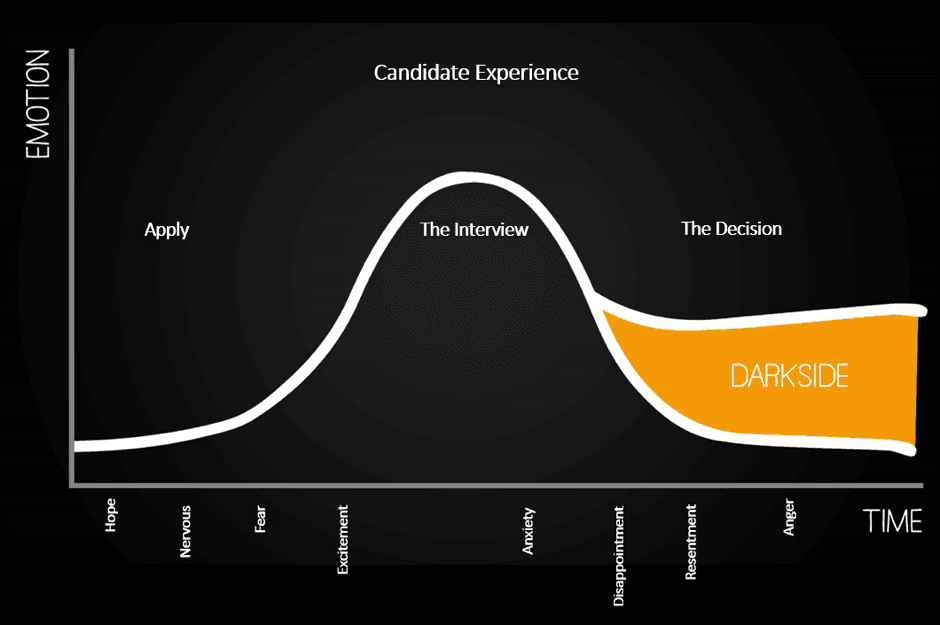
Think about how you can surprise and delight the candidate when least expected. How can you demonstrate real empathy and consideration when it matters? (see image above about time and emotion)
The experience we provide people when they attend an interview lives long in their memory. It is an emotional, life-changing event, and arguably the most critical employer brand impacting moment of all. The way we conduct ourselves, the level of care, attention to detail, level of respect, understanding, manners, and skill we apply when interviewing will make or break our reputation.
So here at BT, after reviewing the NPS insights, and hearing various anecdotes of interview experiences that made me cringe, I decide to isolate the interview experience as an area for immediate focus, mastery, and improvement.
Three ways:
“The search for the Best Interviewer is on!” — Gavin Patterson, CEO, BT
We’ll announce our best interviewers at the end of the year. We have something special planned when we find them. I’ll reveal the results at the ERE conference in the Spring in San Diego.