Advertisement
A Look at the Big Picture of the Future of Work



Get articles like this
in your inbox
The longest running and most trusted source of information serving talent acquisition professionals.
Advertisement
Related Articles
Maybe in your particular vision of the future of work, you imagine factories full of robots, automating commonplace tasks, while human beings orchestrate the work’s ultimate goals and intent. Perhaps you think of the working population’s shifting demographics, with the workforce growing older in developed nations, while emerging economies struggle to assimilate record numbers of young workers. Or you may envision a globalizing economy in which most individuals work for themselves, lending their labor – physical or intellectual, online or in person – to a variety of employers on their time and terms.
The future of work could involve all of these scenarios and more, as disparate forces act and interact to drive the way we behave in the pursuit of a comfortable living, a reasonable profit and a stable and just society.
It’s a big subject and small wonder that pundits in the business and popular press have tended to narrow their focus, studying one or another of the dimensions of the future of work: automation, demographics, the growth of the contingent workforce, or something entirely different. While the narrowing of scope is understandable, the result is that we sometimes lose sight of the connections and inter-dependencies across all these dimensions. We can’t grasp where we are and where we’re headed without seeing the full picture of this transformation in our lives, our businesses, and our society – and we can’t see the whole thing unless we zoom out and let all the elements come in to view.
The outlines of the picture are already emerging. Indeed, it may be misleading to explore all this under the heading of “the future of work” which suggests that the changes are not yet here, and will occur in an indeterminate number of years. The truth is that many of these changes are already playing out. Driven by forces that have been underway for decades. As a science-fiction novelist William Gibson reminded us, “The future is already here — it’s just not evenly distributed.”
The biggest challenge is understanding the future of work comes in surfacing the implications for three broad constituencies – the individual, businesses and other employers, and social and governmental institutions – and getting all three pointed in the same direction. Unless all three of these constituencies manage to align in their understanding and actions to address emerging opportunities and challenges, the road to the future of work will be bumpy at best.
Under the best of circumstances, everyone – individuals, businesses and public institutions – will find this fundamental evolution in the nature of work challenging and stressful. But if our organizational and public policy leaders understand more fully how this complex landscape is evolving, they can target their moves in ways that will help workforces around the world – and societies in general – anticipate and prepare for the coming challenges.
What are the components that collectively constitute “the future of work”? Perhaps the logical place to begin is with the forces that are driving those changes. Based on our experience and research, we have identified three forces that are shaping the nature of future work and the future workforce.
While there are other forces shaping the future of work, we believe that they are part of the broader economic landscape or integrated with the forces identified above. For example, globalization is a long term trend, which is reinforced by the technological, demographic, and ‘power of pull’ forces discussed above.
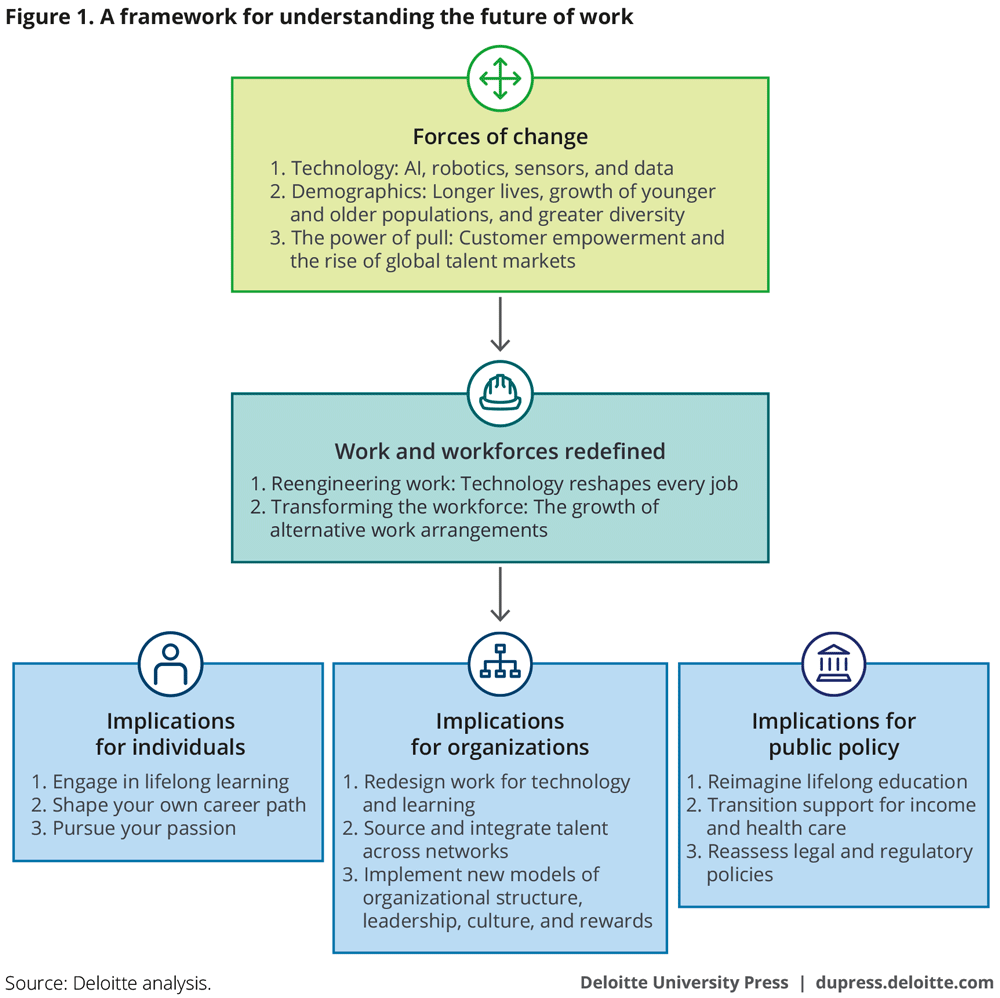
These three driving forces are having two significant effects on work and the workforce.
First, technology is transforming the nature of work and forcing organizations to redesign most jobs. One result we anticipate, will be the reconfiguration of jobs to leverage uniquely human skills: empathy, social and emotional intelligence, the ability to set context and define business problems. Another, due to the accelerating rate of technological change, will be the need for individuals to continually learn new skills to remain employable.
Second, the relationship between employer and worker is shifting. Where once most workers were full-time, on-balance-sheet employees with benefits and defined salaries, employers of the future will also execute a significant proportion of their activities through individuals engaged in alternative work arrangements, from freelancing to crowdsourcing to contract-based work.
These alterations to the nature of work and the workforce will have profound implications for individuals, organizations, and public policy makers – all three of which face imperatives for change driven by the need to adapt to the new realities of work in the future.