The function responsible for identifying, engaging, and bringing talent into an organization has lived under a variety of names over the decades, ranging from staffing to recruitment to talent acquisition to search operations to future state buzz-heavy names like talent fulfillment and career engineering. The processes and designs behind these functions exist anywhere along a spectrum of how and what and why wherein some organizations still rely on paper applications (I, too, shudder to think about it) to workplaces that have moved the candidate experience to places built on VR and gamification. While the names and the way the functions get their work done may vary, one commonality for any and all of these functions is the overarching desire to:
- Find — identify talent appropriate to the needs and wants of the organization
- Enamor — ensure that identified talent is as interested in the role as the organization is with them as a candidate
- Escalate — bring the recruitment process to a close so the organization can begin the onboarding process
- Develop — partner with HR and organizational colleagues to create an employee experience that builds on the candidate experience
In essence, the talent acquisition function FEEDs the organization’s hunger for good people. It seems like an easy enough prospect, but anyone who has sourced, recruited, or hired knows that the dish you order isn’t always the one you get served. Despite best efforts to formalize the talent acquisition process and make it as much a science as an art, not every hire ends up being the best hire. Tools like assessments, simulations, behavioral interviews, competency-based hiring, etc. all make the challenge of bringing on the best people better, but in many organizations, they feel disjointed and ad hoc. Because while the equation of Structure + Interview = Better Hiring Decisions is true, it still leaves lots of opportunities.
What if instead of relying solely piece meal approaches, we looked at A) measuring our past quality of hire — a field Lou Adler and company have cornered the thought market on; B) began measuring the quality of our hiring managers, and C) worked toward predicting quality of hire?
It’s easy to measure things we’ve already done, not so much when it comes to the decisions we’re trying to make. But what if it could be easier? What if we could link quality hiring to performance to organization fit? What if hiring practices fed performance management which in turn fed career pathing and professional development?
Stop asking “what if?” and start asking how we can do the following:
- Identify a select set of competencies (in the ballpark of five to nine) that are true to the organization’s mission, vision, and strategic imperatives
- Scale those competencies based on the types of roles the organization has and begin using them as the primary measure when considering employee performance
- Link performance to pay practices, work toward a model of recruit, retain, and reward
- Build behavioral interviews and assessments that measure a candidate’s fit with the organization’s competencies
Easier said than done, but all within the realm of reasonable and feasible when handed over to a good talent acquisition and HR team. And while these steps all get toward the idea of trying to ensure hires are good organizational fits, they don’t accomplish the blue-sky goal of predicting quality of hire — that’s where data comes in the picture. Or rather, all the data collected by going through these steps and contextualizing what the information tells you.
Using a common set of organizational competencies, understanding each organization will vary, a fairly standard five point Likert scale all linked to a behavioral interview model, and the ACDC Model, one might end up with something like:
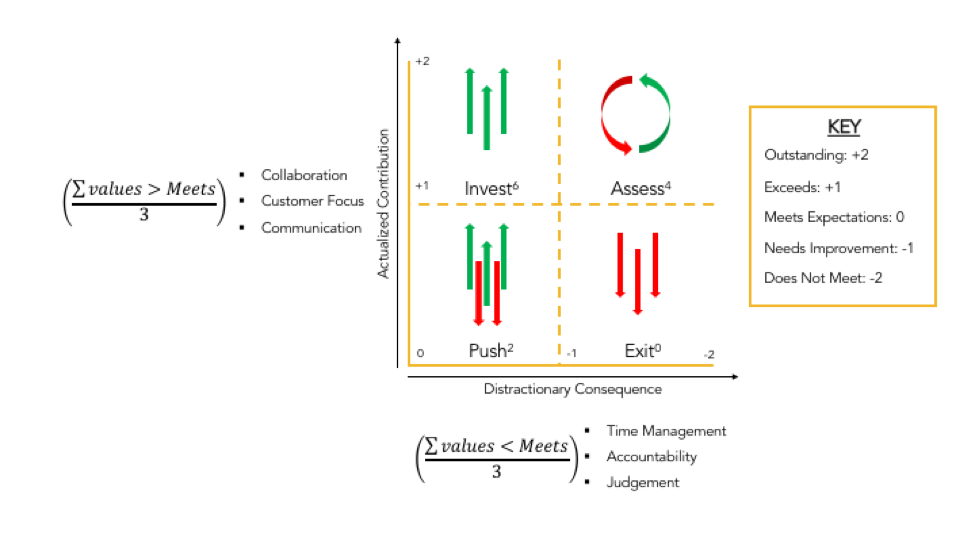
Using the ACDC approach, we can begin to measure and understand performance differently. With that new understanding, we finally have the ability to effectively begin predicting quality of hire instead of just measuring it after the fact using a simple (even for us HR and talent professionals) formula …
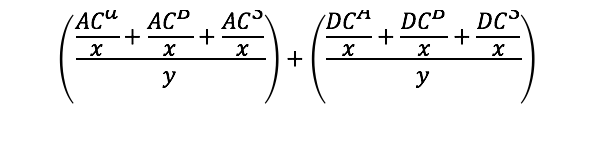
… with ACA, ACB, etc. representing each unique competency, X representing the number of questions focused on a given competency, and Y representing the number of competencies on that half of the matrix.
Interview, calculate, and plot – candidates falling into invest are ones who are a predicted good fit out of the gate, with assess candidates being ones that can move to the invest box with some strong leadership and professional development (the benefits of which can continue to be measured going forward using a similar model and approach as part of the performance assessment/conversation process). In short …
- Build + Interview + Calculate + Measure/Plot = Predictive High-Quality Hiring (PHQH)
- PHQH + Assess + Develop + Reward = Engaged, Productive Employees
- Engaged, Productive Employees = Talent ROI = Organizational ROI