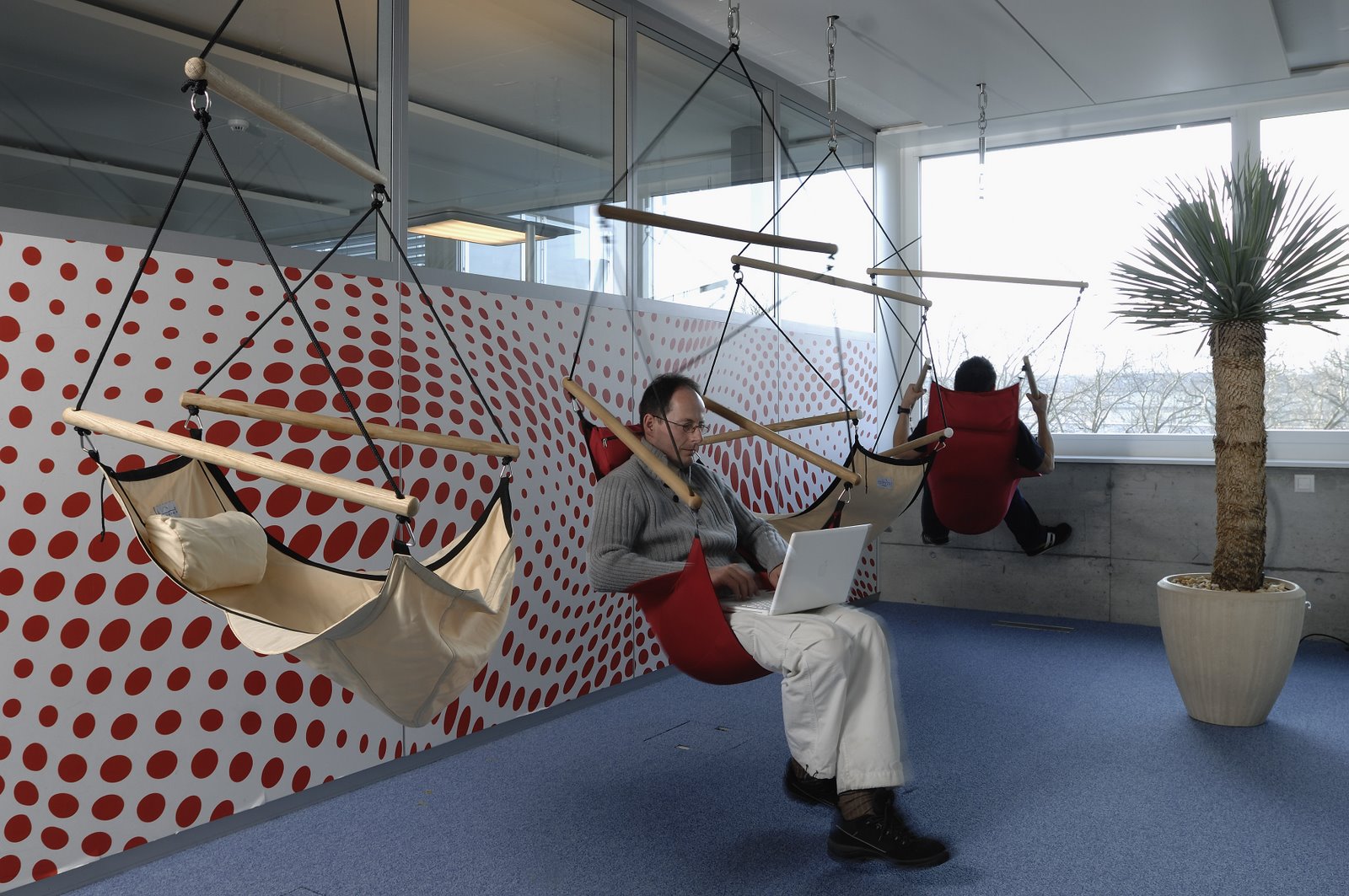
 You might think of your desk or cubicle as simply a place to do work, but forward-looking executives have found that the physical workspace has a profound impact on increasing not just productivity but also innovation. Silicon Valley didn’t invent the cubicle, but it certainly made it an integral part of not only high-tech but also business life. You may even work at a cubicle right now, but you might be surprised to know that the cubicle is dying and going the way of the fax machine and the file cabinet.
This is a gradual death, so don’t expect to see an announcement in the obituaries. The death of the cubicle began at Google and Facebook and is now spreading to numerous startups in the Bay Area. There is no need for a CSI investigation to determine the culprit, because the killer of the cubicle is the higher order need for collaboration and innovation.
If you don’t believe me, go online and look for a picture of the inside of Google or Facebook. Instead of seeing lines and lines of cubicles, you will instead see broad open spaces where people sit side-by-side with no partitions between them. And periodically you’ll see a “standing desk” where the employee literally stands all day. Obviously without partitions separating employees, there will be less privacy, more noise, and constant interruptions. And that is exactly why cubicles are dying because the increased number of interruptions builds collaboration and sharing, which in turn increases innovation, the lifeblood of Silicon Valley. As an added benefit, the open space environment also increases a sense of community.
Google Began the Slow Death of the Cubicle
I give credit to Google for starting this open space work environment concept. You might think that open spaces and simple desks are a way to save money, but cost is not part of the equation. Google is unique among all firms in that it is essentially a “math camp.” Instead of tradition or history, almost everything is guided by a mathematical algorithm. It has an algorithm for recruiting, retention, leadership, and even the ideal length of the café line. And the root cause of the death of the cubicle is their algorithm for increasing innovation, the lifeblood of Google.
Discovery + Collaboration + Fun = Innovation
For years HR and managers have tried to increase innovation using primarily hit-or-miss approaches. But Google has taken a more scientific approach where it has discovered that innovation is increased only after taking proactive steps to increase discovery (learning), collaboration (working with people from other disciplines) and fun (yes, fun in the workplace). It is the second factor, the need for enhanced collaboration, that is primarily responsible for killing the cubicle. Facebook is also a proponent of this collaboration-building open office movement, as are many other Bay Area firms that rely on innovation.
Maximizing Collaboration Open Space Environment
Imagine if you lined up simple tables (that are no more than 36 inches deep) end to end with nothing separating you from the employees next to you or in front of you. If employees spread their arms out simultaneously, they could literally touch each other. And within a stone’s throw, there is a white board where several people can stand and collaborate on ideas. And within 150 feet, there is a snack area where you can share coffee and collaborate with employees from other disciplines. Some employees even have standing desks which provide even less privacy. All of this may seem crazy, but actually it’s crazy smart. The model is similar to one used by sports teams. Players and coaches don’t sit separately and there are no partitions to reduce collaboration and sharing.
How Cubicles Kill Sharing and Collaboration
There are many reasons why cubicles are becoming dinosaurs in the Silicon Valley. Some of those reasons are listed below. Each is immediately followed with the corresponding advantages that you can expect from the open space collaboration environment.
- Partitions require walking in order to share — the partitions that make up the sides of the cubicle purposely hide a worker from view. Although this isolation does reduce distractions for a single worker, it also reduces interactions between coworkers. And when a single employee has a startling idea, they must literally get up and bob in and out of several cubicles in order to share it with their team. And unfortunately, that extra time and effort required may lead an employee to postpone the sharing of the idea until the next meeting, which in turn causes many ideas to go unshared.
- Advantages of the open space solution: in direct contrast, the table and standing desk environment offer no restrictions to the rapid simultaneous sharing of a new idea. When anyone comes up with a brainstorm idea, it can be shared verbally across tables. And if a teammate becomes obviously excited about a new idea, everyone might even be able to see it. When it is warranted, the entire team can instantly walk the short distance to the nearby standup whiteboard wall area to share the details with the team.
- Cubicles cut eye contact and they make it hard to approach — the partitions of the cubicle essentially eliminate eye contact because you sit facing away from the entrance. The depth of a cubicle itself even requires you to walk in and disturb someone who is sitting down with their back to you. Because the interrupter can’t see what they’re working on, there may be a resistance to approach and interrupt.
- Advantages of the open space solution: with a simple table and a chair (with no partitions) you can easily establish eye contact with anyone in front or next to you. In addition, you can literally approach another employee from the side with no obstructions. Some Google offices even include semicircular couches so that everyone can maintain eye contact while relaxing during team meetings. Employees at standing desks are the most approachable and thus they offer the most opportunities for collaboration. When someone approaches an employee at their standing desk, they can approach from 360°. And as an added benefit, there is no need for someone to get up from their chair to talk to you. At Facebook, more than 10% of the employees use standing desks. There are even treadmill standing desks where employees get the added benefit of exercise while working. And because the employees are already standing, it is effortless to walk a few feet to the white board wall to collaborate with others.
- Cubicles reduce energy-creating noise — cubicles are designed to reduce noise, which may seem like a good thing, but working in a quiet environment may actually reduce performance.
- Advantages of the open space solution: strange as it may sound, the right noise level may actually increase productivity and innovation. Just as bars and restaurants plan to create a certain noise level in order to create a sense of excitement, managers can have the same result. The noise of all employees working may act as a motivator to keep everyone else doing their part. But in order to get the right amount and the right kind of noise, managers can use noise filtering and canceling technologies to provide the right amount and the right kind of background noise. And if an individual needs quiet for a period of time in order to think, the simple answer is that they put on their own private music or noise canceling earphones.
- Cubicles are too small for collaborative meetings — because of the size and layout of a cubical, any amount of collaboration needs to be shifted to traditional conference rooms. These unfortunately must be scheduled in advance, and they are often in short supply.
- Advantages of the open space solution: managers in the open space environment realize that the delays involved in finding and scheduling a conference room are collaboration- and idea-killers. As a result, they have created numerous collaboration white board walls adjacent to the workspace, where a small group can leave their tables in order to get together to hash out an idea. Even when walking to the cafeteria, there are numerous alcoves where team members can stop and outline an idea immediately when it comes up. Overall, there is a conscious effort to provide an overabundance of “instant” team collaboration spaces that require no scheduling or advance preparation.
- Cubicles increase personal privacy — cubicles don’t really provide very much privacy because they have no doors or walls. However, the personal privacy that they do provide emphasizes individualism. And thus it is a collaboration killer that must be partially sacrificed for the good of the team.
- Advantages of the open space solution: although privacy may seem like a good thing to you, it is a collaboration reducer. Rapid innovation requires a complete team and community environment. Managers educate their team members about the value of collaboration and innovation. In addition, with the growth of the Internet and social media, most employees in the high-tech world have long ago reduced their concern for personal privacy. Managers at Google and Facebook for example understand that there is a periodic need for quiet team meetings, so they have provided an overabundance of team meeting rooms and quiet spaces, and Google even offers sound and light proof decompression/stress reduction chambers for individual employees. In an electronic world, even the desire to view personal pictures is not sacrificed; it is simply transferred to one’s computer files. And although plain tables provide no room for in-baskets, file cabinets, sticky notes, or cups full of pens, there is no need for them because this is a 100% paperless electronic environment.
Additional Collaboration-increasing Options
In addition to “killing the cubicle,” there are many other actions that firms are taking in order to increase collaboration. For example, offering a shuttle bus to work may seem like an expensive proposition. However, because workers in the same team don’t live close together, shuttle buses provide a valuable opportunity for workers to interact with others from many disciplines. This cross-functional interaction helps to speed up learning and best-practice sharing. And if the riders are members of an overhead function, it may help to reduce bottlenecks and roadblocks by increasing understanding and empathy. Google headquarters even has a laundromat which also helps to improve cross-functional collaboration, and the physical placement of business functions are often determined based on how walking patterns can increase collaboration between interdependent but disparate functions.
When Sun built a new office years ago, it even dramatically increased the width of the staircases so that teams would not have to break up into a single file and thus lose collaboration while walking to the cafeteria. The most outrageous implementation of the concept has to be the Google “conference bike,” where six team members can collaborate and exercise at the same time, while riding around the campus.
Enhancing Collaboration With Remote Workers
Many high-tech firms in the Bay Area offer remote work options, so efforts must be undertaken to increase collaboration with workers who do not physically come into the office on a regular basis. The most obvious solution is a widespread use of internal and external social networks to enhance collaboration and idea sharing. Firms like IBM have developed a number of tools and approaches which educate both remote and regular employees on how to increase team collaboration and innovation between each other.
Final Thoughts
HR and talent management leaders may think that I’m exaggerating about the importance of physical space in increasing productivity, sharing, collaboration. and innovation. But if they do a little research, they would rapidly adopt the idea. One study by USC showed a significant increase in productivity. Firms like Google and Facebook don’t do things on a whim; they have hard data to show that these approaches produced measurable business results.
If you’re still cynical, do some research into the value of innovation at your own firm. Once you or the CFO calculates its extremely high economic value, it’s easy to gain support for approaches for increasing the collaboration that eventually results in implemented innovation.