Gender parity is on everyone’s agenda today. Not just because it’s the right thing to do, but because it’s the smart thing to do. Companies with more women in their C-suites and on their boards are doing better, acting smarter and growing faster than those who don’t.
The question of “why gender parity?” has been asked and overwhelmingly answered. The question now on the table is: “How do we achieve it?” How does an organization attract, develop and retain female talent? In our experience at WOMEN Unlimited, Inc. working extensively with hundreds of Fortune 1000 corporations and other leading organizations, we have found that six key factors come into play.
1. Get top-management buy in
Attracting, developing and retaining female talent starts at the top because if leadership cares, everyone cares. The commitment of top management will filter down the organization only if it goes beyond words to actions. Organizations must provide guidance and guidelines on ways managers can support and develop the women on their teams. Most managers understand the bottom-line importance of attracting and developing female talent, but need help with the specifics of making it happen.
Additionally, the C-suite can show it takes gender parity seriously by holding managers accountable and using metrics to measure their progress.
Heidi Musser, a leading executive in the tech field, summed up the need for metrics: “To truly achieve parity, we need to measure and discuss diversity in a variety of ways. For example, it’s not enough to say, ‘We have increased the number of women we hired by x%.’ We need to measure at what level they are in the organization, what areas they work in, how far they’ve advanced vis-a-vis male counterparts. Until we measure, we will not be giving inclusiveness the serious attention it deserves.”
Result: Everyone in the organization takes initiatives to attract, develop and retain female talent with a new level of seriousness. It becomes a priority.
2. Assess corporate culture
In many cases today, corporate culture is rooted in what companies were like in the early 20th Century: male, hierarchical and lacking in diversity. While we have made great progress, vestiges of that ensconced culture remain. That’s why looking to achieve gender parity through a straight meritocracy approach won’t work. It doesn’t go deep enough. Men and women at all organizational levels need to gain a greater understanding of subtle, anti-inclusive attitudes which often thwart the advancement of female talent. For example:
- Managers often feel uncomfortable giving women the straightforward, career-advancing feedback they provide to the men on their teams. As a result, women often miss out on being in synch with organizational goals and understanding their role in achieving those goals.
- Corporate leaders, harboring unconscious bias, can exclude women from meetings which might allow them to showcase their knowledge and talents to advocates for their career advancement.
- Management can knowingly or unknowingly have concerns about “What if she gets pregnant after we promote her?”
According to Audrey Goodman, former Medco Health Solutions vice president of organizational development: “We can’t presume men understand gender bias. We need to teach them how to be inclusive and to help them realize what it feels like from a female perspective when a bunch of men do something together. We have to work with them so they lose their preconceived notions of what success looks like.”
Result: Old attitudes, of which both men and women are often not aware, start to fall away. Women see a company where they would like to work and one that provides an opportunity for them to rise to leadership roles.
3. Stop the mid-career bleed
Mid-career women are leaving corporations at an alarming rate. They are often tired, overworked and burned out. Their departure is creating a large and costly hole in the talent pipeline. In What Every Manager Should Know About Fostering Female Talent, executives, eager to stop the mid-career bleed, have incorporated developmental approaches that work especially well for women at the mid-career level. For example:
- Laura Mezey of Bayer Corporation encourages women to do a better job at self- promotion; reminds them that good work is not enough and pushes them to gain new experiences and insights.
- Bill Weber, formerly of DuPont, emphasizes the need to put women in direct line roles and not primarily in support roles.
- George Odegi of Colgate-Palmolive stresses the importance of understanding that mid-career level women have responsibilities BOTH in and out of the job, which present limits and possibilities.
Result: Women refocus their energies on what is important to achieve their goals. Fewer “drop out” because they gain a greater balance between their personal and professional lives.
4. Customize. No such thing as one size fits all
Attracting, developing and retaining female talent also means looking at the specifics of the organization and the women in it. Acknowledging the wants and needs of potential leaders throughout their career, benefits both women and their corporations. Tom Dybro, a senior talent development consultant cites this example: “So we wouldn’t lose a promising early career woman, we relocated her over 1000 miles away to join her soon-to-be-husband. She has worked remotely for over two years and is as brilliant as ever. In the past, this kind of accommodation was restricted to more senior-level people.”
Additionally, our experience at WOMEN Unlimited in developing female talent has shown that achieving gender parity is not an either or game. The best results happen when there is a mix of developmental initiatives including in-house and external programs as well as women-only and mixed-gender programs, all geared to the tenor of the organization and the talented women in it.
Result: Management strategies and development programs address the real-world issues women face in their specific environments. As a result, women better understand and appreciate their organization, and are increasingly motivated to contribute to its success.
5. Provide women with a ‘decoder ring’
To their detriment, women often tend to perceive the corporate landscape differently than their male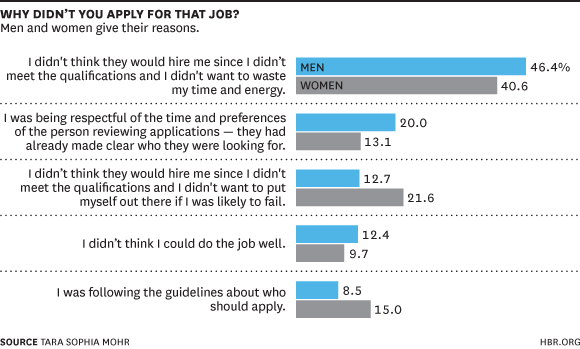 counterparts. Our research, based on thousands of women surveyed as they begin our programs, shows that women often erroneously believe hard work alone will get them ahead. They tend to be more risk-averse than their male counterparts. They often fail to step up and speak out when being noticed matters to their career advancement.
A number of proven strategies can extend women the ‘decoder ring’ they need to achieve success:
- Starting early with development programs so women can stay on the same footing with their male counterparts.
- Offering women more opportunities, formally and informally, to develop their leadership skills.
- Ensuring managers are committed to fostering and supporting the women who work for them.
- Providing female role models who have made it to the highest corporate levels.
Result: Women gain the tools, techniques and strategies that enable them to be on a par with their male colleagues and to feel more like a part of the success team.
6. Make relationships matter
A favorite quote of mine is: “You have to do it yourself, but you can’t do it alone.” It sums up the need for women to forge a variety of career-advancing relationships.
- Relationships with managers: In a survey of over 5,000 talented women and their managers, we found that there was a serious disconnect between how women viewed support from their managers and how the managers viewed it. Overwhelmingly, managers gave themselves significantly higher marks than did the women. These findings point to the importance of straightforward feedback and dialog between women and their managers, not just at annual reviews but regularly.
- Mentoring relationships: Women often fail to understand the importance of mentors, despite the overwhelming evidence that successful mentoring relationships are critical to career advancement. In my independent research, I found that there is a right way and a wrong way for women to develop successful mentoring relationships. Above all, women must be “intentional” in these relationships. They must actively prepare for the encounters with their mentors. They must engage the mentor in areas that are important to their career development. They must be ready and willing to apply the insights provided by their mentors to their corporate situation. Women who take this approach are significantly more likely to achieve their career goals.
- Relationships with sponsors: In over 25 years of working in the HR and development areas, I have found that there is a common misperception about the role of sponsors. Sponsors are the power people in the organization who advocate at the highest levels for those they choose to sponsor. Mentors are the advisors who help women develop the strategies, behaviors and insights to mesh their career goals with organizational ones. Mentors prepare women to understand themselves and their organizations so that sponsors will see them as valued assets to the organization. That’s why it is crucial for women to develop mentoring relationships before seeking out sponsors.
Result: Women become more adept at developing relationships that help them assess their behaviors and develop as leaders who understand and leverage their worth to their organizations.
Our boots-on-the-ground involvement with hundreds of leading organizations and their talented women has shown that companies who address these six issues have greater levels of success in attracting and retaining female talent. Additionally, as these strategies continue to result in more women reaching leadership positions, female talent at entry and mid-career levels will know there’s a place for them at the top as well.