Advertisement
Survey: 63% of Workers Not Engaged, Struggling to Cope With Work


Get articles like this
in your inbox
The longest running and most trusted source of information serving talent acquisition professionals.
Advertisement
Related Articles
Here’s another survey that should get anyone interested in employee engagement talking.
A new Global Workforce Study by global HR consultant Towers Watson found that that almost two-thirds (63 percent) of U.S. workers “are not fully engaged in their work and are struggling to cope with work situations that don’t provide sufficient support.”
Maybe you don’t find that all that much of a surprise, but the Towers Watson analysis is pretty blunt about why so many employees seem to be so disengaged:
This finding suggests employees are finding it difficult to sustain the kind of positive connection to their companies that yields consistent productivity — the result of almost a decade of pressure to do more with less and respond to the challenges of global competition, ever-evolving technology and the ongoing need for strict cost management.”
Yes, a decade or so of being told to do more with less, getting your pay cut or frozen, watching co-workers get laid off and furloughed, and hearing managers and executives say (as I once heard from my former CEO) that “you’re welcome to leave if you don’t like it,” can do that to people.
“When workers are not fully engaged, it leads to greater performance risk for employers. It makes companies more vulnerable to lower productivity, higher inefficiency, weaker customer service, and greater rates of absenteeism and turnover,” said Julie Gebauer, managing director, Talent and Rewards, at Towers Watson, in a press release about the survey.
She added: “Without attention and interventions aimed at improving on-the-job support for employees and creating a sense of attachment to the organization, this trend could worsen — and directly affect business outcomes. Companies have known for years that employee engagement is important to business performance. We’re now seeing — in part because of the tough business climate — that engagement is quite fragile and will not be sustained over time without careful attention to very specific elements in the work environment.”
What caught my eye in this study is the specific list of reasons behind “why” employees are so disengaged. The Towers Watson survey breaks out “some of the key concerns that resonate worldwide, transcending location, age, job level and gender:”
One big difference in this engagement survey is that the Global Workforce Study looks to “break new ground in understanding and measuring what contributes to sustained employee engagement in the workplace today, and demonstrates the strength of the relationship between “sustainable engagement” and specific financial outcomes for employers.”
And what exactly is sustainable engagement?
“Sustainable engagement is an important evolution in the science of workforce behavior — and it’s an approach well suited to the unique aspects of the current work environment,” said Laura Sejen, global practice leader, Rewards at Towers Watson. “It recognizes that employees need support from their employer to continue to give discretionary effort on the job, and right now, employees are telling us they’re not getting that support in the way and at a level they need.”
If sustainable engagement seems like a bit of a difficult concept to get your head around, here’s an informational graphic from Towers Watson that may help a little bit (click on it for a larger version).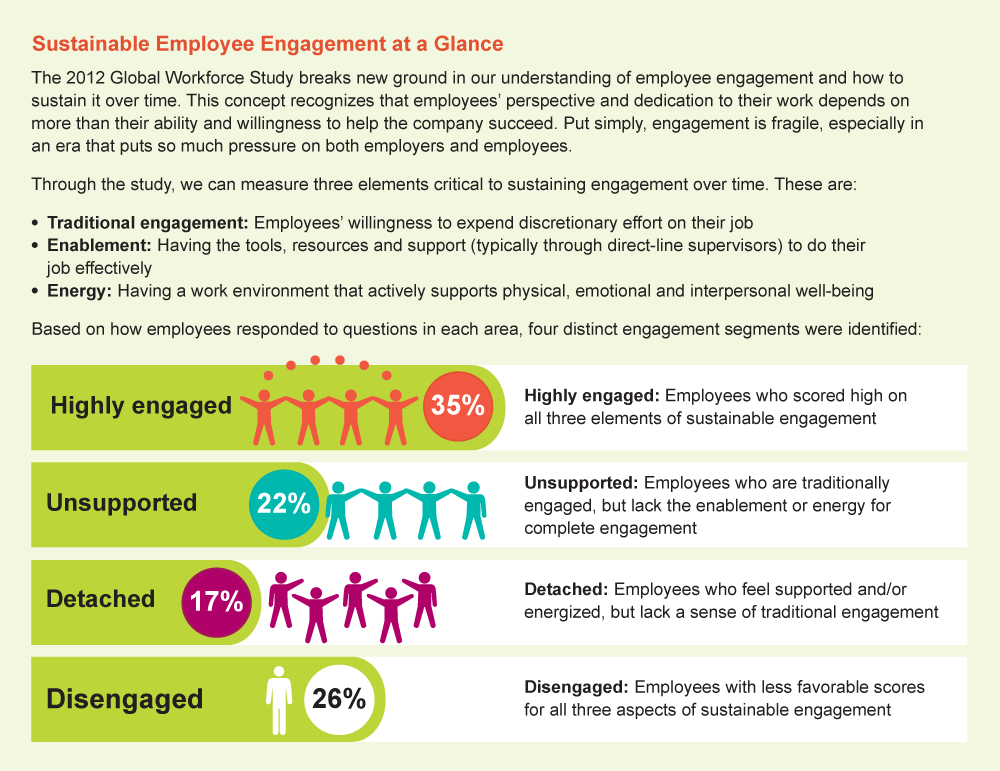
At it’s core, the Global Workforce Study focuses on three elements “that are critical to sustaining engagement in the workplace over time.”
There’s a lot more to the Global Workforce Study, and if you are interested in employee engagement, you should probably take a look and decide whether “sustainable engagement” is a concept for you and your workforce.
“This is an important wake-up call for U.S. companies if they hope to sustain their growth,” said Towers Watson’s Sejen. “When we looked at sustainable engagement scores among 50 global companies in a related piece of research and examined their one-year operating margins, we saw dramatic evidence of the impact of sustainable engagement on performance. The companies with high sustainable engagement had operating margins almost three times those of organizations with a largely disengaged workforce. That fact alone creates a compelling case for change.”
The Towers Watson Global Workforce Study “covers more than 32,000 employees selected from research panels that represent the populations of full-time employees working in large and midsize organizations across a range of industries in 29 markets around the world.” It was conducted via an online questionnaire between February and March 2012. The U.S. sample includes 3,600 employees and has a margin of error of +/- 2 percent.
The survey used “a specific set of questions to measure and classify respondents as to their level of sustainable engagement. Overall, the study showed that:
“Many companies are still operating in a traditional mode, with processes and programs designed for an era that has effectively disappeared,” Sejen said. “Employers need to consider the dramatic changes occurring in the employment relationship, and they need to address the elements creating this situation. The consequences of maintaining the status quo may be more problematic than before, given the level and pace of change.”
Other key findings from the study include:
What? Half of the workers surveyed don’t trust their organization’s leadership? I’m shocked!
Well, not really. That’s a big part of why employees are so disengaged today, isn’t it?