Advertisement
Robotics in HR: Current Trends and Impact

Get articles like this
in your inbox
The longest running and most trusted source of information serving talent acquisition professionals.
Advertisement
Related Articles
The human resources division is an integral part of any business. At its core, the HR department’s strategic role is managing employee relations, ensuring high-quality talent acquisition, and ultimately fostering high employee engagement and retention. However, their day-to-day activities are highly resource-intensive with a myriad of tasks such as payroll, benefits, hiring, offboarding and compliance management. But all this is changing as HR departments are adopting automation and robotics to streamline operations and enhance their contribution to overall business goals.
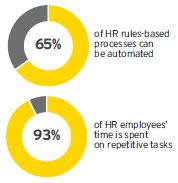 In fact, research from Ernst & Young states that about 93% of time spent by HR employees is on repetitive tasks. The same report goes on to state that 65% of HR rules-based processes have the potential to be automated. And this is where the role of automation, in particular, Robotic Process Automation, can play a big role, as it already is at EY.
The HR domain has many transactional activities which are ideally suited for robotic process automation (RPA). With RPA, organizations can automate HR tasks that are rule-based, repetitive, and standardized and as a result free-up HR employees to focus on more strategic and innovation centric functions like talent development, retention, and policy implementation.
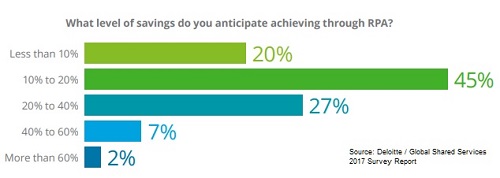
According to a Deloitte report, about 42% of the organizations participating in its Global Human Capital Trends survey reported they have fully implemented or made significant progress in adopting cognitive and AI technologies within their workforce. In another report, 45% of HR global shared services executives expressed confidence that implementing RPA will lead to 10-20% in savings to their business. In fact, this potential is so exciting that in July 2017, global IT-giant IBM partnered with Automation Anywhere (AA) to integrate AA’s RPA platform into IBM’s portfolio of digital process automation software like IBM Business Process Manager and Operational Decision Manager. This integration has now opened up opportunities for developers to create software bots that can manage repetitive and task-based work.
As RPA has evolved it has also benefited from the advancements in cognitive technologies. The implementation of cognitive automation within RPA is broadly categorized into two areas: Cognitive Engagement and Cognitive Insight functions.
Cognitive engagement RPA in HR allows for the use of intelligent agents to interact with employees with the power of natural language processing. With these advantages, they can be used to deliver mass personalization at a large scale very quickly, while also offering end-users with smarter insights. These avatars can offer users contextual recommendations such as answering queries on HR policy, managing leaves, absences and the PTO policy of an organization.
Similarly, cognitive insights help HR teams identify opportunities for growth, diversification, and efficiencies by creating large-scale organizational intelligence. With their advanced pattern detection and data analytics capabilities, cognitive insight RPAs can uncover hidden patterns and help reveal inefficiencies in the workforce through predictive analytics and talent analytics. These data insights can then be directed by human users in making strategic and tactical decisions that strengthen the overall growth trend of the organization.
The potential for RPA technologies to benefit business through the human resources division is immense. And much of this potential is well proven. The key benefits of RPA in HR departments can be summarized as follows:
However, the limits of RPA are based on the ability to translate your HR processes and make them compatible with RPA implementation. Process standardization is still a hurdle as the state of core data in many organizations is typically found to be incomplete and fragmented. Only by standardizing this data can truly sophisticated automation be unleashed and free up the energy of the HR team to contribute towards greater business challenges.