Advertisement
Recruiting From The Middle of Nowhere
Get articles like this
in your inbox
The longest running and most trusted source of information serving talent acquisition professionals.
Advertisement
Related Articles
The evolution of the internet, teleworker technology, and the current shift in workforce demographics offer employment possibilities we once only dreamed about during our daily commutes. For a growing number of companies and their employees, working remotely is the new virtual reality. This is part one of a two-part introduction to the Recruiting from the Middle of Nowhere series, which will explore and highlight virtual workforce practices.
I am one of a growing number of people who work virtually. A couple of years ago, I moved from Warwick, New York, to Columbia County, Pennsylvania. Warwick was a great place to live – a nice town about sixty-five miles northwest of NYC, but the cost of living was becoming absurd. We chose Columbia County because we drove through it often on trips to visit my parents in Ohio. As it turns out, we chose well; Columbia County was recently ranked #1 as the Best Place for Rural Living in the Northeast United States, and #5 overall in the nation(i). Beauty aside, the only real disadvantage of living here is a lack of major employers. Otherwise, we are just over three hours away from New York City, Philadelphia, Baltimore, or Washington, DC. Close enough for weekend trips, but far enough to make a daily commute impractical.
I experienced no major calamities or disasters when I first started working remotely. I knew my work and how to go about it. The biggest problem was the nagging barrier of isolation. My new manager was happy with my abilities and results, but I needed to overcome a lack of personal interaction. I was productive, but always felt I had to prove I was doing just a little bit more. That mild worry was short lived…until my satellite internet service provider began experiencing connectivity issues during its acquisition. How embarrassing to have my manager in Chicago waiting on the phone for what seems like an eternity before your screens are in synch when discussing a salient point about my additional workload! This problem was remedied soon afterwards when we moved into our new home, complete with high speed cable. I will discuss personal, technology, and other related issues in upcoming articles of Recruiting from the Middle of Nowhere soon.
A Virtual Workplace is a Viable Alternative
|
Virtual Workers Trend |
 In 1997, there were approximately 8 million people involved in some form of virtual work, according to the International Association of Virtual Organizations. The Gartner Group, a technology research firm, predicts that, in 2008, approximately 41 million employees around the world will spend at least one day a week working virtually. Nearly 100 million will work from home at least one day each month. The largest proportion of these employees will be U.S. workers(ii).
Forward-thinking companies use virtual employees of several types, with the two current prominent types coined co-located and totally virtual. Virtual employees do all their work from a home office, or somewhere other than a cube at their place of employment (even at Starbucks, for example.) Co-located employees have both a work location at their place of employment and one or more virtual location(s.)
The upside of a virtual office is that it offers the ability to focus on tasks without continual interruptions from phone calls, meetings, training classes, lunches, visitors, and other commotion associated with a typical office environment. Indeed, a number of co-located employees indicated to me that working from their home office at the beginning of a new project helps them with focus, structure, and planning momentum during the project’s initial phase. Distractions can be monumental in an office environment at times; even closing the office door, if you still have one, or draping a “Do Not Disturb” sign across the cubicle entrance doesn’t always work, and sequestering yourself in a conference room may be at odds with your company’s culture.
For me, the downside of working virtually centers on the lack of visibility and social interaction. You do not have the opportunity to participate first-hand in meetings, events, product launches, holiday celebrations, and other typical day-to-day interactions, which can put you at a real disadvantage. There are other times, however, when the office mood is not so endearing, and you can only imagine how lucky you are to have not been there. Some mention the challenges of focusing on work at home; however, a virtual worker is totally in control of handling that set of distractions, even more so than at an office where you are simply one of the employees. The key to addressing that obstacle is to set your work location apart from other home activities and to organize your time, setting aside work time and honoring your own work schedule. Look for this to be covered in greater detail in an upcoming RFMN article about the ‘Changes and Challenges’ of the virtual workplace.
Corporate experience and politics also need to be weighed when considering a virtual or co-located role. After all, when you are in-house and lead a recruitment function, having lunch with the head of finance is relatively easy, for example. Bonding, thought sharing, and visibility is easy when working in-house; not so easy if you work from 300 miles away. From that standpoint, working in-house almost always give you a distinct political advantage.
Virtual Workers Make $ense for Recruitment
Companies can profit from using virtual recruiters in several ways, and the difference can be reduced to dollars and “sense.” First, hiring ramp-up time can be greatly reduced by using virtual recruiters. Second, a virtual sourcer or recruiter can have the same impact as an agency, but at significantly lower cost per hire. In addition, the virtual sourcer acts as a direct representative of the company, producing the collateral effect of positive company branding and development of a future candidate pipeline. A virtual sourcer can develop a relationship with potential candidates for future contact in a way that doesn’t always occur when sourcing through an agency.
1. When companies hire, they must rapidly develop and implement a ramp-up strategy. Having a pool of high quality virtual recruiters is a great way to offset one of the obstacles that companies face: how to identify, qualify, interview, offer, close, and onboard employees in a quick and efficient manner.
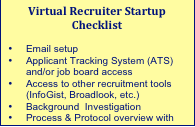 The ability of a seasoned virtual sourcer or recruiter to begin producing results rapidly helps not only to maximize the timeline associated with the search, but also to reinforce the hiring manager’s expectations that the recruiting effort is moving swiftly to meet his or her needs. Simply put, after the position has been approved, getting a virtual sourcer or recruiter started can be as simple as following the company’s protocol for onboarding a contractor; usually a security check, email setup, ATS and/or job board access, access to any other ancillary tools such as InfoGist or Broadlook, and a process and protocol overview with the supervisor. This is minimal when compared to the search-for-hire approach for a new recruiter, especially if it involves relocation. Even without the ATS, job board, or other tool access, a seasoned search professional can begin to produce tangible and effective results almost immediately.
2. Virtual recruiters can also add to the effectiveness of an in-house recruiting staff and can save companies large sums in placement fees.
i. Progressive Farmer Magazine. Best Places to Live in Rural America. March 2008. Jamie Cole. http://www.progressivefarmer.com/farmer/bestplaces/top10.html
ii. Facilities.net. February 2005. Steve Hargis and Mia Jacobsen. http://www.facilitiesnet.com/bom/article.asp?id=2562