 Dr John Sullivan and Master Burnett
The smart phone and the applications associated with it are radically changing the game for advanced, technically savvy recruiters (others need not read on unless you like shaking your head in disbelief). For those not afraid of evolution and innovation, an emerging class of “location aware” social networking applications can and are enabling recruiters to facilitate impromptu face-to-face meetings with top talent outside the structured assessment process.
Originally intended to help friends with time to kill coordinate impromptu meetings with other friends physically located nearby, services like foursquare, Facebook Places, loopt, and countless others provide savvy recruiters with an opportunity to engage face-to-face with elusive top talent often difficult to convert to an applicant or the offer-stage candidate sitting on the fence.
The scenario goes like this: while on your way to grab lunch you check out one or more of the location-based social networking apps (a.k.a. prospect locator apps) to see if any of the top talent you have been courting happens to be in the area. Within seconds, you have identified that a candidate you have been talking to for nearly a year recently checked in at a Starbucks just three blocks away. You make a beeline for that Starbucks, scanning the candidate’s recent wall posts and shooting him/her a quick instant message or text message in route. Upon arrival, you make contact, reinforcing the electronic relationship with a physical one even if the meeting lasts only minutes. You have successfully used GPS technology and social networks to provide you with an informal opportunity to recruit.
The scenario above may seem outrageous to the average recruiter, but it is clear that social networking has become an integral part of the daily lives of millions of professionals and that location-based services which extend the functionality of social networks are a welcomed innovation (as evidenced by their adoption growth rate). When added to the toolkit of a savvy recruiter, these tools can influence the outcome of hard-to-hire recruiting attempts.
Is this stalking? Yes! The idea of cyberstalking may repulse conservative recruiters, but not everyone views taking advantage of technology to facilitate conversion of online relationships to real-world relationships a bad thing. Most social networks provide tools to help users establish privacy boundaries, so using the information when visible to you to facilitate a meeting is within the expectations of the prospect.
We’re not dismissing the idea of privacy. We’re simply arguing that how people define and approach the concept of privacy has changed. Avid social network users and college students in particular often share highly personal information online including addresses, phone numbers, risqué photos, and their present location. While these users may adopt privacy settings that restrict access, they do have an expectation of total privacy. Obviously, recruiters using location-based social networking need to employ good judgment when approaching potential prospects, but that is true of making contact via any channel.
Real-time Meet-up Scenarios
Real-time meet-ups can occur under a wide variety of situations, including:
- Coordinated — an impromptu plan to meet is confirmed by phone or text/IM upon learning of a prospect’s proximity.
- Directed — no advance plan is communicated, but your actions are directed to ensure a face-to-face encounter.
- Coincidence — no advance plan is communicated and no directed actions are taken; you simply take advantage of proximity as it happens.
Each of these scenarios can play out in a 1:1 or 1:many environment.
Michael McNeal, while at Cisco in the late 1990s, pioneered using social gatherings such as wine, art, and beer festivals as recruiting events. He targeted such events because attendee demographic data demonstrated that engineers were frequently in attendance. Real-time location recruiting is really an evolution of that practice, allowing recruiters to target events and location based on real-time intelligence of a prospect;s whereabouts.
The Location Recruiting Toolkit
Hundreds of online services and smartphone apps can be used by tech savvy recruiters to facilitate real-time recruiting. While no means an exhaustive list, the following are a few to consider. (Got your own favorites? Share with others, post them in the comments sections!)
Social Networks (LinkedIn, Facebook, MySpace, Twitter, Yahoo, Google, YouTube, etc.) — Today’s leading social networks offer up a plethora of ways to garner intelligence around a prospect’s whereabouts. The leading sources include:
- Status updates — One of the most common things people post about is what they are up to and where they are doing it. Scanning a prospect’s wall or profile can lead to location trends; for example, every morning the prospect grabs coffee at Starbucks on Third. If the prospect uses geolocation apps, status updates can also be used to identify when the prospect “checks in” at a local restaurant, pub, airport, etc.
- Groups (location, local association, special interest) — LinkedIn, Facebook, MySpace and other social networks are home to numerous online groups that share discussions, and often meet in the real-world based on either a regular schedule or planned meeting. Such online groups are a phenomenal way to identify people who live in a specific area and that share an interest in a topic. For example, a pediatric nurse might join a group for PedNurses of Silicon Valley.
- Public Events Calendar (Persons Attending) — Public calendars on the major social networks are a great way to find local talent and to coordinate a face-to-face with talent you already know will be in attendance. You might be surprised how many corporate events are listed. Scanning the attendance and invite lists shows you who is local.
Public Event Calendars (meetup, zEvents, upcoming, eventful) — If you haven’t explored services such as Meetup, you really should. Some provide more user profile data than others, but almost all provide some information about the people who will be gathering. Search for domain-relevant events or people in the area with domain knowledge. Master recently joined a meetup for adult kickballers because a majority of those playing on one team were from digital media start-ups in San Francisco. Once the season started, he realized that most of the teams had numerous players from individual companies.
Online Rating Services (Yelp.com, etc.) — You might have missed it if you have been a long-time user, but many of the online rating sites have improved their social networking functionality. Yelp, for instance, now let’s reviewers “check in” and build profiles that include information on what they do for a living. While not a deep source of information, profiles can be used to identify where known prospects frequent, be alerted when they check-in, and to find possible talent.
Location Aware Mobile Applications — the newest tools to cyberstalk someone! There are literally hundreds of location-aware applications for people to find other people like them in a local area.
- Location broadcasters (foursquare, Facebook Places, Google Lattitude, etc.) — This category of tools broadcasts a user’s location to those who follow them usually via one of the larger social networks or through the service itself. The most popular is foursquare, but Facebook also recently entered the game with its Places functionality. You can’t search for strangers using either one, but if you had pre-identified people, friended them (or they had a public profile), you could then monitor their location routines and conveniently bump into them!
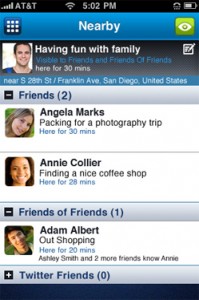
- FriendFinders (loopt, whrrl, face2face, etc.) — This category picks up where the previous one left off. While many of these applications aim at helping singles find more “adult” encounters, a few are intended to truly promote social networking. Most require that users opt-in to share location data with others, but loopt recently launched looptmix (4+ million users) which lets you search for other people (strangers) near you based on interest tags and chat message based bios.
Final Thoughts
It’s unfortunately true that many recruiters are risk-averse and slow to adapt to new approaches, tools, and technologies. If you look beyond recruiting, you will find that many of the approaches outlined above are already use by marketers to reach consumers. You can dismiss it as too intrusive or an invasion of privacy but be careful that you’re not using an outdated definition of privacy or an exaggerated fear of legal issues to cause you to miss out on a powerful recruiting tool.
