Advertisement
Packaging and Selling the Candidate Experience

Get articles like this
in your inbox
The longest running and most trusted source of information serving talent acquisition professionals.
Advertisement
Related Articles
 There are plenty of whitepapers and blogs that attempt to define and describe the candidate experience, but can we go further? Can we find a way to make it part of a holistic recruitment approach, and think of it more like a product, or a “deliverable” item?
Granted, it is hard to imagine that the candidate experience can exist independently of a talent acquisition strategy and vice versa. Instead, we need to refine the entire recruitment strategy to ensure the candidate experience is pre-targeted and delivers real value to the customer.
Recruiters are always looking to enhance, differentiate, and sell their products, but what exactly is the final recruiting product? Some may say it’s the job offer, but if we think about the way recruitment tools and strategies have evolved, this definition alone cannot capture it.
All of the recruiting and talent resourcing efforts that use interactive media sites — creating user-friendly career pages, blogs, communities, etc. — are designed to draw in and gain candidate interest. They hope to entice candidates (as much so as hiring managers) to “buy” into a recruitment process in the hope of obtaining a job. But, if the product is only the job on offer — and this can only be given to one person — this would leave most of the customers who applied with nothing to show for their “purchase.” If we say that the final product is the company job offer, we are bound to have many unhappy customers.
Instead, we can argue that the one thing all buyers can receive from an organization is a candidate experience. Whether they actively apply for a position or they are approached, and regardless of whether or not they are offered and accept the job, the experience is the one thing each applicant can receive.
From the moment the first connection is made, be it a click on a site, an email or a telephone call, the experience begins.
Like a stopwatch, it is something that can then either speed up, slow down, or stop. As the one consistent product for talent, recruiters should treat the candidate experience as a deliverable, which should be targeted, marketed, designed, and tailor-made.
And the tailor-made part is critical. Whether a candidate is fortunate to receive a job offer, or they are rejected or withdraw from a recruitment process, they remember their candidate experience; some even make decisions based upon it which can impact the organizations trying to hire them. By understanding the nature and the main ingredients of the candidate experience, companies can create their own specific product that aligns best to their target audience.
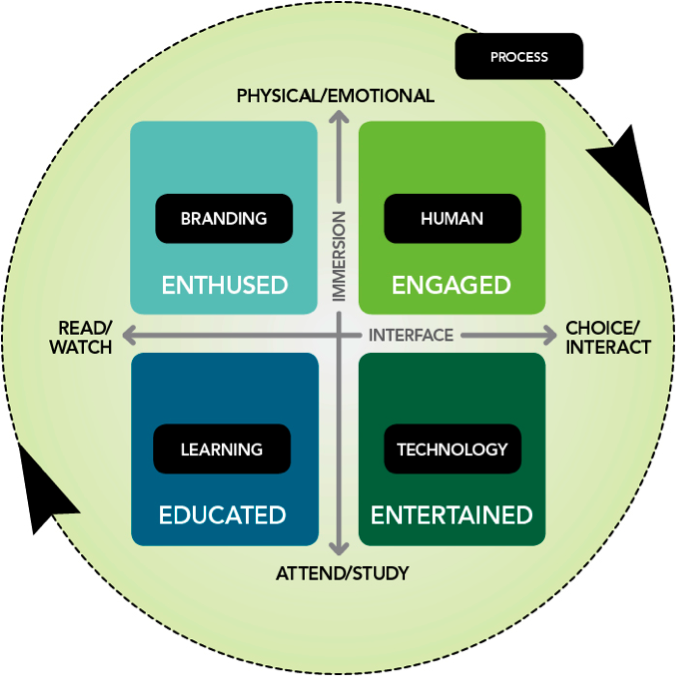
We believe the candidate experience has several key, basic ingredients. There are five different factors which, depending on the intensity of the candidate’s interest, influence the quality of that experience — during, before, and after an application.
The “Experience Economy”
To better understand how these factors affect the application process we have borrowed Joseph Murphy’s pre-employment testing matrix from his Experience Economy blog.
Quoting Mr. Murphy:
[It has been suggested] we consider and evaluate an experience with two continuum variables: interface and immersion.
‘Interface’ is the type of interaction the candidate is offered. At one end of the continuum is ‘read and watch,’ while the other end comprises choices and interactions. Immersion addresses degrees of cognitive, emotional, and physical engagement. At one end is attending to, studying, absorbing information, at the other end is active processing, and emotional and physical participation.
If we overlay our candidate experience factors onto this matrix, four out of five have their place within the matrix, while the fifth (process factor) encompasses all four as a framework.
These factors may not impact the candidate experience with the same importance. Companies can recruit well even if their brand is less attractive or they have no need to educate their candidates for certain positions. Not all companies can deliver a high-tech experience, and likewise we can imagine some positions where the human piece is not the primary question to be considered.
That said, companies should realize and accept the specifics of their own recruitment experience.
There are four essential questions a company should answer before defining it’s candidate experience product.
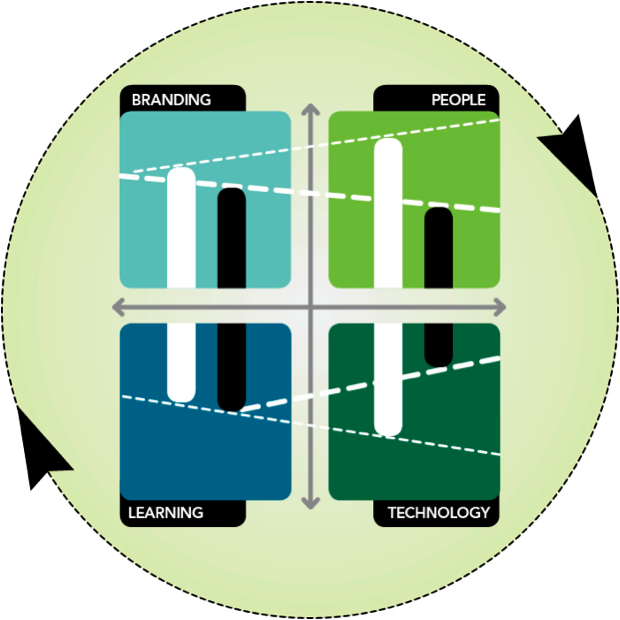 By developing answers to the above questions and using the matrix as part of an overarching talent acquisition strategy, companies could be on a better path to achieve its candidate experience product.
For example, companies might want to drive a lasting candidate experience by focusing their product more on candidates learning about who they are and meeting their people, and focus less on technology. Other companies might want to be more around lasting impressions of strength in technology and brand awareness. Either example must be supported by a process that instills confidence and trust.
The visual shows a sample analysis how a tailor-made candidate experience product can be extended after reviewing the current state. The black bars indicate the current existing factors; the white bars represent a desired, targeted future state. The more a company can increase its presence in its targeted factors, the greater chance that organization will have to engage with a wider candidate audience and effectively deliver the lasting product it desires.
The candidate experience is unique, it’s personal, and it’s a combination of multiple forces, but it is the final product for every buyer in the talent market of any organization. Therefore, to ensure you have a successful candidate experience product, you have to consider the ingredients that go into it. When was the last time you walked in the shoes of a candidate? When was the last time you had the experience of being a buyer in the candidate market? What was your candidate experience? When you know the answers to these questions, it’s far more likely that you’ll create a candidate experience of lasting value to your customers and to your organization.