Advertisement
October Unemployment Drops to 5.8% as 214,000 Jobs Are Added

Get articles like this
in your inbox
The longest running and most trusted source of information serving talent acquisition professionals.
Advertisement
Related Articles
Job creation topped 200,000 for the ninth consecutive month, adding 214,000 new non-farm jobs in October.
Meanwhile, the unemployment rate edged down to 5.8 percent, the lowest in six years.
The Bureau of Labor Statistics, which released October’s monthly employment report, also adjusted its estimates for August and September upward, adding 31,000 more jobs to the previous totals. The numbers are seasonally adjusted.
October’s initial count — which is also subject to change when the November report is issued next month — was less than what labor economists were forecasting. Various surveys put the average of their estimates for October job growth from 235,000 to MarketWatch’s high of 243,000. The October report was also below the 230,000 average of the previous nine months.
Still, jobs have increased every month since September 2010, and that has helped push down the unemployment rate. A second, and less well understood, factor in lowering unemployment has been the decline in the labor force participation rate.
As fewer people want and look for work, it affects the unemployment rate. That wasn’t a factor in the October decline; the labor force participation rate actually rose slightly to 62.8 percent.
What hasn’t much changed over the last few years has been the average hourly pay rates. Average hourly earnings rose 3 cents to $24.57 in October and is up just 2 percent for the year, the BLS reported. A headline in BusinessWeek made a point of this, wondering, 214,00 More Jobs Are Great. But Where Are the Raises?
Mark Zandi, chief economist at Moody’s Analytics, which prepares the monthly National Employment Report for ADP, said that “The job market will soon be tight enough to support a meaningful acceleration in wage growth.”
Speaking to The New York Times, Ian Shepherdson, chief economist at Pantheon Macroeconomics, predicted “faster productivity growth would drive real wages higher next year, after a very long wait.”
Workers are also hopeful about improved earnings and their short-term economic prospects. That optimism was reflected in The Conference Board’s Consumer Confidence Index which took a big jump in October, rising to 94.5.
“Looking ahead,” said Lynn Franco, the Board’s Director of Economic Indicators, “Consumers have regained confidence in the short-term outlook for the economy and labor market, and are more optimistic about their future earnings potential.”
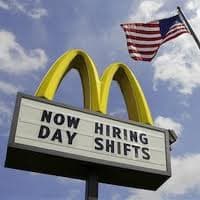
Among the industries with the strongest growth in October, bars and restaurants was the fastest growing category, adding 41,800 jobs. At $14.06, that sector has the lowest average hourly pay according to the BLS.
Other industries with strong October jobs increases are: