Advertisement
Jobs Surge In February, Gaining 235,000


Get articles like this
in your inbox
The longest running and most trusted source of information serving talent acquisition professionals.
Advertisement
Related Articles
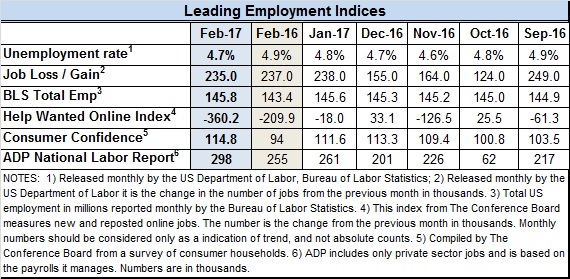
Employers continued to add nonfarm jobs at a rapid pace in February, increasing payrolls by 235,000 during the month, blowing past predictions of a more modest increase.
Adding to economists’ surprise, the Labor Department’s monthly employment report also showed wages rising by 6 cents an hour, a penny more than January’s 5 cents. Unemployment dipped slightly to 4.7%.
 A Bloomberg survey of economists before this morning’s report put the average of their jobs forecast at 200,000. A Marketwatch survey suggested the increase would be closer to 221,000.
“The economy is riding a wave of bullish sentiment post-election,” said Andrew Chamberlain, chief economist at Glassdoor. “We’re seeing strong labor demand across the board and no sign of slowing right now.”
Since the beginning of the year, the economy added 473,000 jobs, according to reports from the Bureau of Labor Statistics. This compares to the first two months last year, which saw a 236,000 increase.
The back-to-back strong reports, as well as other market indicators, including the rising wages — averaging 2.8% over the last 12 months — increases the likelihood that the Federal Reserve will again raise interest rates when the board meets next week.
“They’re ready to go,” said Diane Swonk, founder and chief executive of DS Economics, told The New York Times. “They’re clear as cellophane on this.”
Yet, The Conference Board’s Help Wanted On-Line Series, which counts job ads listed on job boards nationwide, declined for the second consecutive month. Job boards showed a 360,200 decline in new listing in February. In January, the decline was 18,000 new listings.
SHRM’s survey of HR professionals found recruiting difficulty in February was less challenging than the same month last year. SHRM’s LINE report said, “the recruiting difficulty index declined by 8.9 points in the manufacturing sector and 8.8 points in the service sector.”
That doesn’t mean recruiting was easy; the index has been increasing for several years. However, last month’s increase was markedly lower than the year before.
Here are some of the gainers and losers from the Labor Department report: