Advertisement
Is There Really a War For Talent, or Are We Just Paying Lip Service to That?

Get articles like this
in your inbox
The longest running and most trusted source of information serving talent acquisition professionals.
Advertisement
Accenture’s 2014 College Graduate Employment Survey compares the expectations and perceptions of 2014’s university graduates with the realities of the working world according to both 2012 and 2013 graduates.
This comparison casts a focused and specific lens on the issue of entry-level talent development, and, gives us some insightful data.
Accenture’s survey underlines that, at the end of the day, many organizations are not effectively developing their entry-level talent.
When we consider that 69 percent of 2014 graduates state that more training or post-graduate education will be necessary for them to get their desired job, we see that organizations are likely facing a major talent supply problem.
New graduates and entry-level talent’s perceive that their organizations will provide them with career development training: 80 percent of 2014 grads expect that their employer will provide the kind of formal training programs necessary for them to advance their careers.
Despite this, the percentage of graduates that actually receive such training is low, creating a significant discrepancy between expectation and reality.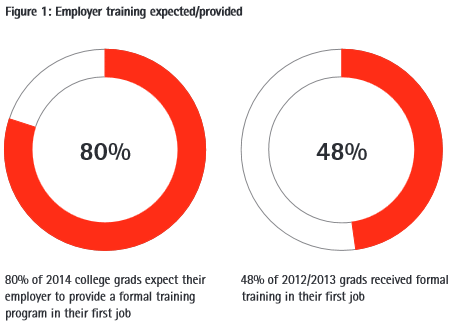
Another concern when it comes to recent college graduates is that 46 percent (nearly half) of 2012/2013 graduates working today report that they are significantly underemployed (i.e. their jobs do not really depend on their college degrees). This statistic was at only 41 percent a year ago.
Accenture’s survey found that 84 percent of 2014 graduates believe they will find employment in their chosen field post graduation, and 61 percent expect that job to be full-time. But again, we find a stark contrast between expectation and reality.
Just 46 percent of 2012/2013 grads reporting holding a full-time job – and 13 percent have been unemployed since graduation.
How long do recent graduates stay at the jobs they do have? More than half (56 percent) of 2012/2013/2014 graduates have already left their first job or expect to be gone within one or two years. Is this be a reflection on the lack of development for entry-level talent? It seems more than plausible…

Recent graduates are also finding discrepancies between expectations and realities when it comes to income and job prospects.
Of the 13 percent of 2012/2013 grads who have been unemployed since graduation, 41 percent believe their job prospects would have been enhanced had they chosen a different major (and, 72 percent expect to go back to school within the next five years).
Among Accenture’s 2014 survey respondents:
The Accenture’s study does have some silver linings, however.
Accenture’s study does, however, put into question many of the highly publicized reports that point to human capital/talent acquisition issues as the No. 1 concern in the C-Suite.
If talent is the No. 1 issue, where is the attention to entry-level talent? Is the attention being placed exclusively on development for upper-level positions?
It’s clear that there are multiple factors influencing graduates’ struggles for acceptable employment, including the rise of part-time and contingent work, but training and development is an important part of any entry-level position. The survey points to six areas in which organizations can focus on to help meet talent supply challenges:
These are logical conclusions. But, perhaps the biggest logical conclusion is that organizations are just paying lip service to the so-called war for talent and aren’t convinced that the there is, in fact, an actual shortage of talent out there.
Am I wrong?
This originally appeared on China Gorman’s blog at ChinaGorman.com.