Having a calm workplace is an important part of encouraging productivity. It’s especially important now, given that there are more distractions at work now than ever. It’s time for some evidence-backed suggestions. With that goal in mind, we at Lucidchart conducted a poll of over 1,000 U.S.-based office workers with the goal of recognizing traits that are often demonstrated by the most productive (and least productive) among us.
We segmented the survey respondents into three productivity personas based on their answers to questions about focus and engagement during the workday, typical work output and self-reported behavioral traits. These three categories were: “Go-Getters,” or the most productive people; “Coasters,” or the least productive people; and “Doers,” who were in-between the two.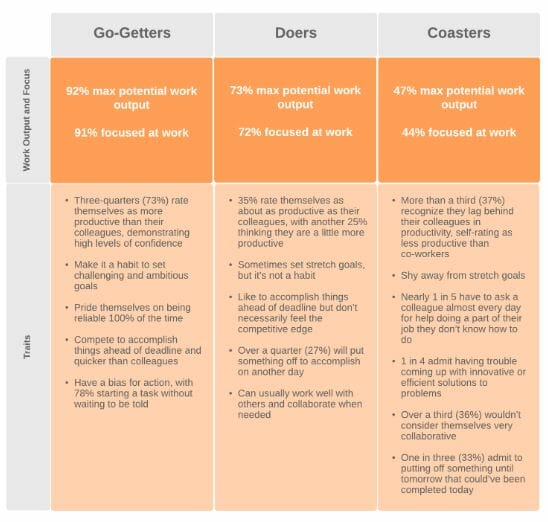
Workspace impacts productivity
Our environments affect our emotions and behavior. If you’ve ever tried writing a report while a baby screams in the background, you get it. Humans are so sensitive to their surroundings that things such as color, heat, air quality, the amount of light, the source of that light and the layout of the room all affect productivity. But that’s not all: When asked about distractions, employees say that a slow computer (50%), noisy colleagues (38%), meetings (30%), hunger (20%) and social media distractions at work (15%) consistently keep them from being more productive.
A workspace that respects the sensitivities of human concentration while working to eliminate distractions will have the most productive output.
Sticky notes and healthy snacks
We also found that what workers tended to surround themselves with varied by groups. Now, just because we found that 33% of Go-Getters had photos of children at their desk, while 24% of Coasters did, doesn’t mean the photos help make someone more productive. Could be that more Go-Getters than Coasters in our survey had children. On the other hand, if you do have children, surrounding yourself with their cute pics might just help motivate and inspire you.
Here are some other correlations we found:
- Sticky notes – Used by 78% of the most productive employees vs. 67% of the Coasters. We do know that writing notes in longhand is linked to better memory. A large majority of productive employees keep sticky notes at their desks, which suggests that they’re writing down notes and reminders to keep them on task and motivated, too.
- Healthy snacking – No secret here that eating healthy is better for you. Eating fruits and vegetables has been linked to curiosity and creativity. Substituting healthy snacks for those morning meetings can be a productivity boost, especially for those who regularly skip breakfast, which has been linked to decreased cognitive performance. Our survey found 26% of Go-Getters kept healthy snack at their desk vs. 18% of Coasters.
- Exercise – 47% of Go-Getters are more likely to work out at least three times a week and are the least likely to hit the snooze button (50% say they don’t hit the snooze button, compared to 44% of Doers and 33% of Coasters). Coasters, on the other hand, are more likely to snooze through their workout with only 38% exercising more than three times a week.
- Vacation — Humans need to recharge, and 48% of Go-Getters use all their vacation time vs. 37% of Coasters. Research shows employees who don’t take time off are less likely to receive a promotion, raise or bonus. Employees may hesitate to use their vacation days if they feel it will have a negative perception. Make it clear that vacation days are meant to be used. You may even want to consider vacation rewards or a sabbatical fund.
Our survey also found one ironic correlation. Despite their healthy work and lifestyle practices, the Go-Getters in our survey were less likely to be senior leaders. 21% of the Coasters held a director level title or above. Only 14% of the Go-Getters did.