Advertisement
Fix the Top 5 Online Job Search Frustrations for Applicants
Get articles like this
in your inbox
The longest running and most trusted source of information serving talent acquisition professionals.
Advertisement
 Brilliant people and companies simplify; others complicate. The evidence of this principle is all around us. Ebay simplified the garage sale; Google distills the enormity of the Internet in seconds; and Apple has engineered the “smart” in phones so that all of its customers don’t have to be.
Conversations with employees, colleagues, and friends have often centered on ways to simplify. Want to lose weight? Burn more calories than you consume. Interested in accumulating wealth? Save more than you spend. Want to have meaningful work? Know your strengths and passions and find a job that personifies them. When approached with a challenge, train your brain to think “what is the simplest way to solve this?” This question will predominately lead to an attainable strategy. We love simple and tend to avoid people, processes, and technology that complicate.
The winning teams always execute the fundamentals better. Are you and your company doing the fundamentals better than the competition?
Recently, I used Google Consumer to gather data regarding the frustrations of job seekers. The results suggest that while companies are entrenched in solving social media and new talent aggregation techniques, they are ignoring the basics. Neglecting candidates is like a surgeon failing to scrub before surgery. Sooner or later someone will suffer. Until your company is mastering the basics, consider not taking on complicated sourcing or talent acquisition strategies. If you build an amazing social media recruitment campaign and have no followers, you will fail.
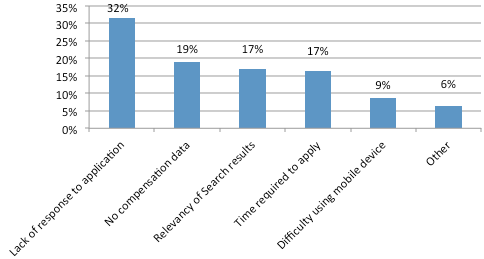
A straightforward question was asked, “What is your single biggest frustration with an online job search”? The responders’ No. 1 frustration was a lack of response after submitting an application. Most applicant tracking systems afford the ability to do an auto response to the applicant, and the letters are usually filled with carefully crafted words to say, “We received your document, are reviewing it, and will get back to you if you align with our needs.” This is an excellent time to include paths to your company page on Facebook, LinkedIn, and Twitter to expand exposure and to improve your odds of getting referrals — the king of quality hires.
When companies talk about building talent pipelines, the unmistakable element required is ongoing and two-way communication. There is a significant opportunity to work on your employment brand and reputation even during the “rejection” process. Once a job is filled, send a second letter to the applicant base to let them know the position has been filled. This letter should repeat the invitation to interact with your company’s branding efforts on social media platforms.
Recruiting has a tough statistical wall in front of it, as the odds for an applicant to be successful are alarmingly low. When we do the math, a recruitment campaign that produces 175 applications represents the fact that only .006 (1 divided by 175) of the respondents will be excited about your decision. Branding is about consumer perception. By ignoring this article you risk branding your organization as one where communication only flows one way, you don’t care about anyone other than yourself, and the time the applicant spent applying has no relevance for you. Conversely, if you are interested in real solutions then follow the data; fix the fundamentals that lead to frustration for job seekers.
The chart above represents 1,502 responses attained through a nationwide survey on Google Consumer.
Some simple solutions to the top 5 applicant frustrations:
As you consider changes, upgrades, and improvements in the applicant experience (and to how it relates to your overall branding campaign), be brilliant and make the process as simple as possible. Your attention to the fundamentals has the power to increase applicant satisfaction and contribute to your reputation as an employer of choice. Many applicant frustrations can easily be addressed and corrected. Doing so will help you focus on the objectives, not the obstacles, in the talent acquisition lifecycle.