Advertisement
Business Agility Demands a Different Kind of Org Chart


Get articles like this
in your inbox
The longest running and most trusted source of information serving talent acquisition professionals.
Advertisement
Most people would love to simplify work but have no idea where to start. Organizational complexity propagates over time until it reaches into every part of a business. Without realizing it we become accustomed to the trademarks of a highly complex organization:
Organizational complexity is a virus that cripples innovation, productivity and engagement. Given the speed of disruption in today’s industries organizations simply cannot afford to be bogged down in slow decision-making, poor execution and incremental innovation. Organizations have to be able to innovate well and fast. To do this they need to free people to focus their time, energy and passion on the most important strategic priorities. The time is ripe to simplify work and throw off the shackles of complexity.
Fueling the propagating nature of complexity are the 20th century organization structures and management practices that many organizations are holding onto. These 20th century business practices are characterized by dense bureaucratic structures and strict, formal processes with rules and more rules.
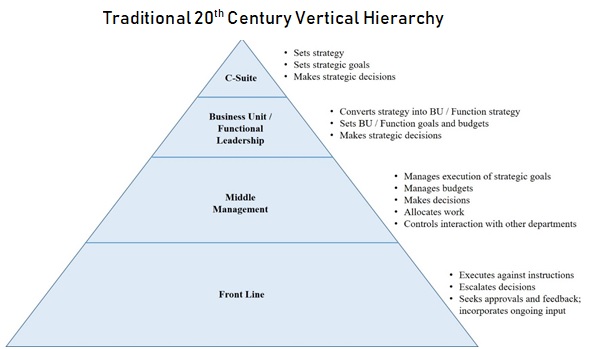
Traditional best practices told us that we need detailed descriptions of all roles, responsibilities, reporting relationships, decision rights, processes, and rules to get anything done. These things were needed because humans weren’t to be trusted. Installing detailed strict structures meant that leaders could control the output of their people, thereby limiting the risk of mistakes and establishing a baseline of quality. So, as companies grew, they added more and more structures and gradually became complicated messes.
Too many employees in one of these organizations spend the majority of their day going from one low value meeting to the next, while attempting to stay on top of the mountain of emails that flow into the inbox. These activities distract our focus and soak up time and energy, which significantly limit our ability to engage in deep innovative thinking.
However there is hope! Companies are starting to explore new ways of operating that are counter to the traditional models. Instead of assuming that people cannot be trusted and therefore need to be controlled, the emerging designs serve to liberate the intelligence of their people by empowering them with the autonomy to work, decide, and execute as they see fit. Progressive organization structures strip out bureaucracy, connect leaders with the front line, and push decision-making down to where the information is.
This emerging organization structure, otherwise referred to as an agile organization or holacracy, is getting more and more attention. An increasing number of organizations, both small and large, are taking steps to move to this progressive structural design. The major differences from the traditional model that this relatively new organization structure embodies include:
Visually, this more progressive and simplified structure can look like this:
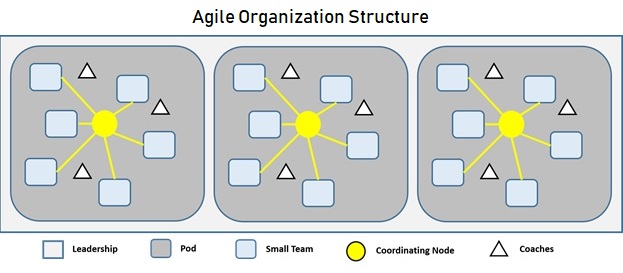
There are many different ways of bringing the core principles of an agile organization to life for a particular company. There can be models where front-office functions are transformed into agile teams and back-office functions retain their legacy structure, but adopt agile ways of working. There are different ways of creating team structures, including the number of people, areas of expertise to include, the broader pod or squad structure, and the governance structure.
The agile organization or holacracy structure should not be blindly rolled out without careful consideration of a company’s strategic context. It should be adjusted to the specific needs of each company. But there is certainly opportunity for any company operating in a legacy model to infuse elements of the agile blueprint into their operating model, such as breaking down bureaucracy, focusing and clarifying the mission, and empowering the workforce.
The results of the transformation can be tremendous and revive companies that have long struggled to achieve the performance they desire.
For more information read the new book Simplify Work.