Advertisement
Building Talent Intelligence: The Secret Formula for Competitive Advantage
Get articles like this
in your inbox
The longest running and most trusted source of information serving talent acquisition professionals.
Advertisement
The digitized workplace is like a giant data buffet. Applications, chat platforms, social networks, email – it creates an endless smorgasbord of talent-related information.
HR may be hungry for it all, but successful companies are especially good at digesting it.
So says a new study from Taleo Research and the Human Capital Institute titled The Business Impact of Talent Intelligence. Based on surveys of more than 600 global organizations, the report shows how companies that make strategic use of workforce data also happen to do a great job of satisfying the demands of their management.
The key is to deliver that data in a way that lets managers make more informed decisions about talent – and make those decisions sooner. Insights like these help companies build their Talent Intelligence. And because the company with the best talent wins, improving Talent Intelligence is fast becoming the secret formula for seizing competitive advantage.
Not surprisingly, some companies are better than others at using workforce data. The report distinguishes between data proficient organizations (those that are adept at using talent data) and the data deficient (those that aren’t). Just 35 percent of respondents were classified as data proficient, and nearly half indicate their management is dissatisfied with the workforce data they provide them.
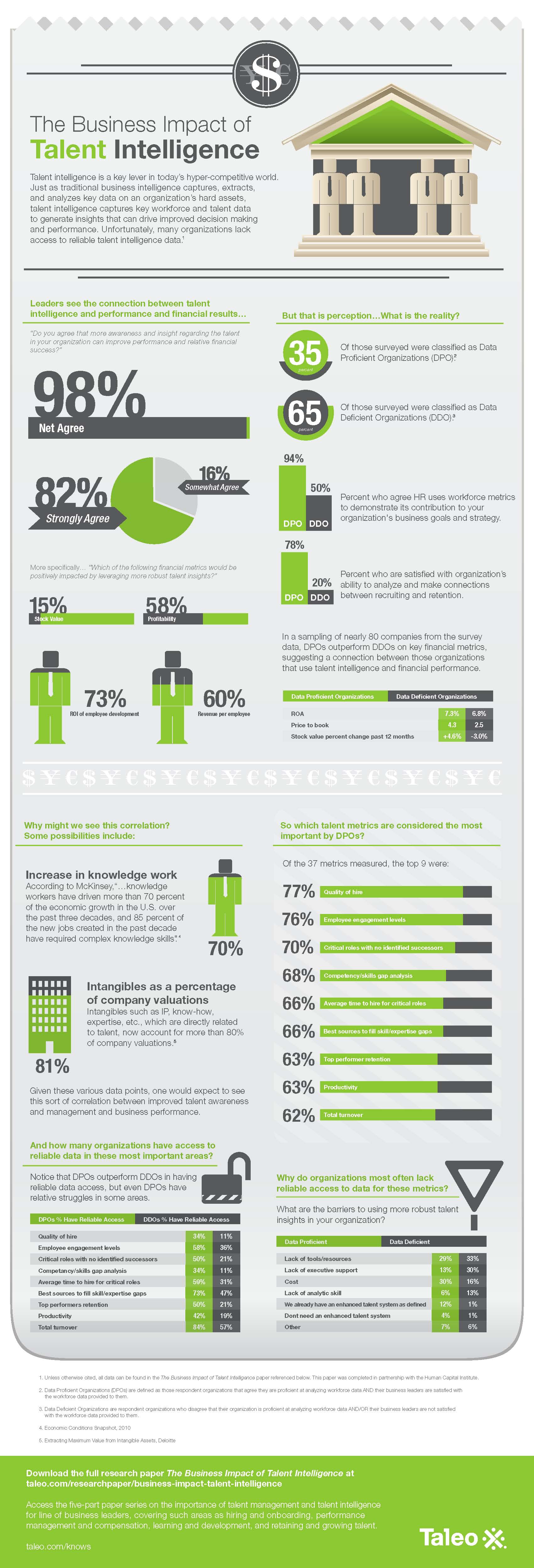 Respondents from data proficient companies paint a far more positive picture: Management is much more satisfied with their workplace data. They’re also better at drawing connections between retention and recruiting, and at calculating HR’s impact on business strategy.
Some other findings:
Most companies surveyed say they use at least some rudimentary form of Talent Intelligence. But Talent Intelligence can involve much more than just tracking the typical “administrative” HR data points. Using advanced techniques, companies gain historical, current, and predictive views of the workforce and its direct impact on business operations.
They measure complex data like quality of hire, competency/skills gaps, and employee engagement. They create accurate and clear profiles of large or dispersed workforces. And they connect HR metrics to enterprise strategy and performance, reaching across functional silos to capture data and provide actionable information to leaders.
The report, available here, bears out that Talent Intelligence is an essential link between HR, business leadership, and the human capital that fuels our knowledge economy. Companies that take advantage of this can gain a strategic advantage. Those that don’t will see lower profits, less innovation, and shrinking market share.