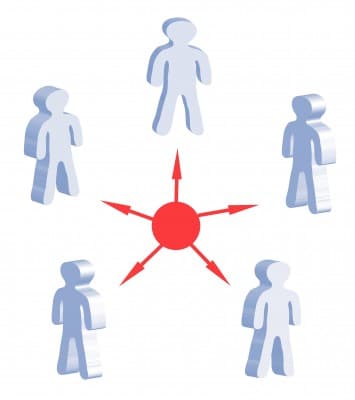
In America’s bootstrap, entrepreneurial culture, the word “dependent” is reserved for children claimed on tax forms and for people who are perceived as weak, unproductive or clingy.
It’s hardly a word anyone would want applied to themselves, and certainly not a characteristic managers and supervisors seek to instill in their direct reports. So how is it, then, that so many organizations end up with a culture of dependency?
Those in leadership positions need look no further than in the mirror. Leaders set the tone for how their direct reports will act and how they will interact with them. The process of people management is an investment in others.
Two ways to invest in direct reports
Practically speaking, supervisors or managers only have two resources they can invest in their direct reports: the time they spend with them, and, the influence potential they have on them. Since time is finite, a manager’s influence can be enhanced or eroded by the way they use their time.
Delegation can be used to develop competencies, gain bench strength, and effectively use the precious work time that’s available. Employees feel empowered, with the resources and authority necessary to carry out important tasks.
However, when supervisors or managers fail to encourage the personal initiative and responsibility of their direct reports and avoid using delegation, they lose control over their time, and therefore, lose much of their ability to influence their employees in a way that influences business results.
How time and influence are squandered
Managers and supervisors must cope with competing demands for their time:
- Boss requirements – delegated down by the boss;
- Organizational requirements – training, meetings;
- Personal requirements – assignments inherent to the job role.
“Leveraged time” is managing these demands effectively to deliver expected results. Often supervisors and managers take action on tasks that are not part of their three time demands and thus compete for the limited resource of managerial time.
This is called “non-leveraged time” — the time spent working on tasks, problems, or activities that their employees bring to them — work that the employees should be doing themselves. Non-leveraged time, which in the long run delivers very little benefit to the organization, the manager, or the employee, begins the moment a manager takes the initiative for action away from the employee.
Why in the world would a manager or supervisor do their direct reports’ work? There are a wide variety of reasons, but here’s a short list:
- Not enough time to coach or teach — The manager, (1) believing he or she can do it faster or (2) feeling time-constrained, steps in and takes ownership of the task. The result — a guarantee that they must do so again next time — breeds managerial dependency going forward.
- Done it before/can do it better — The manager most likely has the skill and experience to do the task well. Additionally, often the task is enjoyable and can act as a kind of “catnip” for the manager. The result: a guarantee that employees won’t develop the acumen or skill to perform, again creating dependency on the manager.
- Lack of trust — Not trusting the employee to take the right action, or to solve the problem. The result: not allowing the requisite learning and development that is fundamental to developing talent and fostering discretionary effort in the workplace.
Lack of delegation undercuts individual initiative and leads to upward delegation — where the employee constantly refers decisions and tasks up to their leader.
This is referred to as the “leaping monkey” scenario, a concept coined by leadership great William Oncken Jr.: A direct report approaches you with an issue — a monkey on his back, if you will — and when you agree to take a look at it, the monkey leaps onto your back. These monkeys steal time and influence from you while stealing initiative and opportunities for growth from employees.
Putting monkeys in their place
It’s vitally important to re-think how you use your time, and to begin seeding initiative into your organization’s culture. Make it known that employees must:
- Bring performance difficulties or problems to you before you find out about them from another source.
- Set up times to “get back to you.”
- Collect all relevant information or data for any issue or problem and use their best efforts to tackle tasks or assignments before bringing them to you.
- Offer possible solutions for any problem they present to you.
Effective delegation allows for increased cross-training — developing multiple skills for the employee and creating more flexibility for the manager. Delegating challenging work that will prepare employees for upward mobility is an excellent way to reward good performance.
Delegation can offer deviations from routine work responsibilities, giving employees both a change and a challenge. And delegating routine tasks by spreading them around to direct reports can give a manager significant leverage for carrying out more critical responsibilities.
No one consciously tries to create dependency at work. A dependent performance culture reduces productivity, stifles talent development, and thwarts employee morale and motivation. But as managers and supervisors become aware of how their behavior thwarts employee performance, they can implement simple changes in their daily work lives.
As leaders learn to delegate, they leverage their time more effectively to meet work demands. This facilitates greater productivity for everyone concerned and begins a cycle of self-empowerment and initiative that puts those pesky leaping monkeys in their place.