The first day at a new job is rough. We are excited and proud but also feel nervous: Will I fit in? Will the reality of the job match my desires?
The first day at a job is when expectations meet reality. And that’s why both employers and employees feel anxious. The first contact with the company’s culture makes us wonder if we’ve made the right decision.
That’s what happened to a former client recently when she finished onboarding at her new job. Maggie was sitting at her new desk while trying to memorize the company’s vision statement.
“Let me tell you how things work here,” someone from the spontaneous welcome committee said.
Unspoken Rules Define Your Culture
This aspiring leader was reminding Maggie of the most important lesson at a new job. Fitting-in is more than just being liked. It’s about behaving according to the unwritten rules that govern an organization.
“Culture is the behavior you reward and punish.” – Jocelyn Goldfein
Maggie is a high performing, confident, and driven executive. That’s why she was so successful at her previous job.
But her smarts seemed less valuable now.
One month into her new job, Maggie was called to her boss’ office to discuss her performance. Maggie works in a large training organization in the business development department. Written rules say she should be making 10 calls per day.
As her boss was reviewing the stats, Maggie couldn’t understand what was going on. Since she joined, thanks to her vast network, she was closing business at almost twice the rate of the rest of the team.
She was “accused” of making fewer calls than expected.
As illogical as it might sound, this particular company rewards fitting-in over being extraordinary.
In this case, the unspoken rule seemed to be: “playing by-the-rules matters more than results” or “bosses reward mediocre employees and fear top performers.”
The behaviors organizations promote and tolerate determine their real culture. They are more powerful than any written rules. Or than a mission statement, for that matter.
Many times, unspoken rules encourage mediocre behaviors from both employees and managers.
Companies believe that the most talented people are expensive. If they just analyze the salary and cost, maybe. The truth is organizations pay mediocre employees way too much. The ROI on mediocre employees is much lower. That’s what makes them more expensive. Especially if you factor in how they negatively affect top performers.
It’s mismanagement that makes unwritten rules official.
Understanding Your Unwritten Rules
“You can observe a lot by watching.” — Yogi Berra
What unwritten rules do is they erode trust; people want to survive, rather than to do their best work.
Steve Simpson, the author of Cracking the Corporate Culture Code, explains how research in Australia and New Zealand has shown a dangerous gap between the desired culture and the actual operating one. When managers’ behaviors are different from their words, employees become cynical about the organization’ mission and values, the author states.
Many senior managers speak about wanting a culture that encourages innovation, collaboration, open communication, and teamwork, but their behaviors promote mediocrity, fear, politics, and individualism.
Here are some examples I’ve seen in both large corporations and fast-growth startups. Use them to reflect on how your organization talks and behaves.
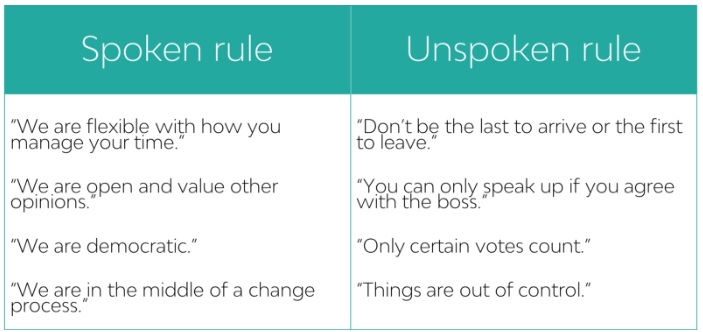 Sound familiar? Which behaviors are promoting unspoken rules? Why? What management behaviors are promoting those unspoken rules? Who benefits from those unspoken rules?
I’m not telling you to lower your organization’s ambition. But when a company’s visions and goals are disconnected from reality, they fuel skepticism.
That’s why it’s so important to build and promote a culture of transparency. Being candid about the reality of how an organization operates will inspire people to help you. Doing the opposite will only widen the gap of trust.
Dealing With the Unwritten Rules
If you are a manager:
- Provide a safe space for people to speak up: Are people rewarded for sharing their ideas? Do you let team members speak up first? Are you actively listening to other opinions, or simply pretending there’s an open dialogue.
- Make sure everyone abides by the same rules: Some organizations allow favorites or bosses to play outside the written rules. This creates a sense of injustice and unfairness.
- Address the tensions between written and unwritten rules: Encourage your team to bring up their observations. Don’t just ask them to do so. Raise the issue yourself.
- Become more aware of your own behaviors: Consciously or not, are you behaving in a way that promotes unspoken rules rather than being consistent with the values you preach? That’s okay. We all make mistakes. Make necessary adjustments and, most importantly, let your team know you are challenging your behaviors.
- To show you are serious, behave boldly: Your actions — what you reward and punish — is the standard that will define your team’s behaviors. Don’t just make statements; leaders need to behave boldly. The more risks you take, the more your team will trust your words.
- Acknowledging your mistakes will build trust. Embracing vulnerability not only shows you are human, but also that you trust yourself and are confident to confront your own flaws.
If you are a new employee:
- Be patient. There’s always a gap, comparing to how you felt at your previous job won’t help.
- Don’t fight what’s different, try to learn and reflect.
- Ask questions, rather than provide solutions. As I told Maggie, people resist ideas from newcomers even if they are right. If you detect something that can be improved, present your observations as a question.
- Challenge the team to reflect and find a solution, rather than show them how wrong they are. Most probably, they have tried to “change things around here” before.
The problem with unwritten rules is not just that they define informal behaviors. What’s wrong with them is that they represent the real culture, one that is not aligned with the vision established by the senior leadership.
Addressing and adjusting behaviors will help build a healthier culture. Promoting transparency drives the necessary safe space for people to speak up and resolve these tensions.
Unspoken rules are just symptoms, what do they say about your company?