Advertisement
A Few Words on Getting Ready for the Workplace of the Future

Get articles like this
in your inbox
The longest running and most trusted source of information serving talent acquisition professionals.
Advertisement
Related Articles
The 2020 workplace of the future may seem to be just a glimmer down the road, but it’s being shaped by social media technologies, and the Millennial Generation that embraces them, today.
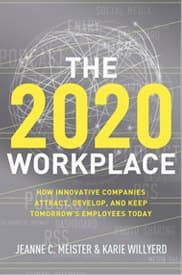
That’s the premise of the new book, The 2020 Workplace: How Innovative Companies Attract, Develop, and Keep Tomorrow’s Employees Today, by Jeanne C. Meister and Karie Willyerd. Author and consultant Jeanne Meister recently talked to TLNT about the 2020 workplace, Millennials, and what organizations can do today to get ready for tomorrow.
TLNT: Why did you focus on the 2020 Workplace? Why did you look 10 years out instead of five years, or maybe even 20 years? And what are major differences you see in 2020 workplace versus today’s workplace?
JEANNE MEISTER: Why 2020? We believe that in the year 2020, the workplace will be transformed by three trends which are just starting to take place today:
We believe that companies that succeed in the 2020 workplace will be defined by acute vision (20/20 vision) in how well they understand these trends, and adjust the way they attract, source, develop, and engage talent.
TLNT: Some feel that the concept of employee engagement has slipped quite a bit in importance due to the cuts and job losses during the Great Recession. Do you see that trend continuing, or will the focus on employee engagement make a comeback?
MEISTER: Companies like Cerner Corporation are focusing on increasing employee engagement as a way to drive greater innovation, collaboration and problem solving throughout the enterprise. Employee engagement will take on an increased business role as companies see this as a way to achieve business goals.
Cerner’s goal for why they created an internal social network is telling and an example of what more companies will do. Cerner wanted to decrease the cycle time from discovery to adoption of new products and services, and in the process, create a more engaged and agile workforce, one that could more easily communicate, collaborate, and innovate with each other.
TLNT: How important will social media skills be in the 2020 Workplace?
MEISTER: Knowing how to use social media to get ahead on the job will be a critical skill for the workplace in 2020. Already companies like Intel are training employees in what they call Digital IQ skills — knowing how to use social media in both a respectful and responsible manner on and off the job. Since employees carry their employer brand with them on sites like LinkedIn, companies are becoming proactive in training employees what they can and cannot share online on these social networks.
TLNT: We hear a lot about Millennials in the workplace and what they are about, but what do we know about the next generation that you call Generation 2020? What defines this generation, and what are they going to bring to the table when they join the workforce?
MEISTER: Generation 2020 born after 1997 is the most hyper connected generation of all. They have grown up with Webkinz and Club Penguin, and on average spend two hours visiting social networks sites each day. This compares to time spent on YouTube (which is 32 minutes) and Facebook (20 minutes). Gen 2020 will bring their expectations for being hyper connected and living in the “real time web,” which is characterized by constantly updating streams of information, conversation, and images. This generation also grew up with the Kindle and the iPad and feel comfortable with immediate access to content online. When they enter the workforce in 2020, they will not have any patience for classroom training. Instead, they will want to learn from peers, mentors, and coaches, and receive immediate feedback on their performance.
TLNT: Did you find anything that surprised you or startled you when you started to dig into this topic?
MEISTER: I found that companies were more resistant than I thought they were in thinking that they could close down and have a closed policy that says “ you are not going to access Facebook from the computer network.” And it’s quite unrealistic because you can just do an end run and access it on your phone.
It also means you don’t have a set of social media guidelines, and you don’t have training on how you should responsibly participate and share with your colleagues. So, our thinking was that it was a pretty dangerous strategy to just think that you could make this happen and not let anyone access these, quote/unquote, “dangerous sites,” and what you were in fact doing was even more dangerous by not equipping them with the right policies and guidelines, and in fact training on how to do this the right way.
So we thought – and this was really something that HR should be proactive and take the lead on — that this really is an opportunity to have “a seat at the table” and be more strategic in your thinking rather than be reactive and thinking about “what can I outsource?” We thought that the dialogue and the conversation should really be moving from outsourcing for savings to “how can I lead my company in bringing these technologies inside so they have great impact on the organization?”